
Chapter 20: Lead Leaders, Not Just Employees
Chapter 20

Lead Leaders, Not Just Employees

Three trucks now. Several technicians, an office coordinator handling the calls and scheduling that used to sit entirely on Mike's plate, and work flowing through the business steadily enough that most days didn't feel like a fight anymore.

The Challenge

Every growing company eventually reaches this exact moment — a business that's outgrown the owner's ability to personally lead every single employee. At first, adding people simply adds capacity. Eventually, adding people adds complexity, and the complexity doesn't get solved by working harder. It gets solved by multiplying leadership, not multiplying supervision.

Mike's instinct — promote the best technician — is the instinct almost every contractor reaches for first, because it feels obvious, fair, and earned. It's also one of the most common ways a growing business quietly loses both a great technician and gains a struggling supervisor, in a single decision.
Why It Happens

Skill and leadership are different talents. The best technician knows how to do the work extremely well. The best leader helps other people do the work well — a completely different skill, built on completely different behaviors, and one that doesn't automatically come bundled with years of technical mastery.

Confusing the two is an easy mistake to make, because technical excellence is visible and measurable — jobs completed, callback rates, customer satisfaction. Leadership potential is quieter, and it shows up in behavior long before it shows up in a title: who people naturally trust, who stays calm when things go sideways, who takes initiative without being asked.

The Framework: The Leadership Ladder

bbok

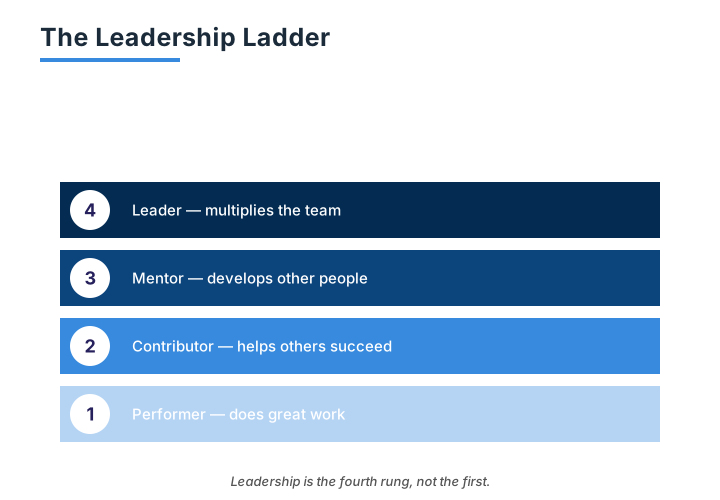
Every employee sits somewhere on this ladder, and promotion should follow demonstrated movement up it — not years of tenure or technical polish alone.

1

Performer

Does their own job well, consistently, with minimal oversight.

2

Contributor

Starts helping beyond their own tasks — offering ideas, pitching in where needed, without being asked.

3

Mentor

Actively helps other people improve, patiently, even when it's not officially part of their job.

4

Leader

Takes real responsibility for outcomes beyond their own work, and other people start looking to them for direction.

5

Leader of Leaders

Develops other leaders, multiplying their own impact through the people they've built up around them.

Jake, by the time Mike noticed him, had already climbed from Performer to somewhere between Mentor and Leader — mostly on his own initiative, without anyone officially recognizing it yet. The mistake would have been promoting him purely on his technical skill as a plumber, without ever asking where he actually stood on this ladder.

Common Promotion Mistakes

Promoting the best technician. Technical mastery says nothing reliable about someone's ability or desire to lead other people.

Promoting based on seniority. Time in the job isn't the same as leadership behavior, no matter how much it feels like it should be.

Promoting because someone asks. Wanting the title and being suited to the role are two entirely separate things.

Giving authority without training. A new supervisor handed authority with no actual guidance on how to lead is set up to fail quietly, usually blaming themselves for it.

Giving responsibility without authority. The reverse mistake is just as damaging — expecting someone to lead without giving them the actual standing to make decisions stick.

Never defining success. A new leader with no clear picture of what "doing this well" looks like has no way to actually succeed at it.

Expecting leadership to happen naturally. Some people have natural instincts toward it. All of them still need it developed deliberately, not assumed into existence.

Sarah's Story

Sarah told Mike about a promotion she'd made early on, one that everyone — including her — assumed was obvious. Her top technician, hands down, the most technically skilled person on her crew. She made him a supervisor because it seemed like the natural next step, the reward his skill had clearly earned.

Within a few months, production across his team had quietly declined. Morale dipped. And the technician himself, once confident and sharp on every job, seemed increasingly unhappy in a role that looked, from the outside, like a promotion.

He finally admitted it to her directly. "I miss fixing plumbing."

"I hadn't promoted him," Sarah told Mike. "I'd moved him out of the career he actually loved and into one he'd never asked for, just because it looked like the obvious reward for being good at his job. That mistake changed how I've selected every leader since."

Real Contractor Comparison

Company A

Promotes based on technical ability alone. Its new supervisors keep doing most of the hands-on work themselves, because that's the skill they were actually promoted for. Employees receive little real coaching, since supervising was never separated from performing. Problems flow upward to the owner anyway, because nothing about the promotion actually built new leadership capacity. Growth slows.

Company B

Develops leadership before promotion happens. Future supervisors are already mentoring others, informally, before they ever get the title. Responsibility increases gradually, matched by real training and real authority. Leaders multiply, because each one is actively developing the next. Growth accelerates, because the business isn't just adding hands — it's adding capacity to lead.

Great companies grow leaders before they need them — not scrambling to promote someone the moment a supervisor role opens up.

The Five Leadership Behaviors

Watch for these behaviors, not just technical performance, when deciding who's ready for more responsibility.

Takes initiative

Solves problems proactively, rather than waiting to be told.

Helps teammates

Invests time and patience in other people's growth, without needing to be assigned.

Communicates clearly

Explains things in a way other people can actually follow and act on.

Accepts responsibility

Owns outcomes — including mistakes — instead of deflecting them.

Develops others

Actively teaches, coaches, and builds up the people around them.

Leadership is measured by the people you develop, not by how skilled you personally are at the trade. Jake had been demonstrating all five of these behaviors for months before Mike ever thought to formally notice.

Practical Exercise

Identify three employees. For each one, honestly answer five questions: Who consistently solves problems on their own? Who naturally earns other people's trust? Who genuinely enjoys helping teammates improve? Who stays calm under pressure? Who demonstrates the company's actual values, not just its rules?

Choose one future leader from that exercise. Give that person one real leadership responsibility this month — not a title yet, just a genuine piece of ownership. Then observe, deliberately, not just whether the task gets done, but how that person influences the people around them while doing it.

Warning Signs

Only one person solves every problem.

This usually means leadership capacity hasn't actually been developed anywhere else in the business yet.

Supervisors spend all day doing technical work.

This usually means someone was promoted for skill, not leadership, and never actually stepped into the leadership role at all.

Employees avoid making decisions.

This usually means no one has been developed and trusted to make decisions independently.

Promotion creates resentment.

This usually means the promotion process feels arbitrary rather than tied to clear, visible behaviors everyone can recognize.

Nobody is preparing future leaders.

This means growth will eventually stall the moment the business needs a new leader and doesn't already have one ready.

Action Checklist

  • Identify one or two employees showing genuine leadership behavior, not just technical excellence.
  • Define, in writing, what leadership success actually looks like in your business.
  • Delegate one real leadership responsibility to your strongest candidate this month.
  • Schedule a regular coaching conversation with that person to support their growth.
  • Evaluate their influence on others, not just their individual output.
  • Start building successors for your current supervisors before you actually need them.

Key Takeaways

Every growing company eventually reaches a point where the owner can no longer personally lead every employee — and growth from there requires multiplying leadership, not multiplying supervision. The Leadership Ladder — Performer, Contributor, Mentor, Leader, Leader of Leaders — shows that promotion should follow demonstrated behavior, not tenure or technical skill alone. Titles don't create leaders. Influence comes before authority, and a leader's real success is measured by the success of the people they develop.

Reflection Questions

Who on your team is already acting like a leader, whether or not they have the title? Who has real technical skill but no actual desire to lead others? Are you promoting performance, or genuine potential? Who, right now, could eventually replace your current supervisors, and what would it take to get them ready?


Several months later, Mike stood at the edge of the shop and watched Jake — now officially a supervisor — walk a newer technician through a tricky diagnosis, patiently, without doing the work for him. Jake wasn't solving every problem personally anymore. He was building someone else who could.

Sarah, standing beside him, noticed his expression. "What are you looking at?"

"I think leadership finally multiplies itself," Mike said.

Sarah nodded. "That's exactly how companies scale." She paused, and Mike could tell there was more. "But leadership alone won't keep five trucks moving smoothly."

"What will?"

Sarah smiled. "Communication. When information stops flowing, everything else stops too — no matter how many good leaders you've built."

Chapter 21 is where you learn to keep that information moving.

Scroll to Top