Chapter 21: Communication Is the Company's Nervous System
Chapter 21

Communication Is the Company's Nervous System

Four trucks now. Crew leaders in place, an office coordinator keeping the calendar straight, multiple jobs running simultaneously on any given day. By every measure that used to matter, the business was thriving.

The Challenge

Then the complaints started, small and strange, none of them about the actual work.

One customer had been promised same-day service by a technician on the phone, only to be scheduled for the following week by the office. Another job got fully documented with before-and-after photos; the next crew over finished a similar job with nothing. One supervisor offered a loyal customer a discount without a second thought; another supervisor, on an almost identical situation, refused one outright.

Nobody was cutting corners. Nobody was being careless. Everyone was working hard and meaning well. And somehow, customers were experiencing four different companies depending entirely on which truck happened to show up.

Mike brought it to Sarah, frustrated in a way that confused even him. "We're doing good work. So why does everything feel inconsistent?"

"How many companies do you own?" Sarah asked.

Mike laughed. "One."

"Then why do your customers experience four?"

He didn't have an answer right away. It wasn't a skill problem, or an effort problem, or even a systems problem exactly — every crew had access to the same checklists from Chapter 13. It was something else entirely, something he hadn't thought to name until Sarah said it plainly.

Communication is the operating system of a growing company. And Mike's had quietly stopped running the same version across all four trucks.

As businesses grow, problems rarely happen because people stop working. They happen because information stops flowing evenly — one crew hears one thing, another crew hears something slightly different, and a customer experiences the gap as inconsistency, even when every individual person involved did their job well.

At one truck, communication was automatic, because Mike was the only source of it. At four trucks, with crew leaders, an office coordinator, and jobs running in parallel, information had to travel through more people, more handoffs, and more chances to quietly change shape along the way.
Why It Happens

Talking is sending information. Communication is creating shared understanding. Mike had been talking to his team constantly — quick instructions, verbal updates, a word here and there between jobs. What he hadn't built was any actual system for confirming that what he said landed the same way with everyone who heard it.

Every misunderstanding begins as an assumption. Mike assumed his supervisors all understood the discount policy the same way. He assumed every crew knew photos were required on every job. He assumed "same-day when possible" meant the same thing to every technician answering the phone. None of those assumptions had ever actually been confirmed — they'd just never been tested loudly enough to notice the gap, until four trucks made the gap impossible to ignore.

The Framework: The Communication Loop

Communication Loop

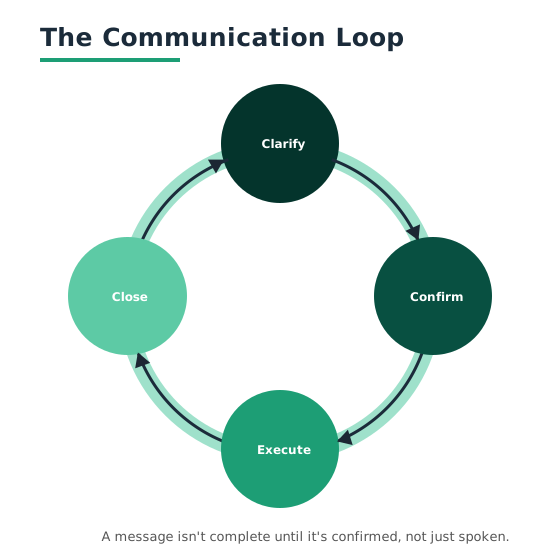
Real communication isn't complete the moment something gets said. It's complete only once the loop closes.

Clarify. State the expectation clearly and specifically — not "handle it well," but exactly what "well" means in this situation.
Confirm. Check that the other person actually understood it the way you meant it — ask them to repeat it back, or explain how they'd apply it, before assuming it landed.
Execute. The work actually gets done, based on the confirmed understanding, not a guess at what was meant.
Report. The outcome gets communicated back — what happened, what worked, what didn't.
Improve. The expectation, the instruction, or the process gets refined based on what the report reveals.
Repeat. The loop starts again, a little clearer each time.

Information isn't complete until understanding has been confirmed. Mike had been stopping at Clarify — saying something once and assuming it was received exactly as intended. The Confirm step was missing entirely, and that single missing step was the whole source of his four different companies.

Common Communication Mistakes

Assuming everyone knows.

What feels obvious to the owner, who's said it a dozen times in his own head, is rarely obvious to someone hearing it for the first time.

Changing expectations verbally.

A standard updated in a passing hallway conversation reaches some people and not others, creating exactly the inconsistency Mike was experiencing.

Different supervisors giving different instructions.

Without a shared, written standard, each supervisor's individual judgment quietly becomes its own separate policy.

Too many text messages.

A constant stream of quick messages, with no structure, buries the important information inside the routine noise.

Too many meetings.

Long, frequent meetings can create the illusion of communication while actually just adding time without adding clarity.

No written standards.

Anything that only exists verbally will be remembered differently by everyone who heard it.

Never confirming understanding.

The single most common mistake on this list, and the direct cause of most of the others.

Avoiding difficult conversations.

Inconsistencies left unaddressed simply repeat themselves, because nobody's told there's actually a problem.

Sarah's Story

Sarah told Mike about her own early instinct, facing a similar problem — she assumed the fix was more meetings. More time spent talking things through, more updates, more check-ins. Instead, the meetings grew longer, and the confusion, somehow, kept increasing right alongside them.

"I finally realized," she said, "that my team didn't need more information. They needed clearer information, delivered the same way, every time, to everyone."

She replaced her long, sprawling meetings with short daily huddles — five minutes, every morning, covering exactly what needed to be aligned that day. She built simple written standards for anything that mattered — discounts, photos, scheduling promises — so nobody had to rely on memory or a hallway conversation. And she added a short weekly check-in specifically for her crew leaders, to catch small misalignments before they became customer-facing problems.

"Confusion dropped almost immediately," she told Mike. "Not because we talked less. Because what we did say finally landed the same way for everyone."

Real Contractor Comparison

Company A

lets every crew communicate its own way. Customers receive different answers depending on who they happen to speak with. Office staff spend a significant part of every day clarifying information that should have been clear from the start. Callbacks increase — not from bad workmanship, but from simple miscommunication about what was actually promised. Frustration builds on every side.

Company B

runs a consistent daily communication rhythm. Job updates follow the same standard format regardless of which crew is reporting. Expectations are written down, not just spoken. Everyone, across every truck, speaks the same language about discounts, scheduling, and documentation. Customers receive one consistent experience, no matter which technician answers the phone.

Customers should experience one company — not four crews. The difference between these two businesses has nothing to do with talent or effort. It's entirely about whether communication closes its loop or stops halfway.

The Five Communication Habits

Start every day together.

A short daily huddle — even five minutes — aligns everyone on what matters that day, before the day's noise takes over.

End every job with complete documentation.

Photos, notes, and completion details, captured the same way, every time, regardless of which crew did the work.

Confirm important decisions in writing.

A quick text or note that summarizes an agreement prevents the "I didn't know" problem before it starts.

Address misunderstandings immediately.

A small miscommunication caught the same day is cheap. Left to repeat for weeks, it becomes expensive.

Share company wins regularly.

Communication isn't only for correcting problems — celebrating what's going well reinforces the standards you actually want repeated.

Clarity scales. These five habits don't require more meetings or more messages. They require the same information, delivered the same way, consistently enough that everyone across every truck is actually working from the same page.

Practical Exercise

Draw out every major communication path in your company — Owner, down through Office, down through Crew Leaders, down through Technicians, out to Customers. For each connection, identify where information commonly gets delayed, distorted, or lost entirely along the way. Choose one specific communication problem from that map. Fix it this week — not the whole system, just the one clearest break in the chain.

Warning Signs

These are the signals that your communication system is starting to break down. Catch them early, and you can fix the pattern before it becomes a crisis.

Signal #1

Different crews follow different standards

This usually means expectations exist verbally, in different supervisors' heads, rather than written down consistently.

Signal #2

Customers receive conflicting information

This is the clearest possible sign that the Communication Loop is breaking somewhere between the owner and the front line.

Signal #3

Employees frequently say "I didn't know"

This means the Confirm step is missing — something was said, but never actually verified as understood.

Signal #4

Meetings solve nothing

This usually means meetings are being used to transmit information instead of to confirm shared understanding.

Signal #5

Office staff repeatedly clarify instructions

This means the same miscommunication is happening often enough that it's become a recurring, unaddressed pattern.

Critical

Callbacks happen because of miscommunication

This is one of the most expensive warning signs of all — quality work undone by an information gap that had nothing to do with skill.

6 warning signs. If you see more than two of these, your communication system needs immediate attention.

Action Checklist

  • Establish a short daily communication rhythm — a five-minute huddle or its equivalent.
  • Standardize job documentation so every crew reports the same information the same way.
  • Define clearly who communicates what, to whom, and by when.
  • Reduce any meetings that aren't actually closing the Communication Loop.
  • Confirm major decisions in writing, not just verbally.
  • Review recurring communication failures once a month, and fix the pattern, not just the latest instance.

Key Takeaways

As businesses grow, problems rarely happen because people stop working — they happen because information stops flowing consistently. The Communication Loop — Clarify, Confirm, Execute, Report, Improve, Repeat — isn't complete until understanding has actually been confirmed, not just stated once. The goal was never more communication. It's better communication — the same clear expectation, reaching everyone the same way, every time. Confusion is expensive, and clarity, once built deliberately, scales right alongside the business.

Reflection Questions

Where does information most often get lost between you and your crews? Which conversations keep happening repeatedly because nothing was ever actually documented? Do your crews currently deliver one company experience, or several different ones depending on who shows up? If a customer called three different employees today, would they hear the exact same answer?


Several months later, communication felt almost effortless. The office knew what was happening on every job without having to chase it down. Crew leaders stayed aligned with each other and with Mike. Customers, across every truck, received the same consistent answers no matter who they spoke with.

Mike noticed something remarkable happening: problems were getting solved before they ever reached him at all.

"Now information moves," Sarah said, watching the shop's morning huddle wrap up on schedule.

"It finally feels like one company," Mike said.

"And that's what allows the next stage," Sarah replied.

"What comes next?"

Sarah looked toward the scheduling board, covered in the day's four trucks and their jobs. "You've built leaders. You've built communication. Now it's time to learn how to actually measure performance — not just to catch problems, but to know exactly what's working."

Chapter 22 is where the numbers come back into the story — bigger this time, across every truck instead of just one.

Scroll to Top