Chapter 19: The Owner Is No Longer the Bottleneck
Chapter 19

The Owner Is No Longer the Bottleneck

Mike had two trucks now, a growing crew, steady revenue — and somehow, he was more trapped than ever. Growth had given him responsibility, not freedom.

The Challenge

Every growing company eventually reaches this exact point — where the owner becomes the slowest part of the business, not from laziness, but from having quietly become the answer to every question the business generates. It happens gradually enough that most owners don't notice until, like Mike, they're busier at two trucks than they ever were at one, and an entire morning meant for real strategic thinking gets eaten alive by a dozen reasonable, thirty-second interruptions.

The greatest threat to further growth is rarely the market, the competition, or the economy. It's the owner's own inability to let the business function without their constant involvement — and worse, the quiet realization that the owner built that dependence themselves, one convenient "just ask me" at a time.
Why It Happens

People are not dependent because they lack ability. They are dependent because the owner unintentionally trained them to be.

Every time Mike answered a question in thirty seconds instead of teaching someone to answer it themselves, he made the fast choice and the expensive one at the same time. It felt efficient in the moment. Multiplied across two employees, dozens of questions a day, and months of habit, it built a business that couldn't move without him — not because his team wasn't capable, but because nobody had ever given them permission, training, or authority to decide anything on their own.

Busy means doing many things. Necessary means doing only the things nobody else can do. Mike was extremely busy. Almost none of what filled his Tuesday was actually necessary for him, specifically, to handle.

The Framework: The Bottleneck Test

Ask yourself five questions, honestly.

Does work stop when I'm unavailable?

If a single missed day genuinely halts progress, the business is running through you personally, not through anything independent of you.

Do people wait for my approval?

Waiting itself is the tell — not whether the approval eventually comes, but whether anyone can move forward without it.

Do customers expect only me?

A business where every customer specifically wants the owner has built a reputation, but not yet a company that can operate at scale.

Do I answer the same questions repeatedly?

This is the Repeatability Rule from Chapter 5, resurfacing at a bigger scale — the same unresolved pattern, just with more people asking.

Can my team make good decisions without me?

Not perfect decisions. Good enough decisions, made confidently, without needing to check first.

Mike's Tuesday made the answer to that fifth question painfully obvious. His team wasn't incapable — they were simply never given the room to prove otherwise.

Common Bottlenecks

approval

Approving every purchase.

Even small ones, routed through the owner out of habit rather than necessity.

customer

Answering every customer issue.

Every complaint, every special request, personally handled instead of trusted to a capable employee.

estimate

Reviewing every estimate.

Even the routine ones your team has been fully trained to handle themselves.

schedule

Scheduling every technician.

A task that could belong to a dispatcher or a simple system, still routed personally through the owner.

check

Signing every check.

A control that made sense at one truck and becomes a genuine bottleneck once there are real employees and real cash flow to manage.

hiring

Making every hiring decision.

Even for roles a trusted manager could screen and recommend confidently.

copy

Being copied on every message.

A habit that feels like staying informed and functions, in practice, as an unspoken requirement that nothing moves without the owner's eyes on it first.

Sarah's Story

Sarah told Mike about the one-week vacation she'd finally forced herself to take, years earlier. Her phone rang over a hundred times that week. At first, she admitted, that number had made her feel almost proud — a hundred calls felt like proof of how essential she was, how much the business genuinely needed her.

It took her most of that week away to realize the calls proved something else entirely. Not that she was essential. That she'd never built anything that could function without her. A hundred phone calls wasn't a compliment. It was a hundred small confessions that she'd spent years training her own team to ask permission instead of use their judgment.

"I came back from that trip and didn't add a single new rule," she told Mike. "I removed a long list of approvals that had never needed to exist in the first place, and handed real ownership of those decisions to the people already doing the work every day. That one change did more for my company than anything else I did that whole year."

Real Contractor Comparison

Company A

Owner approves nearly everything. Employees wait for sign-off before acting. Customers wait for callbacks that require the owner's input. Growth stalls, not from lack of demand, but from a bottleneck of decisions all funneling through one exhausted person. Stress climbs right alongside revenue.

Company B

Clear authority levels defined for the team. Decision limits are explicit — who can approve what, up to what dollar amount, without checking first. Employees solve problems directly. The owner spends the freed-up time on strategy instead of approvals. The business scales, because growth in responsibility was matched, deliberately, by growth in authority.

A business becomes scalable when decisions become distributed — not scattered randomly, but deliberately placed with the people closest to the actual work.

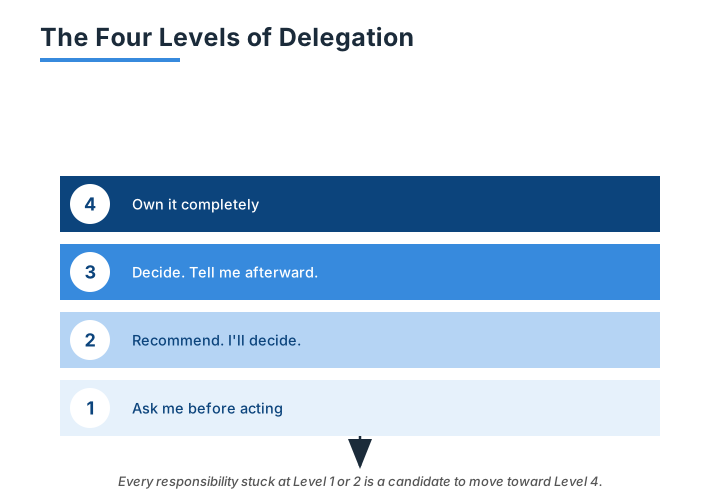
The Four Levels of Delegation

bbok

Delegation isn't a single decision. It's a journey every recurring responsibility travels through, one stage at a time.

Ask me before acting — the natural starting point for a brand-new responsibility, or one where trust hasn't yet been earned.
Recommend. I'll decide — the employee does the thinking, proposes a solution, and the owner makes the final call. A meaningful step forward, even though the decision still routes back through you.
Decide. Tell me afterward — the employee acts independently and simply keeps you informed, rather than waiting for permission.
Own it completely — no check-in required at all. The responsibility genuinely belongs to someone else now, start to finish.

The owner's job was never to make every decision. The owner's job is to build people who can make good decisions. Delegation without authority creates frustration — handing someone a task while still requiring Ask-me approval for every step isn't delegation at all. It's just adding a middleman to your own decision-making.

Practical Exercise

Write down every decision you personally made yesterday — all of it, not a summary. Mike's list, once he actually did this, looked almost embarrassingly ordinary: whether to discount a repeat customer, which supplier to order a part from, whether to reschedule Thursday's job to Friday, whether to approve a small equipment purchase, who should take a callback, which truck should get assigned to which job. Nothing dramatic. Just a long list of small, reasonable, thirty-second decisions that had never once been handed to anyone else.

Highlight the ones someone else could have made, with the right training and the right level of trust. Choose three. Delegate them this week, specifically naming which level of the journey — Ask me, Recommend, Decide, or Own it — you're moving each one to. Review the results after one month, and either move the responsibility further along or address whatever gap made that difficult.

Warning Signs

dependency

You can't take a vacation.

This is the clearest possible sign that the business depends on your continuous presence to function.

frequency
high
interrupt

Employees constantly interrupt you.

This usually means most responsibilities are still stuck at Ask-me, routing everything back through you out of habit rather than necessity.

frequency
moderate
reputation

Customers ask only for you.

This means the company's reputation is currently attached entirely to one person, rather than to the business itself.

frequency
high
evenings

You work evenings catching up.

This usually means your daytime hours are being consumed by other people's small questions instead of your own priorities.

frequency
moderate
reactive

Your calendar controls your business.

This means the business is reactive to whatever's most urgent today, rather than being deliberately guided by anyone's actual plan.

frequency
moderate

Action Checklist

  • List every approval you currently give, no matter how small.
  • Remove one unnecessary approval each week, moving that responsibility toward Decide or Own It.
  • Clarify decision authority explicitly — who can decide what, and up to what limit.
  • Teach your employees how to make the decisions you're handing them, not just that they now can.
  • Measure the results of each delegated responsibility after a set period.
  • Repeat this process monthly, steadily shrinking the list of things only you can do.

Key Takeaways

Every growing company eventually reaches a point where the owner becomes the slowest part of the business — not from laziness, but from having become the answer to every question. People aren't dependent because they lack ability. They're dependent because the owner unintentionally trained them to be, one convenient shortcut at a time. The Four Levels of Delegation — Ask me, Recommend, Decide and tell me, Own it completely — turn delegation into a development journey instead of a one-time handoff. The owner should become the company's greatest builder, not its biggest bottleneck.

Reflection Questions

What decisions genuinely still require your specific judgment right now? Which decisions could someone else fully own, with the right training and trust? If you disappeared for one full week, what would actually stop? Are you building a company — or quietly training your team to depend on you?


Months later, Mike left town for two days — a real trip, phone mostly off, no daily check-ins scheduled. He came back expecting the worst. He checked his messages first thing, braced for a pile of unresolved questions. He opened his laptop looking for the fires he assumed would be waiting.

There weren't any. Customers had been served. Employees had made calls — discounts, reschedules, a callback or two — using exactly the authority he'd spent months deliberately handing them. Revenue hadn't dipped. Nothing had waited for him at all.

He sat there for a moment, laptop open, phone quiet, and didn't quite know what to do with the silence. It didn't feel like relief exactly. It felt like something closer to proof — years of small, uncomfortable handoffs finally adding up to a business that could carry its own weight.

Sarah smiled when he told her about it. "Now your business is finally carrying its own weight," she said. "Not because you stepped back. Because you finally taught it how to stand."

"What changes next?" Mike asked.

"The business itself," Sarah said. "Because the people you've spent all this time teaching to decide things on their own — they're going to need someone to help them grow too. You've learned how to lead employees, Mike. Now you'll learn how to build leaders."

Chapter 20 is where you learn what that actually requires.

Scroll to Top