
Chapter 12: Your First Hire Changes Everything
Chapter 12

Your First Hire Changes Everything

"So," Mike said, sitting across from Sarah the following Thursday, legal pad already open like he'd come prepared. "Who do I hire?"

The Challenge

Every contractor eventually hits this exact moment — the decision to hire feels enormous, and the instinct is to immediately start thinking about who. A cousin. A friend. Someone from the old job who seemed reliable. It feels productive, because a name feels like progress.

It's the wrong first question. Hiring the wrong person for an undefined role doesn't just fail to solve the problem — it often makes things worse, adding a second person to manage on top of an already overloaded owner, with no clear job to actually manage them against.
Why It Happens

Contractors think in people because the trade itself is built around people — customers, crews, relationships. But a business doesn't need a person first. It needs a role, clearly defined, built to solve a specific bottleneck. Roles build businesses. People fill roles — in that order, not the reverse.

Don't hire because you're overwhelmed. Hire because you're prepared. Overwhelm makes almost any warm body look like relief. Preparation makes it obvious exactly what that person needs to actually do, and exactly how you'll know if they're succeeding.

The Framework: The First Hire Filter

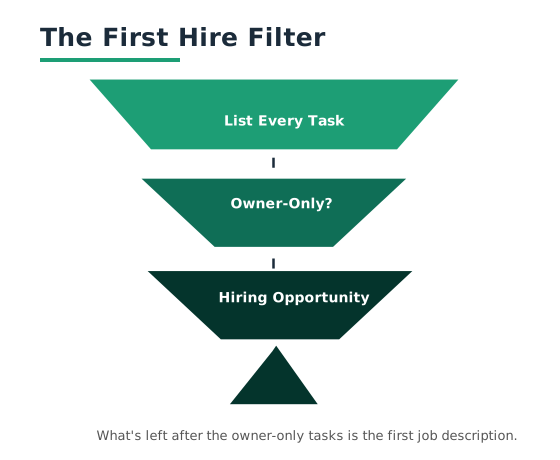
First Hire Filter
1. List every recurring task. Exactly what Mike did on that legal pad — the full, unfiltered list of everything currently running through the owner.
2. Identify what only the owner can do. Final pricing decisions, key customer relationships, the handful of tasks that genuinely require your specific judgment or license right now.
3. Everything else becomes a hiring opportunity. Not a wish list. An actual inventory of work that could belong to someone else, once trained.
4. Choose the role that removes the largest bottleneck. Not the easiest task to hand off. The one currently costing you — and the business — the most.

Owners hire roles, not people. A role has a clear purpose and a clear definition of success. A person hired without one is just an extra name on the payroll, doing whatever seems most urgent on a given day, with no way to measure whether the hire actually worked.

Where the First Hire Usually Lives

The correct first hire is never the same for every contractor, because it depends entirely on what's currently limiting growth. Sometimes it's a field technician, freeing the owner from the physical labor itself. Sometimes it's an office administrator, freeing the owner from invoicing, scheduling, and paperwork. Sometimes it's someone handling customer service — the calls, the follow-ups, the scheduling conversations. Sometimes it's an estimator, someone trained in the TRUST Conversation from Chapter 9, freeing the owner from running every single estimate personally.

Mike's list made his bottleneck obvious the moment Sarah crossed out the field work. He wasn't limited by his ability to price, sell, or manage the business anymore — Part One had fixed most of that. He was limited by the fact that he was still the only person physically doing the work.

Common Hiring Mistakes

1 Hiring family because it's easier.

Comfort isn't the same as fit, and family relationships rarely survive undefined expectations gracefully.

2 Hiring the cheapest person.

A cheap hire with the wrong character or skill often costs more in mistakes, retraining, and turnover than a slightly more expensive hire done right the first time.

3 Hiring too late.

Waiting until you're completely buried means making the decision from exhaustion instead of preparation — exactly the trap this chapter is built to avoid.

4 Hiring before having enough work.

A hire with nothing real to do creates cost without solving a bottleneck, and often leaves quickly out of boredom or confusion.

5 Hiring because you're tired.

Tiredness makes almost anyone look like the answer. It rarely produces a clear-eyed decision about what the role actually needs to be.

6 Hiring without defining expectations.

An employee with no clear picture of success has no way to actually succeed, no matter how capable they are.

7 Expecting one person to solve every problem.

The first hire should remove one clear bottleneck — not become a second version of the overwhelmed owner.

8 Hiring someone exactly like yourself.

A business that only ever hires more of the owner's own strengths never builds the different strengths it actually needs.

Sarah's Story

Sarah's first hire, years earlier, had been her younger brother. It felt safe — she trusted him completely, and trust felt like it should be enough. There was no job description. No clearly defined expectations. No real accountability, because holding your own brother accountable felt awkward in a way holding a stranger accountable never would have.

Family dinners slowly turned into business meetings. Small frustrations that should have stayed at work followed them home. The relationship strained under the weight of a job neither of them had actually defined.

"I hired him because he was available," Sarah told Mike. "Not because he was right for the role — because there wasn't a role yet, just a vague hope that having him around would help. Never hire someone because they're available. Hire because they're right for a role you've actually defined."

Real Contractor Example: Two Owners

Owner A

hires the first available technician who calls back. No systems in place, no training plan, no clearly stated expectations. Frustration builds within weeks — small mistakes, missed details, a general sense that the new hire "just doesn't get it." The employee leaves within six months. Owner A tells anyone who'll listen that "nobody wants to work anymore."

Owner B

documents clear expectations before the interview even happens, builds a simple onboarding checklist, trains consistently using the Repeatability Rule from Chapter 5, and meets with the new hire weekly to check in. The employee succeeds — not because they were more talented than Owner A's hire, but because they were given an actual role to succeed at. Owner B gains back roughly twenty hours a week that used to disappear into field work.

Same trade, same local labor market, same difficulty finding good people. The difference wasn't the candidates. It was whether a real role existed before the hiring process ever started.

The Hiring Scorecard

Every candidate, regardless of the specific role, should be evaluated against six things:

  • 1. character
  • 2. reliability
  • 3. attitude
  • 4. learning ability
  • 5. technical skill
  • 6. culture fit

Notice where technical skill sits — fourth on a list of six, not first. Hire for character. Train for skill. A technically skilled candidate with poor character or low reliability will eventually cost you more than they save. A candidate with strong character, a good attitude, and genuine willingness to learn can be trained in almost any technical skill your business actually needs — the reverse is rarely true.

Practical Exercise

Write your first real position description. Include the role's purpose — why it exists at all. Its responsibilities — the specific tasks it covers. What success looks like — clearly enough that both of you would recognize it. The skills required to do the job adequately from day one. And the values expected — the character traits that matter more than any single technical qualification.

Do this exercise honestly, and you'll stop saying "I just need help" and start saying something much more useful: "I need someone to own this role."

Warning Signs

"I've never written a job description."

This usually means the role itself hasn't actually been defined yet, only the feeling that help is needed.

"I interview by instinct."

Instinct matters, but without a scorecard behind it, instinct alone tends to reward charm over character.

"I hire whoever is available."

This usually predicts the same outcome as Owner A's story — a hire made from urgency instead of preparation.

"I hope they'll figure it out."

Hope is not a training plan, and "figuring it out" alone rarely produces the consistency a real business needs.

"I don't know exactly what success looks like."

If you can't describe it, neither can the person you're about to hire to achieve it.

Action Checklist

  • List every recurring responsibility currently running through you.
  • Identify the single largest bottleneck in your business right now.
  • Define one clear role built to remove that specific bottleneck.
  • Write a one-page position description — purpose, responsibilities, success, skills, values.
  • Build a simple hiring scorecard using character, reliability, attitude, learning ability, technical skill, and culture fit.
  • Commit to hiring deliberately, on your own timeline — not urgently, out of exhaustion.

Key Takeaways

Your first hire isn't just another employee. It's the first brick in an actual company, and the difference between hiring well and hiring poorly rarely comes down to the candidates available — it comes down to whether a real role was defined before the search ever began. The First Hire Filter turns a vague sense of "I need help" into a specific role built to remove your business's largest bottleneck. Hire for character. Train for skill. Great hiring begins long before the interview — it begins with a legal pad, an honest list, and the discipline to cross most of it out.

Reflection Questions

What specific business problem is your first hire actually meant to solve? Would another version of yourself genuinely improve the business, or does it need a different set of strengths entirely? What qualities matter more to you than raw experience? What expectations have you never actually written down, for yourself or for anyone you might hire?


Mike finished writing his first real position description late that night — not a want ad, not a vague "help needed" post, but an actual role: purpose, responsibilities, what success would look like in ninety days, the skills required, and the character he wasn't willing to compromise on. For the first time, he wasn't looking for help. He was looking for a teammate.

He showed it to Sarah the following week, a little proud of it.

"Good," she said, scanning it over. Then: "But hiring someone is only the beginning. They still have to actually become successful in the role."

Mike nodded slowly. "So now I teach them?"

"No." Sarah smiled. "You build a system that teaches them. There's a difference — and it's the difference between an employee who only ever works as well as you personally trained them, and one who keeps getting better long after you've stopped watching."

Chapter 13 is where you build that system.

Scroll to Top