Chapter 11: The Hardest Job You'll Ever Quit
Chapter 11

The Hardest Job You'll Ever Quit

Mike's business, several months after the reputation overhaul from Chapter 10, was healthier than it had ever been. Prices held. Reviews were rolling in. The phone rang more than it used to, and it rang with the right kind of customers — the ones who'd already decided to trust him before he ever answered.

The Challenge

This is the hardest transition in the entire book, and it has nothing to do with paperwork or payroll software. The hardest job most contractors ever quit is the one they're best at — the one where they personally touch every job, answer every call, and solve every problem. Letting go of that job doesn't feel like promotion. It feels like giving something up.

Mike's business had genuinely improved. Better pricing, better selling, better reputation — everything Part One taught him was working. And none of it had freed up a single hour of his actual time, because he was still the one doing every task that made the improvements real.

Why It Happens

Owners don't cling to control because they're bad leaders. They cling to it because doing the work is where their identity, their pride, and their sense of safety all live. Chapter 3 named this the Technician Trap, and here it is again, in a slightly older, more successful disguise — a business that's grown enough to need help, run by an owner who still can't imagine handing any of it over.

The first person you must stop managing is yourself. Not your future employees — yourself. Every hour spent proving your value through doing is an hour not spent building a business that can survive without you in the room.

If your business cannot operate without you, you don't own a business yet. You own a demanding job. It might pay better than working for someone else. It still isn't a company. A company, by definition, is something that produces value independent of any one person's daily presence — including its owner's.

The Owner's Ladder — Revisited

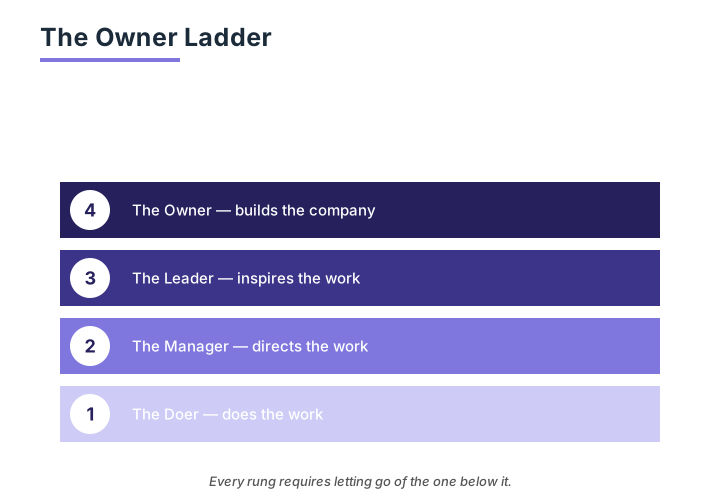
Owner's Ladder

Back in Chapter 4, you climbed onto the Owner Ladder for the first time — Doer, Manager, Leader, Architect — the four rungs every contractor eventually climbs. Now that a real hire is on the horizon, it's worth looking at that first, hardest climb in finer detail, because "Doer to Manager" isn't one step. It's five.

1. I do everything. Every task, every decision, every hour of the work runs through you alone.
2. I decide what only I should do. You start separating the tasks that genuinely require your specific judgment from the ones that don't — the first real crack in the Technician Trap.
3. I teach others. You begin transferring the tasks that don't require you specifically, using the Repeatability Rule from Chapter 5 to turn what's in your head into something someone else can actually follow.
4. I verify. You stop doing the task and stop hovering over every detail of it. Instead, you check the outcome, coach where needed, and let go of watching every step.
5. I lead. You're no longer managing tasks at all. You're managing people, priorities, and the direction of the business itself.

Nobody skips a stage. Mike, right now, is still stuck between Stage 1 and Stage 2 — he knows intellectually that some tasks don't require him personally, but he hasn't yet made the actual list.
Working IN the Business vs. Working ON the Business

Every hour Mike spends this week falls into one of two categories, whether he notices it or not. Working in the business means doing the actual service work — the estimates, the jobs, the invoices, the calls. Working on the business means deciding what the business should become — who to hire, what to systemize, where to grow next.

A technician works entirely in the business, because that's the whole job. A supervisor starts directing some of the in-business work. A manager splits time between both. An owner should be spending a growing share of time working on the business. A leader spends the majority of their time there — not because the field work stopped mattering, but because someone else now handles it well enough that the owner's attention is worth more spent elsewhere.

Mike, right now, is still functioning as a technician who happens to own the truck. Every task on his list this week — estimates, materials, invoices, warranty calls — is in-business work. None of it is building the business itself.

The Framework: The Delegation Matrix

Delegation Matrix

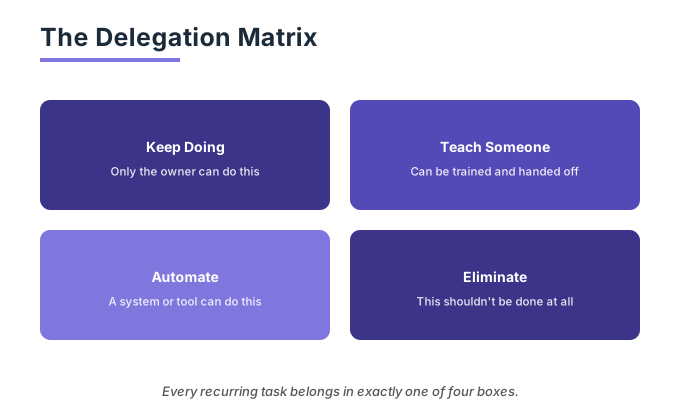
Sort every recurring task in your business into exactly one of four categories.

Keep Doing.

Tasks that genuinely require your specific judgment, license, relationship, or final say — right now, at this stage of the business. This category should be smaller than it feels.

Teach Someone.

Tasks that could be handled by a trained employee, using a documented standard, without needing your involvement in every instance.

Automate.

Tasks that could be handled by a tool, a system, or a service instead of a person at all — scheduling software, an answering service, automated invoice reminders.

Eliminate.

Tasks that don't actually need to happen at all, or that exist only out of habit, without adding real value to the customer or the business.

Control feels safe. Delegation builds freedom. The Delegation Matrix isn't about doing less work. It's about making sure the work you're personally doing is the work that actually needs you — and nothing else.

Sarah's Story

Sarah told Mike about her own first hire, years earlier, over the same kind of exhausted evening he was having now. She'd finally brought on a technician, and she hovered over every single job — correcting small details, redoing work she considered slightly below her standard, stepping in the moment anything looked different than she would have done it herself.

Her new technician finally said something she never forgot. "If you won't let me learn, I'll never become the employee you need."

"That was the whole lesson," Sarah told Mike. "I thought I was protecting quality. I was actually protecting my own need to be the only person who could do it right. He was patient enough to say it out loud. Most employees just quit instead."

Real Contractor Example: Two Businesses

Contractor A

is still doing everything himself — every estimate, every job, every invoice. He's booked six weeks out, which sounds like success and feels like a trap. He hasn't taken a real vacation in years. Revenue has plateaued, not because the demand isn't there, but because there are only so many hours in one person's week, no matter how well-priced and well-reviewed the business has become.

Contractor B

hired one technician a year ago, documented her core processes using the Repeatability Rule, and deliberately delegated the routine work — material runs, standard estimates, follow-up calls. She spends her time on customers, pricing, and planning instead. Her revenue has roughly doubled in that year, with noticeably less personal stress than she carried running everything alone.

Same starting point. Same market. The only difference is which side of the Delegation Matrix each of them was willing to move work into.

Common Fears

"No one will care like I do."

Probably true, at first. Care isn't the only thing that produces good work — clear standards and good training do too, and those can be built even where personal passion can't be transferred directly.

"They'll make mistakes."

They will. So did you, when you were learning. Mistakes made while learning under a good system are how competence gets built — they're not evidence delegation was a mistake.

"I can do it faster."

Almost certainly true the first ten times. It stops being true the moment you count the hours you spent doing it yourself instead of building something that didn't need you.

"It takes longer to teach."

It does, once. It saves time every single time after that — the same math that made the Repeatability Rule worth the upfront effort back in Chapter 5.

"They'll quit."

Some will. That's a cost of building a team, not a reason to avoid building one.

"What if customers don't like them?"

Some customers will miss you specifically. Most simply want the problem solved well, by someone they can trust — which an employee, properly trained, can absolutely become.

Sarah never dismissed these fears when Mike raised them. She just reminded him that every owner who ever successfully delegated felt every one of them first.

Practical Exercise

Track every task you personally perform for one full week — not a summary, an actual list. For each one, ask three questions: Only I can do this. Someone else could learn this. No one should be doing this at all. At the end of the week, circle everything that landed in the second category. That circled list is your delegation plan, and it's usually longer than most owners expect.

Warning Signs

"I'm the only one who knows."

This means critical knowledge exists only in your head, which makes the business fragile in a way no amount of revenue can fix.

"My phone never stops."

This usually means every decision, big or small, is still routing through you by habit rather than necessity.

"I can't take a day off."

This is the clearest possible sign that the business currently depends entirely on your continuous presence to function.

"I haven't had a vacation in years."

This isn't a badge of honor. It's a diagnosis.

"Everything waits for me."

This means the business has no functioning Stage 3 or Stage 4 on the Owner's Ladder yet — no one has been taught, and no one is being trusted to be verified instead of watched.

Action Checklist

  • List every recurring task you personally perform in a typical week.
  • Highlight the tasks that genuinely require your specific judgment or license.
  • Highlight the tasks someone else could be taught to handle.
  • Choose one task from that second list to delegate this month.
  • Write simple, clear instructions for that one task, using the Capture-Clarify-Codify-Coach process from Chapter 5.
  • Accept, before you even start, that the first few attempts won't look exactly like you'd have done it — and that this is not the same thing as failure.

Key Takeaways

The hardest job most contractors ever quit is the one they're best at, and letting go of it feels like loss even when it's actually the beginning of real growth. The Owner's Ladder's first climb — from doing everything to deciding what only you should do, to teaching, to verifying, to leading — happens in five distinct stages, and nobody skips one. The Delegation Matrix — Keep Doing, Teach Someone, Automate, Eliminate — turns a vague feeling of being overwhelmed into an actual plan. The owner who refuses to let go eventually becomes the ceiling the whole business grows against.

Reflection Questions

What are you actually afraid will happen if you let go of one task this month? Which task on your weekly list consumes real time without requiring any of your specific expertise? What work in your business gives the highest return on the hours you personally spend on it? What kind of work should never belong to the owner, no matter how good you are at it?


Mike finished his delegation worksheet late that night, sitting at his kitchen table instead of a job site for once. One category kept filling up faster than the others: field work. Estimates. Routine repairs. The exact work he'd built his entire identity around.

He looked up at Sarah the next Thursday, the worksheet still folded in his jacket pocket. "I think it's time."

"For what?"

He took a breath. "My first hire."

Sarah nodded slowly, like she'd been waiting for exactly this conversation for months. "Good." Then, almost gently: "The next challenge isn't finding an employee, Mike. It's becoming the kind of boss someone actually wants to work for."

Chapter 12 is where you find out what that actually takes.

Scroll to Top