Chapter 13: Train Once. Benefit Forever.
Chapter 13

Train Once. Benefit Forever.

Mike's first hire was everything he'd hoped for. Hardworking. Positive. Showed up fifteen minutes early every single day. Customers liked him immediately - he had an easy way of putting people at ease that even impressed Mike a little.

He was also calling Mike's phone roughly every fifteen minutes.

"Hey Mike, where do we keep the extra fittings?" "Mike, how do we normally handle a customer who wants to reschedule same-day?" "What do I charge for this extra part?" "What do I tell her if she asks about the warranty?" "What happens if the crawlspace access is blocked?"

By Wednesday of his new hire's second week, Mike was spending more time answering questions from the truck than he was spending on his own jobs. He said as much to Sarah, half-joking, half-desperate. "Hiring made me busier."

"No," Sarah said. "You hired someone. You forgot to build a system." She let that land. "A good employee without a system just becomes a very motivated person who has to interrupt you constantly to find out what to do. That's not his failure, Mike. That's yours."

The best system answers questions before people ask them.

The Challenge

Hiring solves one problem and immediately creates another. A great employee with no system still has to get every answer from somewhere, and if that somewhere is you, personally, every single time, you haven't actually freed up any capacity. You've just added a second full-time job: answering questions.

Chapter 5 introduced the Repeatability Rule - if it's happened twice, it needs a system. Now that you actually have someone to use those systems, that lesson stops being theoretical and starts being the only thing standing between you and your phone ringing constantly.
Why It Happens

Knowledge lives inside one person's head. Systems live inside the company. Everything Mike knew about how to run a job - where materials were kept, how to handle a rescheduling request, what to say about a warranty - existed only in his own memory. His new hire couldn't access any of that without asking, because none of it had ever been written down anywhere else.

A business only becomes genuinely valuable - and genuinely capable of growing past one person - when knowledge moves out of the owner's head and into something the company itself can teach. Until that happens, every new hire is just another person who needs you personally, indefinitely, to function.

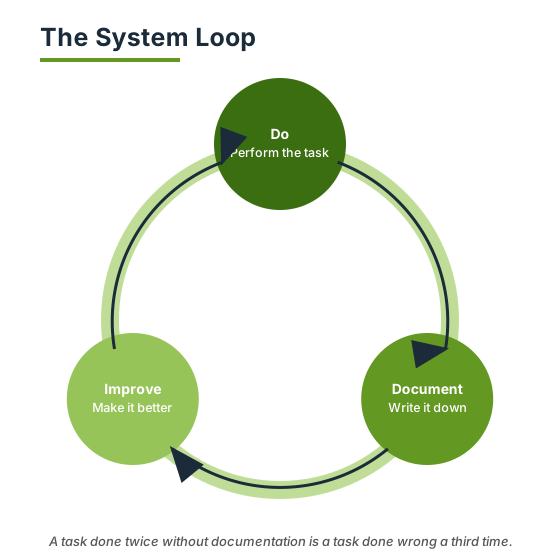
The Framework: The System Loop

The System Loop

Systems aren't built in advance, sitting in a binder waiting for a business to need them. They're built the moment a task proves itself repeatable, using a simple loop.

Do. Complete the task the way it should be done, at least once, ideally a few times, so you know it actually works.

Document. Write down exactly what happened - the same Capture step from Chapter 5's Repeatability Rule, now applied to something a real employee will actually read.

Improve. Look at what you wrote and ask if there's a better, clearer, or faster way to do it, now that it's on paper instead of just in your head.

Teach. Walk your employee through the documented process, explaining not just the steps but the reasoning behind them.

Repeat. Every time the process gets used, refine it slightly. A system isn't static - it gets a little better every time someone actually follows it.

Don't build systems in advance for tasks that haven't proven themselves repeatable yet. Build them the moment you notice yourself answering the same question for the second time - which, for Mike, had already happened about a dozen times in two weeks.

Common Training Mistakes

Training by memory.

Explaining a task once, out loud, and trusting it'll stick - it rarely does, especially under the pressure of an actual job site.

"Watch me."

Demonstration teaches what to do once. It doesn't create something an employee can refer back to later, alone, without you standing there.

"I'll explain it later."

Later rarely comes, and the employee is left improvising in the meantime, often incorrectly.

Different answer every time.

If the answer to "how do we handle this" changes depending on your mood or memory that day, no employee can ever build real confidence in their own judgment.

Assuming people "should know."

Nobody arrives already knowing your business's specific way of doing things, no matter how experienced they are.

Teaching only technical work.

The trade itself is only part of the job - customer greetings, invoicing, truck organization, and communication all need training too, and often get skipped entirely.

Never explaining why.

A step followed without understanding its purpose gets abandoned the first time it feels inconvenient.

Correcting mistakes after they happen instead of preventing them.

Waiting for an error to correct it is far more expensive - in redone work, in frustrated customers - than building the system that would have prevented it in the first place.

Sarah's Story

Sarah remembered training every one of her early employees a little differently - whatever felt natural in the moment, whatever she happened to be doing that day. Each technician developed his own way of greeting a customer, his own habits around invoicing, his own system - or lack of one - for organizing his truck.

One customer, who'd used her company twice with two different technicians, finally asked her outright: "Are these really the same company?"

"That question hit me harder than any complaint ever could have," Sarah told Mike. "She wasn't even upset. She was just confused, because the experience felt like two completely different businesses. That's when I understood consistency wasn't about controlling my employees. It was about protecting the trust I'd worked so hard to build with every customer, regardless of who showed up at their door."

Consistency is professionalism made visible.

Real Contractor Example: Two Companies

Company A

lets every technician handle jobs their own way. One greets customers warmly; another barely says hello. One follows a consistent job-completion process; another skips steps when rushed. Customers get a noticeably different experience depending on who arrives, callbacks creep up as small inconsistencies turn into real mistakes, and the owner is constantly intervening to catch problems after the fact.

Company B

uses a small set of simple checklists - a standard customer greeting, a job-completion checklist, a truck organization standard. Any customer, regardless of which technician shows up, gets essentially the same professional experience. Mistakes are caught by the checklist before they become callbacks, not after.

The difference isn't talent. It's whether the company's standards live in a system everyone can follow, or only in whichever employee happens to be on the job that day.

The Five Repeatable Systems

Almost every one‑truck business, once it hires its first employee, can eliminate the bulk of its daily interruptions with just five simple systems.

Daily startup

What happens every morning before the first job, so nobody has to ask.

Customer arrival

How a technician greets a customer and sets expectations for the visit.

Job completion

The standard steps at the end of every job to make sure nothing gets missed.

Payment collection

Exactly how and when payment gets requested and processed, consistently.

End‑of‑day closeout

How the truck gets restocked, paperwork handled, and the day reported.

Five systems. Not a binder. Not a manual thick enough to gather dust. Five one‑page standards that answer the majority of the questions a new hire would otherwise have to interrupt you to ask.

Practical Exercise

For one full week, every time someone asks you a question you've already answered before - even once - write it down. Don't filter yet, just capture it. At the end of the week, take the ten most common questions and turn each one into a simple, one-page checklist or procedure. That short stack of pages is the first real Operations Manual your business has ever had, built entirely from real, recurring need - not written in advance, guessing at what might come up.

Warning Signs

"I answer the same questions every day."

Knowledge that should already be documented is still living only in your head.

"Everyone does it differently."

No shared standard exists yet, and customers experience a different company depending on who arrives.

"I have no written procedures."

Every new hire starts from zero, learning entirely by trial, error, and constant interruption.

"I train every employee differently."

Consistency depends on your memory and mood, not on anything the business can reliably teach.

"I can't leave because no one knows what to do."

The clearest sign of all that knowledge has never actually left your head and entered the business.

Action Checklist

  • Write down your ten most repeated questions from the past two weeks.
  • Turn each one into a simple, one-page checklist or procedure.
  • Standardize one customer-facing interaction this month - greeting, follow-up, or payment collection.
  • Standardize one field process - job completion or truck organization.
  • Review the new procedures with your employee directly, explaining the reasoning behind each one.
  • Commit to improving one system every week, even slightly, rather than trying to finish all five at once.

Key Takeaways

Hiring someone creates potential. Training them creates capability. Building systems creates consistency - and consistency is what actually frees an owner from being the answer to every question. The System Loop - Do, Document, Improve, Teach, Repeat - turns real, recurring work into something the business itself can teach, instead of something that only lives in your head. Systems don't replace people. They help people succeed, on their own, without needing you on the other end of every phone call.

Reflection Questions

What knowledge right now exists only inside your own head? Which single process causes you the most daily interruptions? What part of the customer experience should never vary, no matter who shows up? What's one thing you've explained more than twice that could simply be written down instead?


Mike spent the next two weekends writing simple, one-page checklists for his five most common interruptions. Nothing fancy - plain language, taped inside the truck, exactly like his old dashboard from Chapter 6. Within a couple of weeks, the calls slowed dramatically. His technician started solving problems on his own, checklist in hand, without needing Mike on the other end of the line.

One Tuesday, Mike ate an entire lunch without his phone ringing once. He mentioned it to Sarah like he'd won something.

She laughed. "Good. But there's another challenge waiting for you." She paused just long enough for it to land. "Just because someone knows what to do doesn't mean they'll always do it."

Mike nodded slowly. "So now I need accountability."

Sarah smiled. "Exactly."

Chapter 14 is where you learn to build accountability - without becoming the kind of boss who has to watch over everyone's shoulder to get it.

Scroll to Top