Chapter 5: Build Systems, Not Heroics
Chapter 5

Build Systems, Not Heroics

Mike had climbed to Rung 2 on the Owner Ladder, and for about six weeks, he was proud of it.

The Challenge

This is where delegation quietly turns into a new kind of trap. You hand off a task, expecting relief, and instead you get an employee who needs almost as much of your attention as the task did when you were doing it yourself — just funneled through questions instead of hands-on work.

The instinct is to blame the employee. He should be able to figure this out. She should use better judgment. But the honest question isn't what's wrong with the employee. It's what's missing from the business that's forcing every decision to route back through you.

Why It Happens

Call this the Hero Trap — the cousin of the Technician Trap from Chapter 3, and just as dangerous. The Technician Trap keeps you doing the work yourself. The Hero Trap keeps you as the answer to every question about the work, even after you've technically handed it off. Both leave you exactly as indispensable, just with a different job title.

Here's why it happens: training a person feels complete the moment they can do the task once, correctly, while you're watching. But a demonstration isn't a system. It's a memory — yours, and now theirs, both fragile, both dependent on remembering a specific moment instead of following a specific standard.

People leave. Systems stay. An employee who learned a task by watching you do it once will forget the details, improvise under pressure, or hand the job to the next new hire the same fragile way it was handed to them — by demonstration, not documentation. A system doesn't get tired, doesn't have an off day, and doesn't quit without notice.

Common Mistakes

01

Training once and assuming it's permanent.

A single demonstration teaches a task. It doesn't install a standard. Standards need to be written down somewhere more durable than one employee's memory.

02

Answering the same question every time it comes up.

If you've answered "what do we do when the customer wants a discount" more than once, that's not a one-off question anymore. That's a system that doesn't exist yet, disguised as a series of unrelated interruptions.

03

Believing systems are for companies bigger than yours.

Systems don't wait for scale — they create it. A one-truck business with three written processes will outgrow a five-truck business running entirely on the owner's memory.

04

Blaming the employee instead of the gap.

An employee who keeps asking the same question isn't necessarily incapable. They're often just accurately reporting that no clear standard exists yet, and you're the only standard they've got.

The Framework: The Repeatability Rule

The Repeatability Rule

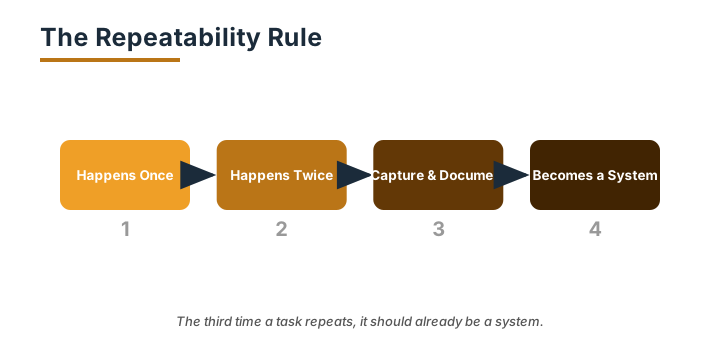
The Repeatability Rule is simple enough to say in one breath: if it's happened twice, it needs a system. The first time a problem shows up, it's an event. The second time, it's a pattern — and patterns are exactly what systems are built to catch.

Once a task passes the twice test, turn it into a system using four steps:

Capture.

Write down exactly what happened the last two times this situation came up, and how it got handled. Don't summarize from memory — write down the actual decision, in enough detail that someone with no context could follow it.

Clarify.

Turn that written record into a clear standard: when this happens, do this. One sentence is often enough. "If a customer asks for a discount on a same-day service call, offer 10% and note it in the file" beats an employee guessing what Mike might say.

Codify.

Put the standard somewhere permanent — a one-page document, a laminated card, a shared note, whatever your business actually uses. If it only lives in your head, it isn't codified yet, no matter how clear it feels to you.

Coach.

Walk your team through the new standard once, explain the reasoning behind it — not just the rule but why it exists — and then hold them to it. A system without coaching is just a document nobody reads. Coaching without a system is just you, answering the same question forever.

The goal isn't to create perfect employees. It's to create predictable systems that ordinary people can follow on an ordinary day. Great companies aren't staffed entirely by extraordinary people doing extraordinary work. They're staffed by ordinary, well-trained people following systems extraordinary enough that the customer never notices the difference.

Real Contractor Example

Mike went home after his coffee with Sarah and made a list of every question his new hire had asked in the past two weeks. Eleven questions. Nine of them had come up more than once. He picked the discount question first, since it was the one costing him the most interruptions, and ran it through Capture, Clarify, Codify, Coach in under an hour — something he could have done in week one, if he'd known to look for the pattern instead of just answering the question again.

Within a month, he'd built five simple, one-page standards: discounts, material substitutions, difficult invoice conversations, same-day scheduling conflicts, and how to open a new customer file. The questions didn't stop entirely — new situations always come up — but the repeat ones nearly vanished. His technician started referencing "the discount sheet" instead of texting Mike mid-job, and for the first time, Mike realized his employee wasn't failing to use judgment. He'd simply never been given anything to use it against.

The owner who becomes indispensable has already limited the company's future — not because he isn't good enough, but because he's too good to replace.

Sarah had learned this earlier and harder. Her first year, she'd personally handled every callback herself, believing customers deserved to hear from the owner. It felt like great service. It also meant she couldn't take a single day off without callbacks piling up untouched. Building a simple callback system — who gets contacted first, within what window, using what script — didn't make her business feel less personal to customers. It made it more reliable, because the response no longer depended on whether Sarah happened to be free.

Action Checklist

  • List every question an employee has asked you more than once in the past month.
  • Pick the single most frequent one and run it through Capture, Clarify, Codify, Coach this week.
  • Choose one recurring task — scheduling, material ordering, customer onboarding, callbacks — and write its standard down in one page or less.
  • Share the new standard with your team and explain the reasoning behind it, not just the rule.
  • Notice the next time you're tempted to answer a repeat question yourself instead of pointing to the system. Point to the system instead.

Key Takeaways

The Hero Trap keeps an owner indispensable long after delegation should have set them free — the difference between training a person and building a system is the difference between temporary relief and permanent progress. The Repeatability Rule is simple: if it's happened twice, it needs a system, built through Capture, Clarify, Codify, and Coach. Systems create consistency. Consistency creates trust. Trust is what eventually lets a business grow past the limits of one owner's memory and effort. Stop asking what's wrong with your employees. Start asking what system failed.

Reflection Questions

What question have you answered more than twice this month that still isn't written down anywhere? Which of your current employees is only as good as the last time you personally trained them? What would change in your business if five of your most common decisions were documented instead of remembered? Are you building employees, or are you building a company that can survive without you?


Systems tell you how work should get done consistently. They don't yet tell you whether the business is actually healthy — whether the consistency you're building is translating into the growth, profit, and stability you started this whole thing for. Chapter 6 is where the numbers finally enter the conversation.

Scroll to Top