Chapter 4: Thinking Like an Owner
Chapter 4

Thinking Like an Owner

The Tuesday after Mike ran the Bottleneck Test, he tried the obvious fix. He worked harder.

The Challenge

Recognizing the Technician Trap, like Mike did in Chapter 3, is the easy part. Escaping it is harder, because nobody hands you a manual for what to do instead. You know you're the bottleneck. You don't yet know what an owner actually does all day if not the work.

Most contractors respond to this gap the same way Mike did first — they work harder at being the technician, hoping the exhaustion itself will eventually turn into growth. It never does. Effort spent doing the work is not the same as effort spent building the business, and no amount of the first one substitutes for the second.

Why It Happens

A technician gets paid to solve the problem in front of them. An owner gets paid to make sure the same problem never has to be solved by them personally again.

That's the entire difference, and it's harder to live than it sounds. Every instinct that made you a great tradesperson — jump in, fix it, don't let the customer down — works against you the moment your job becomes building a company instead of doing a job. The owner who solves every problem personally is quietly training a crew that never learns to solve anything.

Owner Thinking, first named back in Chapter 2, isn't a mindset you adopt once. It's a daily trade — the hours you used to spend rescuing the business have to get spent instead on the four things only an owner can do: making decisions, building systems, coaching people, and thinking ahead. Every hour spent on the first list is an hour stolen from the second.

Common Mistakes

01

Waiting to feel ready before delegating.

Nobody feels ready. Readiness is a result of handing work off, not a precondition for it — Mike didn't feel ready on that Saturday morning either.

02

Rescuing employees the moment something goes wrong.

Stepping in to fix every mistake feels like leadership. It's actually the fastest way to build a crew that never develops judgment, because judgment only grows where mistakes are allowed to happen and get corrected — not prevented by an owner hovering over every decision.

03

Measuring your day by how busy you were, not by what moved forward.

A technician's day is well spent if every job got done. An owner's day is well spent if the business is even slightly less dependent on them than it was yesterday. Those are different scoreboards, and most contractors are still using the first one long after they should have switched.

04

Confusing being needed with being valuable.

It feels good to be the person everyone calls. It's a warning sign, not a compliment, if you're still the only person who can answer most of the questions your own business generates.

The Framework: The Owner Ladder

The Owner Ladder

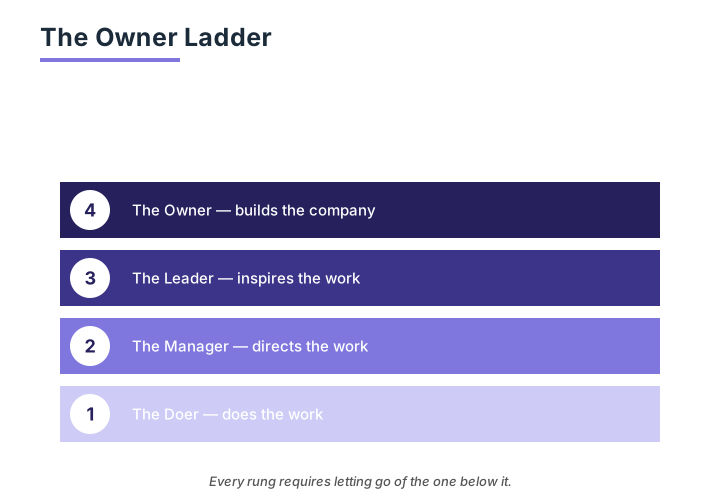
Every contractor climbs the same four rungs on the way from technician to owner. You don't skip rungs, and you don't stay on one forever — but you can absolutely get stuck, sometimes for years, if you don't know the ladder exists.

1

Rung 1 — The Doer.

You personally perform the work. This is where every contractor starts, and there's no shame in it — it's where the skill and the reputation get built in the first place.

2

Rung 2 — The Manager.

You stop doing every task yourself and start directing other people who do it. This is where Mike stood the Saturday his phone stayed face-down — uncomfortable, but functional.

3

Rung 3 — The Leader.

You stop directing every task and start developing people who can make good decisions without you — teaching judgment, not just steps. This is where a business stops needing an owner in the room to run a normal day.

4

Rung 4 — The Architect.

You stop managing people day to day and start designing the systems, culture, and strategy that let the whole business run and grow without your constant presence.

Here's the part that trips almost every contractor up: you don't graduate a rung and never return to it. Some days, especially early, you'll drop back down to Doer because a job genuinely needs it. The goal isn't to never touch a wrench again. The goal is that touching it becomes your choice, not your only option.

Your calendar reveals whether you're building a company or protecting a job. Look at last week. If it was full of Rung 1 and Rung 2 work — doing and directing — you're still standing where you've always stood. Growth happens when Rung 3 and Rung 4 work starts claiming real hours on purpose, not just whatever's left over after the fires get put out.

Real Contractor Example

Mike's Saturday experiment was Rung 2 — directing instead of doing. It worked, so he kept going. Within a month, he'd handed off supply runs to a part-time helper with a simple shopping list. Within three months, he'd trained his first hire to run routine estimates using the pricing sheet Sarah had shown him. Each handoff felt smaller than the last, and each one bought him back a few hours he hadn't had in over a year.

The real shift happened four months in, when that same employee called with a pricing question on a job Mike would normally have answered himself. Instead of giving the answer, Mike asked, "What would you price it at, and why?" The employee's answer wasn't exactly what Mike would have said — it was close enough, and reasoned well enough, that Mike approved it and said nothing more. That was Rung 3. Not doing the job. Not even directing it. Teaching someone else to think it through.

Sarah Chen had already lived this shift a year earlier, and when Mike called her frustrated that his new hire "wasn't doing it exactly like I would," she didn't lecture him. She just asked one question: "Was the customer happy, and did the job make money?" He admitted both were true. "Then it doesn't need to look like you," she said. "It just needs to work."

Progress beats perfection every time perfection means doing it all yourself forever.
Action Checklist

  • Look at last week's calendar and label each block of time Doer, Manager, Leader, or Architect.
  • Identify one decision you made this week that an employee could have made instead, with the right training.
  • The next time someone brings you a problem, ask what they think the answer is before you give yours.
  • Pick one Rung 3 habit to start this week — teaching the reasoning behind a decision, not just the decision itself.
  • Block one hour on next week's calendar for Rung 4 thinking — no calls, no jobs, just deciding what the business needs to become next.

Key Takeaways

Working harder never fixes a Technician Trap — it just proves the trap is real. Owner Thinking means trading hours spent solving problems for hours spent making decisions, building systems, coaching people, and thinking ahead. The Owner Ladder — Doer, Manager, Leader, Architect — gives you a map for a promotion nobody officially hands you: the one from technician to owner. Every problem you refuse to delegate becomes a permanent part of your job description. Progress up the ladder is rarely comfortable, and it's almost never optional if you want the business to outgrow you.

Reflection Questions

Looking honestly at last week's calendar, which rung did most of your time actually live on? What's one decision you're still making that someone else could learn to make instead? When an employee does something differently than you would have, do you correct it immediately, or ask them to explain their reasoning first? What would Rung 4 — designing the business instead of running it day to day — actually look like on your calendar a year from now?


Thinking like an owner tells you how to spend your time differently. It doesn't yet tell you what to actually build with it — the systems, structure, and setup that turn a business run out of a truck into one that can survive a bad week without you. Chapter 5 is where you lay that foundation.

Scroll to Top