
Chapter 3: The Technician Trap
Chapter 3

The Technician Trap

Fourteen months in, Mike Delgado was busier than he'd ever been in his life, and he told himself that was the whole point.

The Challenge

This is the quiet crisis almost every one-truck contractor eventually hits, and almost none of them see it coming, because it doesn't look like a crisis. It looks like success. Revenue is climbing. Customers are happy. The phone won't stop ringing. Everything about it feels like proof the business is working.

But there's a difference between a business that's growing and a business that's just asking one person to carry more weight. Mike wasn't building a company. He was building a heavier and heavier version of the exact same job he'd started with — the job of doing everything himself.
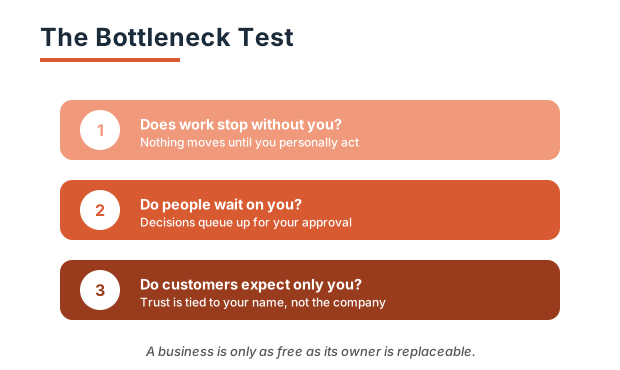
Why It Happens

Call it the Technician Trap: the belief that being the best hands on the crew means you should keep every task in your own hands, forever, as the business grows around you.

It's not stubbornness. It's pride wearing a work shirt. Every skilled tradesperson got here because they were good at the work — good enough that customers ask for them by name, good enough that quality became their identity. Letting go of a task doesn't feel like delegation. It feels like admitting the work might get done worse.

And here's the part nobody warns you about: for a while, they're right. The first employee who answers the phone will sound a little less polished than you. The first person who runs an estimate will price it a little differently than you would have. That short-term dip in quality feels like proof that no one else can do it — when it's actually just proof that no one else has done it yet.

Your company will only ever grow as large as your ability to let go of it.

Every hour you spend doing something someone else could learn to do is an hour you didn't spend doing something only you can do — deciding what the business becomes next. Owners who never make that trade don't run out of customers. They run out of themselves.

Common Mistakes

Mistaking speed for value.

You can answer the phone faster and price a job better than anyone you'd hire. That doesn't mean answering the phone is the best use of an owner's time — it means you've never separated being capable of a task from being the right person to keep doing it.

Treating every task as equally irreplaceable.

Some things only you can do right now — signing checks, making a final call on a tough customer situation. Most things only feel that way because you've never trained anyone to do them.

Waiting for "the right time" to start letting go.

There's no month where the business is calm enough to hand something off comfortably. The business gets busier, not calmer, and the longer you wait, the more expensive the eventual handoff becomes.

Confusing exhaustion with commitment.

Working sixteen-hour days feels like proof you're serious about the business. Often it's proof the business has no systems yet — and no system gets built by an owner too busy doing the work to design a better way to do it.

The Framework: The Bottleneck Test

The Bottleneck Test

Run this test on your own week, honestly, before you decide you're the only one who can do any of it.

1. List.

Write down every task you personally handled in the last seven days — every phone call, estimate, supply run, invoice, and customer conversation. Don't summarize. List it.

2. Label.

Next to each task, write one of three labels: Only Me (requires your specific judgment, license, or relationship), Learnable (someone could be trained to do this within a few months), or Habit (you're doing it because you always have, not because you should).

3. Let Go.

Pick the single Learnable task that eats the most hours in your week. Not the easiest one to hand off — the biggest one. That's the one actually worth your time to teach.

4. Leverage.

Redirect the hours you free up toward the one thing an owner is supposed to do that a technician never has time for: deciding what the business becomes next — who to hire, what to price, which customers to keep, which niche to double down on from the FIT Filter you ran in Chapter 2.

Most contractors discover something uncomfortable the first time they run this test: less than a quarter of their week actually belongs in the Only Me column. The rest is Learnable or Habit — tasks they're doing not because the business needs them to, but because letting go still feels like losing control.

Real Contractor Example

Mike ran the Bottleneck Test on a rough Tuesday, mostly to prove to his wife he'd tried. His list had thirty-one tasks on it. Four landed in Only Me. Eleven were Learnable. The other sixteen were Habit — things he'd been doing the exact same way since the day he bought his first truck, simply because no one had ever asked him to do them differently.

The biggest time sink was answering every incoming call personally, even during active jobs. He hired a part-time answering service for eight hours a week to start — not because he trusted them yet, but because he had to find out if the business would survive it. It did. Customers didn't notice a dip in quality. Mike noticed four extra hours a week, and he spent the first one sitting still, which felt more uncomfortable than any job he'd ever done with a wrench.

Sarah Chen hit her own version of the Technician Trap a year into Chen HVAC, but hers looked different — she wasn't drowning in phone calls, she was drowning in estimates, insisting she had to personally walk every job site before quoting a price. When she finally ran the Bottleneck Test, estimates were her biggest Learnable item. She spent three weekends training her most reliable technician to run routine estimates using a simple pricing sheet. Her close rate didn't drop. Her Saturdays came back.

Working harder was never the goal. It was the habit that felt like one.

Action Checklist

  • List every task you personally handled in the last seven days, without summarizing.
  • Label each one Only Me, Learnable, or Habit.
  • Circle the single Learnable task consuming the most hours in your week.
  • Identify one person — an employee, a part-time hire, even a paid service — who could take that task off your plate within thirty days.
  • Block one hour this week to actually train or hand off that task, not just think about it.
  • Notice what you do with the hour you get back. If you fill it with another task instead of a decision, you haven't actually let go yet.

Key Takeaways

The Technician Trap doesn't announce itself as a crisis — it shows up dressed as hard work and a growing business. Your company will only ever grow as large as your ability to let go of it, and every hour spent on a Learnable task is an hour not spent deciding what the business becomes next. The Bottleneck Test — List, Label, Let Go, Leverage — turns a vague feeling of being overwhelmed into a specific, actionable map of exactly what to hand off first. Most of what feels like Only Me work is actually Habit wearing a disguise.

Reflection Questions

When you ran your own list, how many tasks honestly landed in Only Me? What's the one task you know you should hand off, but haven't, and what's actually stopping you — trust, cost, or pride? What would you do with four extra hours a week if you had them back? Are you building a company, or a job with better titles and worse hours?


Recognizing you're the bottleneck is the easy part — you just did it. Knowing exactly who to hand the work to, and how to make sure they don't drop it, is a different skill entirely, and it's the one that decides whether letting go makes your business better or just makes it messier. Chapter 4 is where you learn how to hire and train the person who finally takes the first task off your plate for good.

Scroll to Top