Chapter 02: Choosing the Right Business to Build
Chapter 02

Choosing the Right Business to Build

Mike Delgado passed the Go/No-Go Test. Runway, saved. Proof, in hand. Motive, honest. Ownership, willing. Six months of cushion in the bank and four customers who'd already said yes.

The Challenge

Every new contractor faces a version of Mike's Monday-Tuesday-Saturday problem. You passed the test in Chapter 1 — you're ready to own a business. But readiness to own a business and clarity about which business are two different things, and almost nobody separates them either.

Most new owners think the goal is simply "get customers." Any customer. Every customer. Say yes to the work, worry about the strategy later. It feels like ambition. It's actually the fastest way to build a business with no shape, no specialty, and no ceiling worth reaching.

Why It Happens

Technician Thinking says: I can do this job, so I should take this job. Owner Thinking asks a harder question first: does this job build the kind of company I actually want to run in five years?

Every job you take becomes part of your company's Business DNA — and Business DNA doesn't just decide what work shows up on the schedule. It decides who you can hire, what you can charge, which customers trust you on sight, and how far the company can ever grow before it hits a wall. New construction, commercial service, and residential service aren't just different jobs. They're different businesses, with different cash cycles, different customers, different crews, and different ceilings on how big they can grow.

Say yes to all three, and you don't get three revenue streams. You get one exhausted business with no identity, chasing whatever rang the phone last, and a Growth Ceiling that shows up years sooner than it should — not because the market ran out of work, but because a company built to do everything for everyone can never get efficient enough at any one thing to grow past a certain size.

This isn't only a profit problem. It's a burnout problem, a hiring problem, and eventually a family problem — because a business with no clear identity can't teach a crew what it stands for, and it can't hand its owner a single night off.
Common Mistakes

Saying yes to every job type.

It feels like more opportunity. It's actually a slower path to mastery, because your crew, your pricing, and your systems never get to specialize in anything.

Choosing a niche based on what pays best this month.

Chasing this quarter's most profitable job type is a pricing decision, not a business decision — and pricing shifts every year while a business built on the wrong foundation stays wrong for a decade.

Ignoring your own energy, not just the market.

A niche can be profitable and still be wrong for you. A contractor who hates evening emergency calls will eventually resent a business built entirely around them, no matter how well it pays.

Confusing "I can" with "I should."

The market will hand you work you're capable of doing that has nothing to do with the business you're actually trying to build. Capability is not the same as fit.

The Framework: The FIT Filter

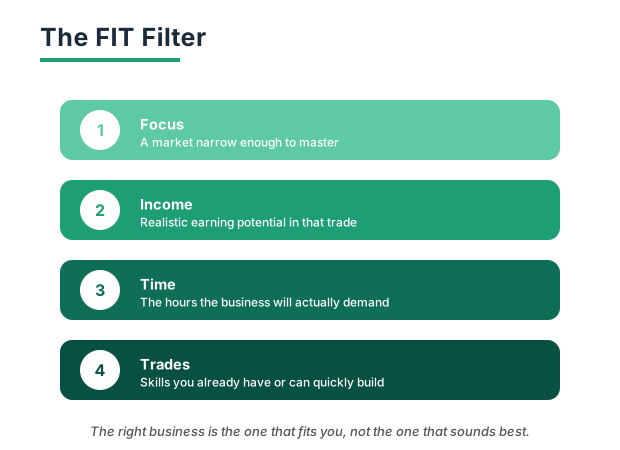
The FIT Filter

Before you decide what kind of contracting business you're building, run every option through four filters. This is the second gate in the Contractor Growth System — Chapter 1 asked if you should own a business at all. The FIT Filter asks which business deserves to be built.

F — Focus.

Can you say, in one sentence, exactly who you serve and what problem you solve for them? If it takes a paragraph, you don't have a business yet. You have a collection of jobs.

I — Income.

What's the honest five-year income ceiling of this niche, done well, at the size you actually want to reach? Not this year's best month.

T — Talent.

Does this niche build on the skill you already have, or does it force you to relearn your trade from a different angle every time the work changes? The strongest businesses compound existing skill. They don't restart it.

T — Territory.

Is there enough of this specific work, close enough to home, to support the crew you'll eventually need — not just enough to keep one truck busy?

Four questions. Ninety seconds to ask. A decision that shapes the next ten years.

A niche that scores well on all four has Customer Fit — the alignment between what you do best and what a specific customer actually needs that makes word-of-mouth, pricing power, and hiring get easier together, instead of fighting each other.

Score honestly. A niche that's strong on Income but weak on Focus and Talent will make you money for a while and exhaust you for longer. The businesses that eventually become Freedom Machines — companies that fund your life instead of consuming it — are almost always built on a niche that scored well across all four, not just the one that looked best on a spreadsheet.

Real Contractor Example

Mike finally ran all three options through the FIT Filter. New construction scored high on Income, low on Focus — one bidder among dozens with no specialty. Commercial scored high on Territory, low on Talent — most of his three years of experience was residential, and commercial work required a relationship-selling skill he'd never built. Residential service scored well across all four: clear Focus, solid Income at the size he wanted, direct use of his existing Talent, and enough Territory in his own town to support a real crew someday.

He picked residential service and said no to the new-construction bid he'd already half-written.

A few towns over, Sarah Chen was having the opposite experience. She'd started Chen HVAC doing a little of everything — new install, service calls, light commercial — because turning down any job felt like turning down income she couldn't afford to lose. Eighteen months in, she was profitable on paper and miserable in practice, juggling three customer types with three different expectations and no clear reputation in any of them. A conversation with a mentor, and her own version of the FIT Filter, showed her that Talent and Focus both pointed the same direction: residential service for growing families, the exact customer she was already best at serving without knowing it. Once she said no to the rest, her business got smaller for about four months — and then it got easier to grow than it had ever been.

A business that tries to serve everyone ends up serving no one particularly well.

Action Checklist

  • Write, in one sentence, exactly who you serve and what problem you solve for them.
  • List every job type you currently accept or are considering, and score each one against Focus, Income, Talent, and Territory.
  • Identify the one niche that scores strongest across all four — not just the highest-paying one.
  • Write down one job type you're currently saying yes to that doesn't fit, and set a date to stop accepting it.
  • Say the sentence from step one out loud to someone who knows your business. If they look confused, it isn't clear enough yet.

Key Takeaways

Readiness to own a business and clarity about which business are two separate decisions, and the second one shapes everything that comes after it. Every job you accept becomes part of your company's Business DNA — it decides who you can hire, what you can charge, and how far you can grow, long before it shows up on a P&L. The FIT Filter — Focus, Income, Talent, Territory — turns "I'll take any work" into a deliberate choice about the business you're actually building. Score well on all four, and you're not just choosing a niche. You're building toward a Freedom Machine instead of a second job with more paperwork.

Reflection Questions

If you had to describe your business in one sentence to a stranger, would it hold up? Which job type are you currently accepting that scores low on Focus, Talent, or Territory, no matter how well it pays? What would you have to say no to this month to move closer to the business you actually want in five years? Are you choosing your Business DNA on purpose — or is it choosing you by default?


The FIT Filter tells you what business deserves to be built. It doesn't tell you how to make that business real — the paperwork, the banking, the systems that quietly separate a company from a guy with a truck and a dream. Chapter 3 is where you build that foundation.

Scroll to Top