Chapter 42: Grow Through Acquisition Without Losing Your Culture
Chapter 42

Grow Through Acquisition Without Losing Your Culture

Nearly one hundred trucks now. Growth opportunities arrived almost weekly at this point some worth a conversation, most not. One afternoon, Mike took a call from the owner of a respected plumbing company that had served its community for thirty years.

The Challenge

Many acquisitions look successful on paper. Revenue increases. Truck counts grow. Market share expands. Yet within a few years, employees leave, customers disappear, culture deteriorates, and the value that was purchased slowly evaporates a pattern common enough that most contractor books don't even bother discussing it, since so few contractors ever grow large enough to face it.

The greatest risk in an acquisition isn't overpaying. It's losing the culture that made your own company successful in the first place. Growth should strengthen culture, not dilute it and the best acquisitions don't simply add businesses together. They multiply capabilities while preserving identity.

Why It Happens

Buying Revenue vs. Buying Capability. Poor acquisitions ask, "How much revenue does this add?" Great acquisitions ask a harder set of questions: What capabilities do they bring? What relationships do they strengthen? What leaders do they add? What values do they reinforce? Will both organizations genuinely become stronger together? Acquisitions should improve the institution, not simply increase its size the same distinction Chapter 40 drew between business and institution, now applied to growth strategy itself.

Culture determines whether acquisitions create value or destroy it. The spreadsheet can justify almost any deal. Only the people involved determine whether it actually works.

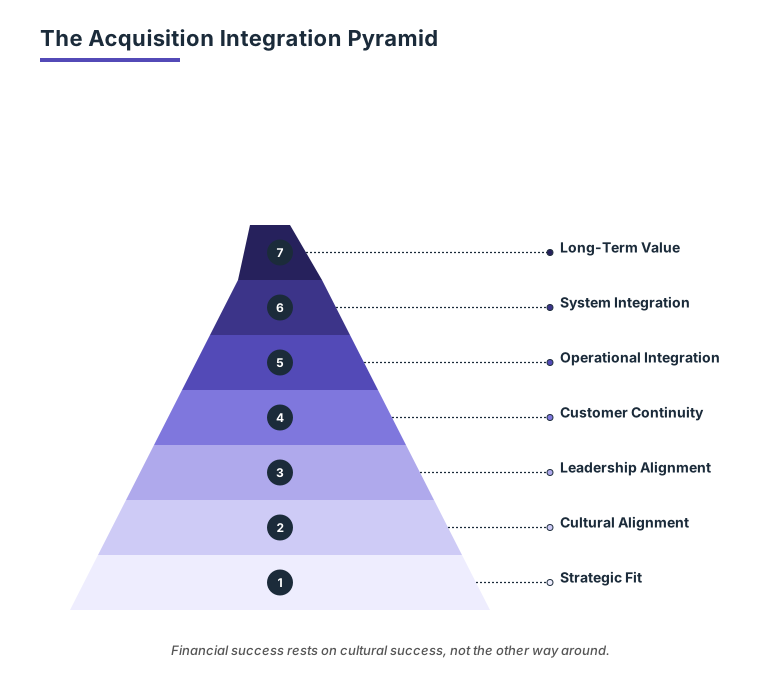
The Framework: The Acquisition Integration Pyramid

Acquisition Integration Pyramid

Financial success rests on cultural success, not the other way around.

Strategic Fit

the foundation, whether the acquisition genuinely makes sense for both organizations.

Cultural Alignment

the layer most acquisitions skip, and the one that determines almost everything above it.

Leadership Alignment

whether the acquired company's leaders share, or can grow into, the same standards.

Customer Continuity

protecting the relationships that took the acquired company decades to build.

Operational Integration

combining systems, gradually and deliberately.

System Integration

the technical work, important but never the starting point.

Long-Term Value

the outcome of everything below it, never something pursued directly through the deal terms alone.

Sarah's Story

Years earlier, Sarah watched two competitors acquire similar companies around the same time. The first immediately changed uniforms, systems, leadership, policies, and branding moving fast, confident that speed meant progress. Within a year, most of the experienced employees had resigned. Customers followed them out the door.

The second spent six months simply listening before changing anything. They preserved local traditions. Retained respected leaders. Introduced new systems gradually, once trust had actually been established. Five years later, customers still referred to the company by its original reputation only now with even greater confidence than before.

Sarah's mentor told her afterward, "People don't resist change. They resist losing what they value."

"I think about that every time we consider an acquisition," Sarah told Mike. "The company we're buying isn't just an asset. It's someone else's version of everything we've spent years building."

Common Mistakes

overload

Tracking too many metrics.

A dashboard with dozens of numbers gets ignored, exactly like the fifty-page report in Sarah's story below.

misdirection

Measuring activity instead of outcomes.

Activity feels productive to track. Outcomes actually reveal whether something's working.

silence

Reviewing reports without discussion.

A number nobody discusses might as well not exist the value comes from the conversation it produces, not the report itself.

myopia

Ignoring trends.

A single data point rarely tells the whole story; the trend across several weeks usually does.

late

Waiting for major problems before acting.

By the time a problem is undeniable, it's usually already cost more than an early correction would have.

guesswork

Managing by intuition.

Intuition matters, but at this scale, across multiple locations Mike can't personally visit every day, intuition alone can't reliably catch what a dashboard would surface immediately.

Real Contractor Comparison

Company A

moves fast rapid acquisition, immediate restructuring, new branding within weeks. Employee turnover spikes. Customers grow confused about who they're actually dealing with. Cultural conflict simmers beneath the surface. The synergies the deal promised never fully materialize.

Company B

selects acquisitions carefully, integrates deliberately, and retains the leaders customers and employees already trust. Communication stays open throughout. Existing relationships are respected rather than disrupted. Over time, the two organizations genuinely become one stronger culture, rather than one culture quietly overwriting the other.

Patient integration consistently outperforms rapid assimilation. Company B's advantage isn't a better deal price it's the discipline to treat the first year after closing as more important than the negotiation that preceded it.

The Cultural Due Diligence Checklist

Before every acquisition, evaluate: core values, leadership philosophy, customer reputation, employee engagement, safety culture, community relationships, and decision-making style. Cultural due diligence matters as much as financial due diligence a company can look flawless on the balance sheet and still be a poor cultural fit that erodes value within a year.

The 100-Day Integration Plan

Focus deliberately on: listening before changing anything. Meeting every employee personally. Retaining key leaders. Protecting existing customer relationships. Introducing new systems gradually, not all at once. Celebrating shared successes early, so the combined team has something to build on together. The first one hundred days shape the next ten years the exact standard the second company in Sarah's story understood, and the first one learned only in hindsight.

Practical Exercise

Select one potential acquisition and evaluate it using two separate scorecards. The Business Score: revenue, profitability, assets, market position. The Culture Score: leadership quality, employee trust, customer loyalty, community reputation, values alignment. Only pursue acquisitions that score well on both a strong Business Score with a weak Culture Score is exactly the deal that looks successful on paper and fails within a few years.

Warning Signs

bottleneck

Owner attending every meeting.

This is Mike's exact relapse, and the clearest sign that visibility hasn't yet replaced personal supervision.

frequency
high
drift

Branches operating differently.

This means shared systems and dashboards haven't yet unified how each location actually runs.

frequency
moderate
surprise

Late discovery of problems.

This means the Visibility Pyramid isn't functioning issues are surfacing at ground level instead of being caught earlier through weekly or monthly review.

frequency
high
mismatch

Conflicting reports.

This usually means metrics aren't standardized across locations, making comparison and trend-spotting unreliable.

frequency
moderate
clutter

Too many KPIs.

This means the dashboard has drifted back toward Sarah's old fifty-page report, overwhelming instead of clarifying.

frequency
moderate
dependency

Leaders waiting for inspections.

This means visibility hasn't actually replaced control leaders are still operating as though the owner's personal check is what matters most.

frequency
high

Action Checklist

  • Define clear acquisition criteria before opportunities arrive, not while evaluating one under pressure.
  • Conduct cultural due diligence with the same rigor as financial due diligence.
  • Create a written integration plan before the deal closes, not after.
  • Communicate transparently with employees and customers from day one.
  • Protect trusted relationships, especially respected local leaders.
  • Measure cultural integration alongside financial performance, not instead of it.

Key Takeaways

Many acquisitions look successful on paper while the value that was purchased quietly evaporates underneath. The greatest risk isn't overpaying it's losing the culture that made the acquiring company successful in the first place. The Acquisition Integration Pyramid and the Cultural Due Diligence Checklist ensure financial success rests on genuine cultural alignment. Revenue can be purchased. Trust must be earned, and the best acquisitions strengthen identity rather than replacing it.

Reflection Questions

Why are you actually acquiring this business, beyond the numbers? Will this acquisition strengthen or dilute your culture? What traditions in the acquired company deserve to be preserved rather than replaced? What capabilities are you truly buying, beyond the balance sheet? How will employees describe this acquisition five years from now?


Six months after the acquisition closed, Mike visited the newly integrated branch. The building still looked familiar. Many of the original employees were still there, doing the same work they'd always done, now with better systems and stronger support behind them. Customers still greeted technicians by name in the parking lot.

The retiring owner walked through the shop one final time, taking it in. He smiled at Mike.

"I was worried you were buying my company."

Mike looked puzzled.

"You protected what mattered," the owner said.

Sarah, standing nearby, said quietly, "That's the difference between ownership and stewardship."

As they left the branch, Mike realized they hadn't simply acquired another company. They'd expanded the institution without losing its soul and for the first time, he understood that growth through acquisition wasn't a shortcut at all. It was one of the truest tests of everything the company had spent decades becoming.

With acquisitions expanding the organization and leadership now extending across multiple markets, Mike begins thinking beyond operational excellence. The next challenge is ensuring the company's purpose survives future generations. Chapter 46 Build a Legacy That Outlives You is where that final question takes center stage. The greatest companies are remembered not for how large they became, but for how many lives they improved after their founders were gone.
Scroll to Top