Chapter 43: Build a Legacy That Outlives You
Chapter 43

Build a Legacy That Outlives You

Just past one hundred trucks now. Mike attended the retirement celebration of one of the company's very first employees someone who'd been with him since long before Sarah, before Jake, before most of the people in the room had even been hired.

The Challenge

Every business owner leaves something behind. The question is whether it's simply a company, or a legacy. Revenue eventually gets forgotten. Buildings are remodeled. Equipment is replaced. Even company names sometimes change. What endures are the people developed, the values preserved, the communities strengthened, and the standards established for future generations.

Legacy is not measured by what you built. It's measured by what continues growing after you're no longer there to lead it and that afternoon, driving home from a retirement party, Mike understood for the first time that his own legacy had already begun growing without him.

Why It Happens

Success vs. Legacy. Success asks, "What did we accomplish?" Legacy asks, "What continues because we were here?" Success measures achievement. Legacy measures influence. Enduring organizations focus on both but most owners spend their entire careers focused only on the first, never quite arriving at the second until, like Mike, they stumble into it almost by accident.

Great founders eventually become chapters in the organization's story, not the entire story. The highest achievement of leadership is creating a future that no longer depends on you the exact thing the retiring employee's story had just proven, without either of them planning it that way.

The Framework: The Legacy Pyramid

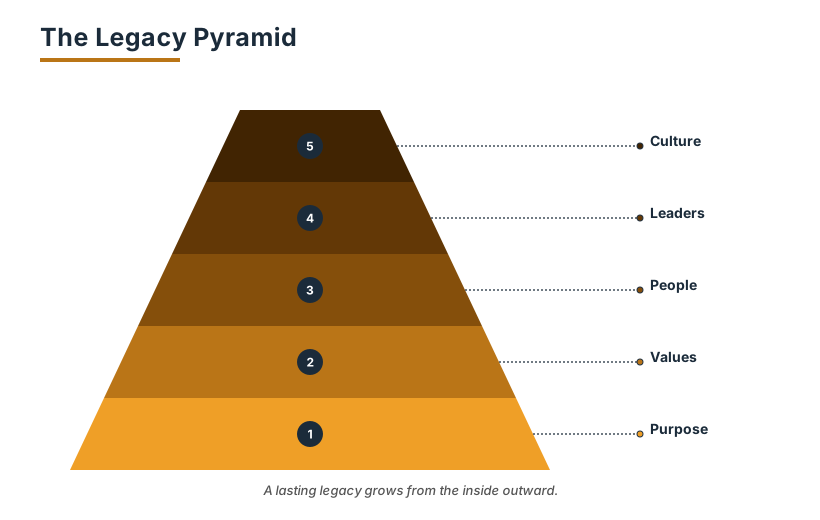
Legacy Pyramid

Legacy grows from the inside outward. Buildings don't create legacy. People do.

Purpose

sits at the base the reason the company exists, unchanged since Chapter 16 first named it.

Values

sit above purpose the principles protected across every chapter since Chapter 24.

People

sit above values the individuals who actually carry both forward, day after day.

Leaders

sit above people the continuity built deliberately in Chapter 42.

Culture

sits above leaders what those leaders create together, often without realizing they're creating it.

Institution

sits above culture the structure from Chapter 40, strong enough to outlast any single person within it.

Generational Impact

sits at the very top the outcome, exactly like the young technicians telling stories about a man they respected, none of it directed by Mike personally.

Sarah's Story

Years earlier, Sarah attended the funeral of her own mentor. Hundreds of former employees attended, many of whom hadn't worked for him in decades. Each told a different story. Not about profits. Not about awards. Not about growth.

They remembered the opportunity he'd given them. The confidence he'd built in them. The standards he'd refused to compromise, even when compromising would have been easier.

Sarah realized something standing in that room. The company had survived because its founder had already placed his values into thousands of people, one at a time, over decades. His greatest creation wasn't the business.

"It was the leaders who carried it forward," she told Mike. "That funeral taught me more about legacy than anything else ever has."

Common Mistakes

high risk

Rewarding firefighters instead of fire prevention.

Praising the rescue, every time, quietly teaches the organization that heroics are the goal rather than the warning sign.

caution

Keeping knowledge inside people's heads.

The same vulnerability from Chapter 31's Dependency Audit, still showing up here as recurring operational fragility.

inconsistency

Allowing each branch to invent different processes.

Inconsistency at this scale multiplies the communication and quality problems Chapters 21 and 24 first named.

gap

Skipping documentation.

A process that only exists as tribal knowledge can't actually improve it can only be repeated, imperfectly, by whoever happens to remember it best.

recurring

Accepting recurring mistakes as "part of business."

This resignation is exactly what keeps a company stuck at the People Solve Problems stage indefinitely.

opportunity

Not celebrating prevention.

When prevention goes unnoticed, the organization learns that only visible heroics matter the quiet work of building better systems gets undervalued.

Real Contractor Comparison

Company A

is founder-centered, its success dependent almost entirely on one personality. Retirement creates real uncertainty. Culture weakens gradually once that personality steps back. Employees remember the owner fondly, but struggle to articulate what the company actually stands for beyond him.

Company B

is purpose-centered. Leadership development never stops. Values remain consistent regardless of who's currently leading. New generations of employees embrace the culture as their own, not as something imposed from above. Employees remember what the company stands for which, unlike a person, doesn't retire.

Institutions ultimately outlive individuals. Company B's advantage isn't a founder with a longer career it's a purpose strong enough that the founder's eventual absence barely changes anything at all.

The Legacy Filter

Before every major decision, ask six questions distinct from the daily and institutional filters built in Chapters 35 and 40: Will this strengthen our purpose? Will future leaders thank us for this decision? Does it improve the organization beyond today's results? Will this still matter ten years from now? Does it reinforce our values? Are we building something worth inheriting? Legacy begins the day you stop building only for yourself this filter exists to make that shift deliberate rather than accidental.

The Generational Impact Score

Evaluate annually: leadership continuity, employee development, community impact, customer trust, cultural consistency, innovation continuity, and long-term sustainability. Legacy should be measured intentionally rather than assumed the same discipline Mike had already learned to apply to financial resilience, now applied to something far less tangible but no less real.

Practical Exercise

Write your company's Legacy Statement. Complete these sentences honestly: We want to be remembered for... Future employees should say... Future customers should believe... Future leaders should continue... Our greatest contribution will be... Review this statement annually, and let it quietly shape the decisions that don't show up on any quarterly report.

Warning Signs

cycle

The same problems keep returning.

This is the clearest sign the organization is still stuck solving symptoms instead of causes.

burnout

Top performers constantly rescue projects.

This means the company's best people are compensating for systems that should be doing that work instead.

variance

Customers receive different experiences.

This is Chapter 24's culture warning resurfacing here as an operational consistency problem.

improvisation

Managers reinvent processes.

This means SOPs either don't exist or aren't being followed, leaving each leader to improvise their own version.

tribal

Training depends on verbal explanations.

This means the System Loop from Chapter 13 never fully matured into real documentation.

ceiling

Growth creates more chaos instead of more consistency.

This is the clearest possible sign that systems, not people, are the actual constraint on further scaling.

Action Checklist

  • Define your enduring purpose in language that will still make sense to people not yet born.
  • Document your organizational values clearly enough that they can be taught, not just felt.
  • Teach company history deliberately, the way the young supervisor was already doing without being asked.
  • Celebrate legacy-building behaviors as visibly as growth and revenue.
  • Mentor future leaders continuously, not only when a role happens to be open.
  • Make at least one decision each year that benefits the next generation more than the current one.

Key Takeaways

Every business owner leaves something behind the question is whether it's simply a company or a genuine legacy. Success asks what was accomplished; legacy asks what continues because you were here. The Legacy Pyramid grows from purpose outward through values, people, and leaders, all the way to generational impact and buildings don't create that impact. People do. Leadership is temporary. Influence can be permanent, and the greatest leaders become unnecessary without ever becoming forgotten.

Reflection Questions

What will your company actually be remembered for, once the current generation has moved on? What lessons will your employees pass down to people you've never even met? What traditions deserve to survive another generation, unchanged? If your name disappeared from the building tomorrow, would your values remain exactly as strong? What legacy are you building today, in decisions nobody will trace back to you?


Not long after, Mike visited the company's original one-truck garage, preserved now as part of the training center. A group of apprentices walked through it, listening to a young supervisor explain the company's history the used van, the first customer's card, the slow years before anyone would have called it a company at all.

None of them recognized Mike, standing quietly near the back.

As they filed out, one apprentice said to another, "I hope someday I can build something like this."

Mike turned to Sarah. "They don't even know who I am."

Sarah smiled warmly. "They know something far more important."

"What's that?" Mike asked.

She looked back toward the training center, where the group was already moving on to the next stop on their tour. "They know what your company stands for."

Mike stood there for a long moment, watching another generation begin its own journey through the same building where his had started. He realized, finally, that his greatest accomplishment was never reaching one hundred trucks. It was building something that no longer needed him to keep growing.

As Mike reflects on the journey from one truck to one hundred, he realizes that every lesson from answering the first phone call to leading a lasting institution forms one complete system. The final chapter is not about adding another principle. It is about bringing every principle together. Chapter 47 The Contractor Growth System™ is where the entire journey finally becomes one. The goal was never one hundred trucks. The goal was becoming the kind of leader who could build something that lasts.
Scroll to Top