Chapter 42: Becoming the Contractor Every Community Trusts
Chapter 41

Becoming the Contractor Every Community Trusts

Nearly ninety trucks now. A major storm tore through the region overnight, damaging hundreds of homes across every market the company served. By morning, the phones hadn't stopped ringing.

The Challenge

Customers buy because of today's need. Communities recommend companies because of years of consistent behavior. The strongest contracting companies eventually become something larger than service providers they become trusted institutions within the communities they serve.

When disasters strike, when schools need sponsors, when families need help, when a neighbor asks, "Who should I call?" the answer isn't determined by advertising. It's determined by trust that's been earned, deliberately, over many years. Great companies don't simply build homes, repair systems, or install equipment. They build confidence, and that confidence compounds exactly like reputation does every customer interaction either strengthens it or quietly weakens it.
Why It Happens

Reputation vs. Trust. Reputation is what people say about you. Trust is what people believe about you. Reputation attracts customers. Trust keeps families recommending you for generations. Reputation can be shaped by marketing. Trust has to be earned, repeatedly, through behavior nobody's watching closely enough to reward in the moment.

Trust compounds faster than advertising. The storm was exactly the kind of moment where that compounding either accelerates sharply or reverses and most companies, under pressure, default to the version of themselves that erodes it.

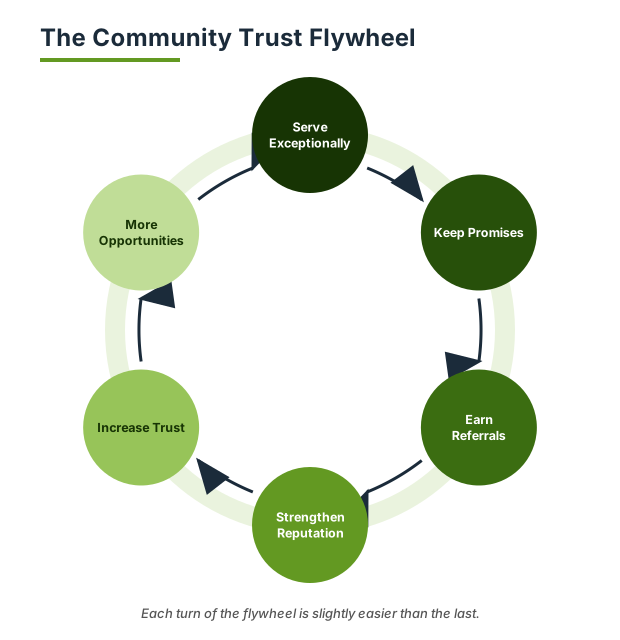
The Framework: The Community Trust Flywheel

Community Trust Flywheel

Trust compounds over years through consistent action, not campaigns.

Serve Exceptionally

the baseline, the same standard from Chapter 10's original Trust Builders, still the foundation decades later.

Keep Promises

especially, and most visibly, when keeping them is inconvenient.

Earn Referrals

the natural result of the first two, never the direct target.

Strengthen Reputation

what people begin saying, unprompted, because the referrals accumulate.

Increase Trust

what people begin believing, which runs deeper and lasts longer than reputation alone.

Receive More Opportunities

the practical return on years of the cycle running honestly.

Serve Exceptionally Again

the flywheel repeating, each turn slightly easier than the last because trust is already there to build on.

Reputation vs. Trust

Reputation attracts a first call. Trust is why the second, third, and tenth call happen without a moment's hesitation and why that trust gets handed down, as it eventually would for Mike, from one generation of a family to the next.

Sarah's Story

Years earlier, Sarah watched two contractors respond after a tornado tore through a nearby town. One focused entirely on maximizing short-term revenue, working the most profitable jobs first and leaving the rest for later.

The other quietly repaired several homes belonging to elderly residents who couldn't afford immediate work. Nobody asked them to. Nobody documented it for marketing. They just did it.

Years later, the second company had become the most respected contractor in the entire region.

Sarah's mentor told her afterward, "Communities never forget who stood beside them when they needed help."

"I think about that every storm season," Sarah told Mike. "The work you do when nobody's watching becomes the reputation everyone eventually hears about."

Common Mistakes

high risk

Rewarding firefighters instead of fire prevention.

Praising the rescue, every time, quietly teaches the organization that heroics are the goal rather than the warning sign.

caution

Keeping knowledge inside people's heads.

The same vulnerability from Chapter 31's Dependency Audit, still showing up here as recurring operational fragility.

inconsistency

Allowing each branch to invent different processes.

Inconsistency at this scale multiplies the communication and quality problems Chapters 21 and 24 first named.

gap

Skipping documentation.

A process that only exists as tribal knowledge can't actually improve it can only be repeated, imperfectly, by whoever happens to remember it best.

recurring

Accepting recurring mistakes as "part of business."

This resignation is exactly what keeps a company stuck at the People Solve Problems stage indefinitely.

opportunity

Not celebrating prevention.

When prevention goes unnoticed, the organization learns that only visible heroics matter the quiet work of building better systems gets undervalued.

Real Contractor Comparison

Company A

relies on strong advertising and aggressive promotions, thinking mostly in short-term cycles. Customer turnover stays high. Referrals stay rare. Community involvement is minimal, treated as optional rather than central to the business.

Company B

delivers consistent service at fair, honest pricing, communicates openly, and participates actively in its community not as a marketing strategy, but as simply how the company behaves. Referral rates run high. Customer relationships span multiple generations of the same family.

Trusted companies become increasingly difficult to compete against. Company B's advantage isn't a bigger advertising budget it's years of behavior that a competitor can't replicate quickly, no matter how much they're willing to spend trying.

The Trust Pyramid

Trust is built layer by layer, over many years.

Integrity

sits at the base doing the right thing even when it costs something, exactly as Mike did with emergency pricing.

Reliability

sits above integrity consistently following through, job after job.

Consistency

sits above reliability the same standard, delivered the same way, regardless of circumstance.

Competence

sits above consistency genuine skill, without which the layers below eventually mean less.

Transparency

sits above competence honest communication, especially when the news isn't good.

Community Commitment

sits above transparency genuine investment in the place the company operates, not just the customers within it.

Legacy

sits at the very top the outcome of everything below it, exactly as the newspaper story quietly proved.

The Community Impact Score

Evaluate annually: referral percentage, repeat customers, customer lifetime value, community partnerships, employee volunteer participation, local reputation, and customer advocacy. Community trust can be intentionally measured and strengthened it doesn't have to remain the vague, unmeasured feeling most companies assume it is.

Practical Exercise

Conduct a "Trust Audit." Ask honestly: why do customers recommend us? Why do some customers never return? Where have we broken promises, even small ones? How do our employees represent us out in the community, off the clock? If our advertising disappeared tomorrow, would referrals alone sustain our growth? Build an annual Community Trust Plan from the honest answers.

Warning Signs

cycle

The same problems keep returning.

This is the clearest sign the organization is still stuck solving symptoms instead of causes.

burnout

Top performers constantly rescue projects.

This means the company's best people are compensating for systems that should be doing that work instead.

variance

Customers receive different experiences.

This is Chapter 24's culture warning resurfacing here as an operational consistency problem.

improvisation

Managers reinvent processes.

This means SOPs either don't exist or aren't being followed, leaving each leader to improvise their own version.

tribal

Training depends on verbal explanations.

This means the System Loop from Chapter 13 never fully matured into real documentation.

ceiling

Growth creates more chaos instead of more consistency.

This is the clearest possible sign that systems, not people, are the actual constraint on further scaling.

Action Checklist

  • Measure referral rates consistently, not just occasionally.
  • Participate genuinely in community events, not as a marketing exercise.
  • Protect pricing integrity especially during emergencies, when it matters most.
  • Encourage and support employee volunteerism.
  • Celebrate trust-building behaviors as visibly as you celebrate sales numbers.
  • Review customer promises quarterly, and honestly assess whether they're being kept.

Key Takeaways

Customers buy because of today's need. Communities recommend companies because of years of consistent behavior. Reputation is what people say; trust is what people believe, and only trust keeps families recommending a company for generations. The Community Trust Flywheel and Trust Pyramid turn character into a measurable, compounding business asset. Marketing earns attention. Integrity earns generations.

Reflection Questions

Why do your customers truly trust your company, beyond simple satisfaction? Would your community notice if your business disappeared tomorrow? What promises actually define your reputation, whether or not you've named them out loud? How will people describe your company twenty years from now? What legacy of trust are you building today, in decisions nobody's currently watching?


Months after the storm, Mike attended a community event, more out of habit than obligation at this point. An elderly homeowner approached and introduced him to her grandchildren.

"When our house flooded," she told them, "his people treated us like family."

Mike smiled, not quite sure what to say.

She continued. "That's why my daughter called you last month." She looked at her grandchildren. "And someday they'll call you too."

As they walked away, Sarah said quietly, "That wasn't a customer."

Mike nodded. "No."

"That was a legacy."

For the first time, Mike understood that the company was no longer measured only by jobs completed or revenue earned. It had become woven into the actual life of the community it served not something the company had marketed its way into, but something it had simply, patiently earned.

As the company's reputation continues to grow, opportunities begin arriving from outside its traditional markets some partnerships, some acquisitions, some entirely new territory. Mike realizes that growth through acquisition requires a very different kind of leadership than growth through hiring. Chapter 45 Grow Through Acquisition Without Losing Your Culture is where that next challenge begins. Buying companies is easy. Preserving what made your own company great is the difficult part.

Scroll to Top