Chapter 22: What Gets Measured Gets Improved
Chapter 22

What Gets Measured Gets Improved

Communication had gotten better. Leaders were developing. Customers, by most accounts, were happy. So Mike walked into Monday's leadership meeting expecting an easy answer to an easy question.

The Challenge

"How are we doing?" He got five different answers from four people.

"We're slammed," said one crew leader. "We've had a great month," said another. "Callbacks seem lower," offered the office coordinator. "I think revenue is up," Jake added. "I haven't heard many complaints," said the newest supervisor.

Sarah, sitting quietly at the end of the table, asked the only question that mattered. "So which one of those is true?"

Nobody answered. Not because they were hiding anything — because nobody actually knew. Every person in the room had a genuine impression of how the business was doing, and not one of those impressions was backed by an actual number.

The scoreboard doesn't create performance. It reveals it. And right now, Mike's business had no scoreboard at all — just five confident opinions, all slightly different, all treated as equally true.

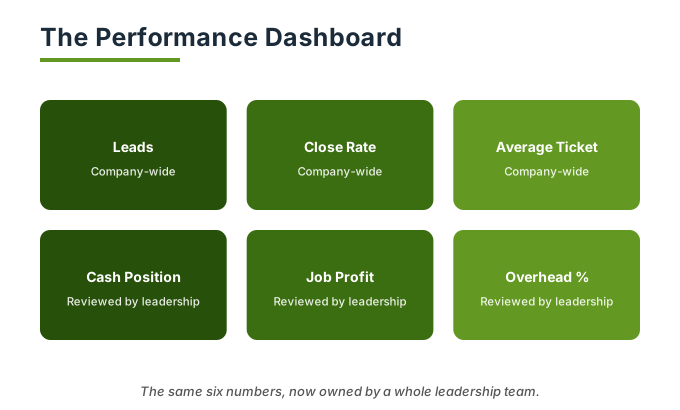
Back at one truck, Chapter 6 gave Mike his first dashboard — six simple numbers taped inside his glovebox. That worked fine when there was one truck. At four trucks, with a leadership team making decisions Mike never even sees, personal memory and gut feeling stop being a reliable instrument entirely.
Why It Happens

Without data, every problem becomes an opinion. With data, problems become visible. Mike's leadership team wasn't lying to each other — they were each reporting their own honest, limited slice of the business, with no shared numbers underneath any of it to settle the disagreement.

Great leaders don't measure because they distrust their team. They measure because they want to improve the system. Measurement was never about catching anyone doing something wrong. It's about replacing five competing impressions with one shared, honest picture everyone can actually work from.

The Framework: The Performance Dashboard

Performance Dashboard

This isn't a replacement for the six-number dashboard — it's what that dashboard grows into once a business has multiple trucks and a real leadership team.

  • Measure outcomes
  • Review together
  • Understand the meaning
  • Improve with action
  • Repeat next week
Numbers alone don't improve businesses. People using numbers wisely do. A scoreboard nobody discusses is just decoration. The value comes from the conversation it forces.

Data vs. Drama

Without shared numbers, every disagreement in a leadership meeting becomes a matter of opinion, and opinions are impossible to actually resolve — everyone's impression feels equally valid.

With shared numbers, the conversation changes shape entirely. Instead of arguing about whose impression is correct, the team can look at the same figure together and ask what it means and what to do about it. Leaders should discuss facts before discussing solutions — skip straight to solving a problem nobody's actually confirmed exists, and you risk fixing something that was never really broken.

Common Measurement Mistakes

Tracking too many numbers.

A dashboard with thirty metrics gets ignored within a month. A dashboard with five or six gets used every week.

Measuring only revenue.

Revenue alone hides exactly the kind of problem Sarah's story reveals — a business that looks healthier while quietly becoming weaker underneath.

Using reports nobody reads.

A report that exists but never gets discussed provides the illusion of measurement without any of its actual benefit.

Measuring people instead of processes.

A scoreboard aimed at blaming individuals creates fear and hidden problems. A scoreboard aimed at understanding the system creates honest improvement.

Looking only after problems occur.

Reviewing numbers only in a crisis means you're always reacting to damage that's already been done.

Never reviewing trends.

A single week's number means little on its own. The trend across several weeks is where the real signal lives.

Using numbers to punish employees.

The fastest way to make a scoreboard useless is to turn it into a weapon — people will quietly start managing the number instead of managing the actual problem it represents.

Sarah's Story

Sarah told Mike about a month she'd once genuinely celebrated — revenue was up, the schedule was full, spirits were high across the whole team. It felt, by every conversation happening around the shop, like one of her best months ever.

When she actually reviewed the real numbers afterward, the picture told a different story entirely. Revenue had gone up, yes. Profit had actually fallen. Callbacks had roughly doubled. Her technicians were working noticeably longer hours to produce those same results. The business looked healthier from the outside and was quietly becoming weaker underneath.

"That was the month I stopped trusting how things felt," she told Mike. "Feelings don't scale. Facts do."

Real Contractor Comparison

Company A

Runs almost entirely on instinct. Weekly meetings revolve around opinions and impressions. Problems appear unexpectedly, because nobody was tracking the trend that would have predicted them. Leaders disagree, often sincerely, because there's no shared fact underneath the disagreement. Growth becomes unpredictable, driven by whichever crisis happens to be loudest that week.

Company B

Uses simple, shared scoreboards. Everyone on the leadership team looks at the same numbers, at the same time, every week. Conversations become objective, moving quickly from "what happened" to "what should we do about it." Improvements happen faster, because problems get caught in the data long before they become customer complaints. Growth becomes intentional, guided by what the numbers actually show.

Visibility creates better decisions — not because numbers are magic, but because a team looking at the same reality can actually agree on what to do about it.

The Five Company Scoreboards

At this stage of growth, five categories cover almost everything a leadership team needs visibility into.

Customer

reviews, callbacks, satisfaction

Operations

jobs completed, on-time arrival, efficiency

Financial

revenue, gross margin, cash collected

People

training, retention, safety

Growth

lead conversion, referral rate, repeat

You don't need hundreds of KPIs. You need one or two clear numbers per category — enough to reveal the business's actual health without burying anyone in reports nobody has time to read.

Practical Exercise

Choose one metric for each of the five categories. Write them on a whiteboard somewhere your leadership team sees every week. Review them together every Monday, and ask three questions each time: What improved? What declined? What should we change? The conversation, not the whiteboard itself, is where the actual value lives.

Warning Signs

If you recognize any of these patterns, your scoreboard culture needs attention.

Nobody knows the company's numbers.

Decisions are being made on impression rather than fact, exactly like Mike's Monday morning.

Leaders argue using opinions.

There's no shared data to settle the disagreement with anything more solid than confidence.

Problems surprise everyone.

Trends were building for weeks without anyone tracking them.

Reports are ignored.

Measurement exists on paper but isn't actually driving any real conversation or decision.

Meetings end without decisions.

Numbers were reviewed, if at all, without ever being connected to a specific next action.

The same issues repeat month after month.

The Performance Dashboard's Improve step is missing — problems are being noticed, but never actually acted on.

Don't wait for a crisis. The warning signs above are early indicators that your measurement system isn't delivering its full value. Address them now, before they become embedded habits.

Action Checklist

  • Choose five core metrics, one per category: Customer, Operations, Financial, People, Growth.
  • Review them together, as a leadership team, every week.
  • Share the numbers openly rather than keeping them to yourself.
  • Celebrate genuine improvement when the numbers show it.
  • Investigate declines immediately, treating them as information rather than blame.
  • Eliminate any report that isn't actually driving a conversation or a decision.

Key Takeaways

Growing companies cannot rely on memory, assumptions, or intuition — as complexity increases, leaders need actual shared visibility, not just individual impressions. The Performance Dashboard — Measure, Review, Understand, Improve, Repeat — turns raw numbers into real conversations and real decisions. What gets measured gets improved, not because the number itself does the work, but because a team that shares the same facts can finally agree on what to do next. The purpose of numbers is improvement, not judgment.

Reflection Questions

What numbers actually predict your company's success, and do you track them? Which reports currently waste your time without driving any real decision? What do you wish you knew, with certainty, every Monday morning? If your scoreboards disappeared tomorrow, which decisions would immediately become guesses again?


Several months later, the leadership meeting felt entirely different. Nobody argued from opinion anymore. Everyone looked at the same shared scoreboards, and the conversation moved quickly from "what happened" to "what should we improve."

"It finally feels like we're managing the business instead of reacting to it," Mike said.

"Exactly," Sarah said. She pointed to one number on the board. "Now let's make sure the business can survive when something actually goes wrong."

"You mean another slow season?" Mike asked.

Sarah smiled. "No. I'm talking about something much bigger."

Chapter 23 is where you find out exactly what she means.

Scroll to Top