Chapter 23: Build a Business That Can Survive the Unexpected
Chapter 23

Build a Business That Can Survive the Unexpected

Four trucks, a productive leadership team, real communication, real visibility. Mike had started to feel, for the first time in years, like he'd actually gotten ahead of the business instead of constantly chasing it.

The Challenge

Every contractor eventually faces a version of Mike's Tuesday — a setback that has nothing to do with skill, effort, or decision-making, and everything to do with the simple fact that businesses exist inside a world that doesn't ask permission before changing. The question was never whether adversity would eventually arrive. It was whether the business was actually prepared for it when it did.

Mike's leadership meetings, scoreboards, and communication systems had made the company genuinely healthy. None of that automatically made it resilient — those are related qualities, but they're not the same thing.
Why It Happens

Some businesses survive because they get lucky. Great businesses survive because they prepare. Preparation for a crisis that hasn't happened yet almost always feels unnecessary, right up until the day it becomes priceless. Nobody builds a cash reserve, diversifies their customer base, or cross-trains a second person on a critical task because it feels urgent. They do it because they understand that growth and stability are two different achievements, and a business can have plenty of one while quietly lacking the other.

Mike had grown his revenue steadily. He hadn't diversified his customer base at the same pace, which meant one customer's decision, entirely outside his control, could take a fifth of his business with it overnight.

The Framework: The Resilience Pyramid

bbok

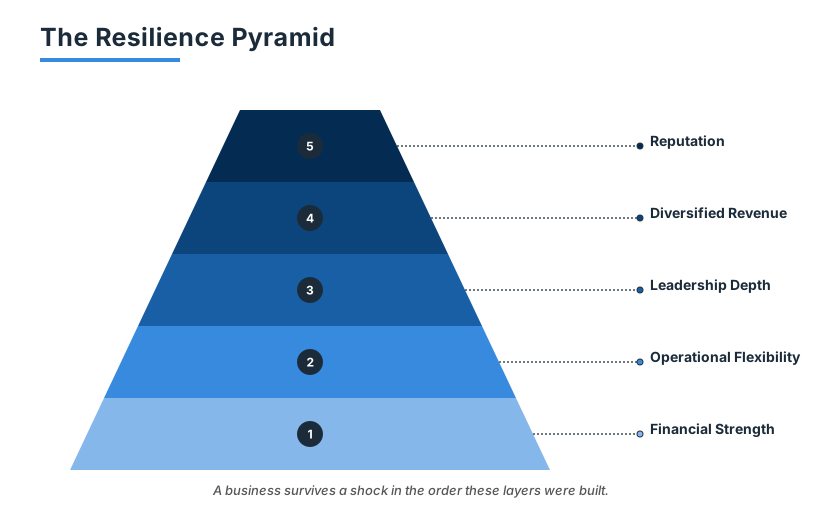
Resilience is built long before adversity shows up, in five layers.

Financial Strength

— the base of the pyramid. Real cash reserves, sound pricing, and healthy margins that give the business room to absorb a shock without panicking.

Operational Flexibility

— the ability to adjust quickly when circumstances change, without the whole business grinding to a halt.

Leadership Depth

— enough capable decision-makers, built through the work of Chapter 20, that the business doesn't depend entirely on one person to respond to a crisis.

Customer Diversity

— no single customer or contract representing so much revenue that losing them threatens the company's survival.

Continuous Adaptation

— the habits from Chapter 18's Improvement Cycle, applied specifically to risk: constantly noticing and addressing vulnerabilities before they become emergencies.

Mike's business, tested against this pyramid, was strong on the first three layers and dangerously thin on the fourth. The fifth layer — continuous adaptation — was the one that would determine how quickly he actually recovered.

Prepared vs. Lucky

The uncomfortable truth is that many businesses survive their first serious setback purely by luck — the timing happened to work out, a new customer happened to appear, the cash happened to be there. Luck isn't a strategy, and it isn't something you can depend on the second, third, or tenth time adversity arrives.

Hope is not a business strategy. A business built on the assumption that nothing serious will ever go wrong is a business that hasn't yet been tested. Mike's Tuesday was his test, and the parts of his business that were genuinely prepared — his leadership team, his cash position, his scoreboards — were the parts that kept the company from spiraling into real panic.

Common Resilience Mistakes

Depending on one customer.

A single relationship representing too much of your revenue means someone else's decision, entirely outside your control, can threaten your entire business.

Living month to month.

No cash cushion means any disruption immediately becomes a crisis instead of a manageable setback.

No emergency cash reserves.

The Cash Available number from Chapter 6's dashboard exists precisely to prevent this — a business that's never built a reserve has no room to absorb a shock.

Owner is the only decision maker.

Chapter 19 and Chapter 20 exist to solve exactly this vulnerability — a business that stalls the moment the owner is unavailable is a business with no real resilience at all.

No succession plan.

Without a clear picture of who steps up if a key leader is suddenly unavailable, the business has a single point of failure hiding in plain sight.

No documented processes.

Knowledge that exists only in people's heads disappears the moment those people aren't available — exactly the fragility Chapter 13's System Loop was built to prevent.

Ignoring warning signs.

Small, early signals of risk — a customer's ownership rumored to be changing, a slow payment pattern emerging — often get dismissed until they become undeniable.

Growing faster than cash flow.

Rapid growth without the cash discipline from Chapter 7's Journey of a Dollar creates a business that looks successful and is quietly vulnerable underneath.

Sarah's Story

Sarah told Mike about losing nearly a third of her own business years earlier, during a broader economic downturn that had nothing to do with her company's quality or reputation. For several weeks, she genuinely believed the business might not survive it.

Instead of panicking, she focused on exactly four things: protecting whatever cash she had left, keeping her best employees even when it meant difficult conversations about hours, doubling down on customer service when it would have been easier to cut corners, and strengthening the relationships she still had rather than chasing every lead indiscriminately.

"The business came back stronger than it had ever been," she told Mike. "Looking back, that crisis forced me to build a genuinely healthier company than the one that existed before it — leaner, more diversified, more disciplined about cash. I wouldn't have chosen to go through it. I also wouldn't undo what it taught me."

Real Contractor Comparison

Company A

depends on one major customer, carries little to no cash reserve, has no documented systems, and routes every decision through the owner personally. An unexpected setback — a lost contract, an owner's sudden absence, a slow season — creates genuine panic, because nothing in the business was built to absorb it.

Company B

has diversified its customer base deliberately, maintains a real cash reserve, cross-trains employees on critical tasks, and has leaders capable of making decisions without the owner in the room. Systems keep operating even under stress. An unexpected setback becomes a manageable problem instead of an existential threat, because resilience was built in long before it was ever tested.

Companies don't fail because problems appear. They fail because they weren't prepared when the problem inevitably showed up.
⏤ 01 ⏤

The Five Resilience Habits

Invisible in calm weather — indispensable in the storm. These are the practices that separate businesses that survive from those that merely exist.

01

Protect cash.

Build and maintain a real reserve, treating it as non-negotiable rather than optional.

02

Diversify customers.

Actively work to prevent any single customer from representing too large a share of total revenue.

03

Cross-train employees.

Make sure critical knowledge and skills exist in more than one person at all times.

04

Document critical systems.

Extend the System Loop from Chapter 13 to cover not just routine tasks, but the processes that would matter most in a crisis.

05

Review risks quarterly.

Set aside deliberate time to ask what could go wrong, before anything actually does.

Resilience is invisible — until it's needed. None of these five habits produce a visible, immediate reward. They produce something better: a business that doesn't panic when reality inevitably arrives.

Practical Exercise

Ask yourself three direct questions. If revenue dropped by 20% tomorrow, what would you actually do? If you were personally unable to work for a full month, what would happen to the business? If your largest customer disappeared entirely, would the company survive intact? Identify your single biggest vulnerability from those three questions, and develop one concrete action this month to reduce it.

Risk Assessment

Warning Signs

Six indicators that your business may be more fragile than it appears

01

One customer represents too much revenue.

This is the exact vulnerability that hit Mike, and it's often invisible until the moment it's suddenly very visible.

02

Payroll depends on next week's deposits.

This means there's no real cash cushion standing between the business and a genuine crisis.

03

Nobody can replace key employees.

This means a single person's absence could halt entire parts of the business.

04

Processes exist only in people's heads.

This means knowledge is one resignation or one bad week away from simply disappearing.

05

Cash flow is always tight.

This means there's no room to absorb even a small disruption without immediate strain.

06

Every emergency becomes a crisis.

This usually means resilience habits were never built before they were needed.

Any one of these is a concern. Three or more? That's a systemic risk.

Action Checklist

  • Review what percentage of your revenue comes from your single largest customer.
  • Build or strengthen a genuine emergency cash reserve.
  • Cross-train at least one additional person on every critical task in your business.
  • Document the systems that would matter most if something went wrong.
  • Create a simple contingency plan for your biggest identified vulnerability.
  • Schedule a quarterly review specifically dedicated to identifying business risks.

Key Takeaways

Strong companies are defined not by how they perform during easy times, but by how they respond when life doesn't go according to plan. The Resilience Pyramid — Financial Strength, Operational Flexibility, Leadership Depth, Customer Diversity, Continuous Adaptation — is built deliberately, layer by layer, long before any crisis arrives. Preparation turns panic into decisions. The goal was never to avoid every storm. It's to build a business that can survive them, recover from them, and sometimes even come back stronger because of them.

Reflection Questions

What could unexpectedly hurt your business tomorrow, with no warning at all? How prepared are you, honestly, for that possibility today? Which risks have you been quietly ignoring because they haven't caused a problem yet? If a real setback hit your company tomorrow, would it recover — or simply react?


Several months later, revenue had fully recovered. New customers, found through deliberate diversification rather than luck, had replaced much of what was lost. The company, if anything, felt stronger than it had before the crisis.

"I never want to go through that again," Mike told Sarah.

"You will," she said simply.

Mike looked surprised.

"Business is full of surprises," she continued. "The goal was never preventing every problem. It's becoming the kind of company that can actually handle them when they come."

Mike nodded slowly. "So what's next?"

Sarah gestured toward the leadership team gathered around the conference table — the same table where five different opinions had once stood in for real answers. "You've built a company that can survive. Now it's time to build one that keeps getting better without depending on you to make it happen."

Chapter 24 is where you learn how to build a culture that outlives the owner entirely.

Scroll to Top