
Chapter 38: Expand Without Losing Control
Chapter 38

Expand Without Losing Control

Forty-five trucks now, and the expansion into a neighboring market had genuinely worked revenue kept climbing, the second branch was pulling its own weight. Something still felt off.

The Challenge

Growth creates distance, and distance creates inconsistency. The farther an owner moves from daily operations necessarily, as the company grows past what any one person could physically oversee the easier it becomes for quality, communication, culture, and financial performance to quietly drift apart between locations.

Mike's instinct, more supervision, was the exact instinct that doesn't scale. Two locations, forty-five trucks, and dozens of leaders can't all be personally supervised by one person, no matter how many hours he was willing to work.
Why It Happens

Control vs. Visibility. Control says, "I need to approve everything." Visibility says, "I'll know immediately if something needs attention." The first requires the owner's constant, physical presence. The second requires a system that surfaces problems clearly enough that the owner doesn't need to be there to catch them.

The best leaders don't know everything. They know what matters. Mike had been trying to personally know everything happening across two locations an impossible standard that was already exhausting him again, just weeks after he'd finally learned to let go.

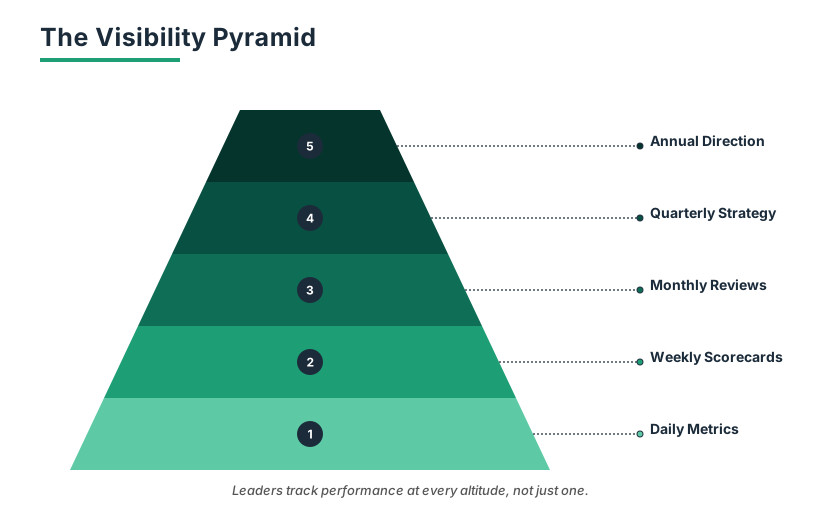
The Framework: The Visibility Pyramid

bbok

Leaders should operate at different altitudes depending on the kind of decision in front of them.

Daily Metrics

the ground-level numbers, checked frequently, close to the actual work.

Weekly Scorecards

a step back, revealing short-term trends rather than single-day noise.

Monthly Reviews

a broader view, connecting weekly patterns into something more meaningful.

Quarterly Strategy

where genuine direction-setting happens, informed by everything below it.

Annual Direction

the highest altitude, tying back directly to the vision from Chapter 16.

Owners should spend decreasing time inspecting individual work and increasing time understanding trends moving up the pyramid as the organization grows, rather than staying stuck at ground level trying to personally verify everything, everywhere, all the time.

The Business Dashboard

Every department should report just a handful of key indicators, organized into four categories. Sales lead conversion, average ticket. Production jobs completed, callbacks, schedule adherence. Customer Experience review score, satisfaction, referral rate. Financial cash flow, gross margin, accounts receivable. People employee retention, leadership pipeline strength, training completion.

What gets measured improves. This extends the Owner's Dashboard from Chapter 6 and the Performance Dashboard from Chapter 22 across multiple locations at once the same discipline, now applied at organizational scale instead of a single truck or a single company.

Common Mistakes

overload

Tracking too many metrics.

A dashboard with dozens of numbers gets ignored, exactly like the fifty-page report in Sarah's story below.

misdirection

Measuring activity instead of outcomes.

Activity feels productive to track. Outcomes actually reveal whether something's working.

silence

Reviewing reports without discussion.

A number nobody discusses might as well not exist the value comes from the conversation it produces, not the report itself.

myopia

Ignoring trends.

A single data point rarely tells the whole story; the trend across several weeks usually does.

late

Waiting for major problems before acting.

By the time a problem is undeniable, it's usually already cost more than an early correction would have.

guesswork

Managing by intuition.

Intuition matters, but at this scale, across multiple locations Mike can't personally visit every day, intuition alone can't reliably catch what a dashboard would surface immediately.

Sarah's Story

Sarah told Mike about proudly showing her mentor, years earlier, a fifty-page monthly report she'd assembled every metric she could think of, comprehensive and thorough. He flipped through it for a moment, then closed it.

"I have no idea how your business is doing," he told her.

She looked confused. "It has everything in it."

"It has information," he said. "Not insight." He drew six simple boxes on a piece of paper. "Show me these every month. If they're healthy, your business is probably healthy."

"I never built another fifty-page report after that," she told Mike. "Insight beats information every time and insight almost always comes from fewer numbers, not more."

Real Contractor Comparison

Company A

owner visits every branch personally, fields constant phone calls, and sits through endless meetings trying to stay on top of everything directly. Decisions move slowly, because they're all still routing through one exhausted person. Problems get discovered late, often only once a customer complains.

Company B

shares dashboards across every location, reviewed on a consistent weekly rhythm. Accountability is clear each leader owns their own numbers. Decisions move quickly, because problems surface early enough to address before they become customer-facing. Trust and speed both increase together, because visibility replaces the owner's physical presence as the actual mechanism of control.

Dashboards don't replace leadership. They focus it. Company B's advantage isn't a smarter owner it's a system that lets leadership attention go exactly where it's actually needed, instead of everywhere at once.

The Red-Yellow-Green System

Every KPI receives a simple status. Green healthy, no action needed. Yellow needs attention, worth watching closely. Red immediate action required. This simple coding lets a leadership team scan an entire dashboard in seconds and focus discussion on the handful of numbers that actually need it, rather than reviewing everything with equal weight regardless of urgency.

The Five Executive Questions

Every review meeting should ask the same five questions: What's improving? What's declining? What's unexpected? What requires a decision? What should we stop doing entirely? Data without decisions is just paperwork these five questions make sure every number reviewed actually leads somewhere.

Practical Exercise

Identify every KPI currently being tracked across your organization. Reduce the list to the five most genuinely meaningful ones. Assign clear ownership for each. Review them weekly, discussing trends over time rather than reacting to any single isolated data point.

Not long after the whiteboard conversation, Mike drove out to the second branch half-expecting to find exactly the kind of problem that had been nagging at him. Instead, the branch manager greeted him with a short update: a callback rate had ticked into yellow the week before, she'd already traced it to a training gap on one specific repair, corrected it, and the number was back to green by the time Mike walked in. She mentioned it the way she'd mention the weather not a crisis averted, just a Tuesday.

Mike hadn't known any of it happened until she told him.

Sarah, hearing about it later, said simply, "That's visibility. The problem was solved before the owner ever knew it existed."

Warning Signs

bottleneck

Owner attending every meeting.

This is Mike's exact relapse, and the clearest sign that visibility hasn't yet replaced personal supervision.

frequency
high
drift

Branches operating differently.

This means shared systems and dashboards haven't yet unified how each location actually runs.

frequency
moderate
surprise

Late discovery of problems.

This means the Visibility Pyramid isn't functioning issues are surfacing at ground level instead of being caught earlier through weekly or monthly review.

frequency
high
mismatch

Conflicting reports.

This usually means metrics aren't standardized across locations, making comparison and trend-spotting unreliable.

frequency
moderate
clutter

Too many KPIs.

This means the dashboard has drifted back toward Sarah's old fifty-page report, overwhelming instead of clarifying.

frequency
moderate
dependency

Leaders waiting for inspections.

This means visibility hasn't actually replaced control leaders are still operating as though the owner's personal check is what matters most.

frequency
high

Action Checklist

  • Simplify your executive reporting down to the metrics that actually matter.
  • Create clear scorecards for every department and location.
  • Assign explicit ownership for every KPI being tracked.
  • Review trends weekly, not just individual numbers in isolation.
  • Build simple comparisons across branches to catch drift early.
  • Remove any reporting that isn't actually driving a decision.

Key Takeaways

Growth creates distance, and distance creates inconsistency the farther an owner moves from daily operations, the more quality, culture, and performance can quietly drift apart between locations. Control doesn't scale. Visibility does. The Visibility Pyramid, the Business Dashboard, and the Red-Yellow-Green System replace personal supervision with clear, early information. The best leaders don't know everything they know what matters, and they've built the systems that make sure they find out early enough to act.

Reflection Questions

Could you explain your company's overall health in five minutes, right now, using only a handful of numbers? Which metrics genuinely predict future performance, rather than just describing the past? What information are you currently collecting but never actually using? Which problems consistently seem to surprise you, and what would need to change to catch them earlier? How could better visibility reduce the amount of direct supervision your organization currently requires?


During the next monthly executive meeting, each department leader presented their own dashboard no lengthy explanations, no surprises. One KPI showed yellow. Before Mike could even ask about it, the leader responsible walked through it plainly: what happened, why it happened, what corrective action was already underway, and when the number should be back to green. Mike simply listened. There was nothing left for him to ask.

Sarah leaned over quietly. "That's visibility. Problems arrive with solutions."

Mike said very little the rest of the meeting.

Afterward, he told Sarah, "I've never spent so little time managing."

"What were you doing instead?" she asked.

He thought about it. "I was making decisions."

Sarah nodded. "Exactly. Managers inspect. Executives see."

Mike looked around the empty conference room. "I don't know every detail anymore."

Sarah smiled. "You don't have to. You finally know the right ones."

Chapter 40 is where the shift from business owner to institution builder truly begins.

Scroll to Top