Chapter 36: Multiply Leaders, Not Managers
Chapter 36

Multiply Leaders, Not Managers

Thirty trucks now, and expansion moving faster than it ever had a second branch was actively under discussion, something that would have sounded impossible only a couple of years earlier.

The Challenge

Every growing company eventually reaches a leadership ceiling not because there aren't enough customers, and not because there isn't enough work, but because there aren't enough leaders ready to run the next stage of growth. Mike had spent Chapters 20, 28, and 29 building capable managers, people who could run departments and hold their teams accountable. What Jake was pointing out was a level deeper: the pipeline behind those managers had quietly run dry.

Why It Happens

Managers organize work. Leaders develop people. Managers focus on today's results. Leaders prepare tomorrow's organization. Managers supervise the people currently in front of them. Leaders multiply capability, by continuously developing the people who'll eventually replace them.

A company can have plenty of excellent managers and still run out of leadership capacity, because managing well and developing the next generation of managers are genuinely different skills and most contractors, understandably, get very good at the first one before ever consciously practicing the second.

The Framework: The Leadership Pipeline

Leadership Pipeline

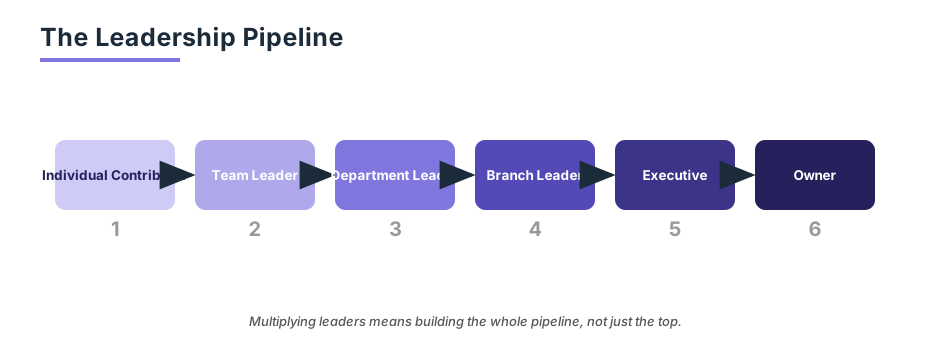
Leadership moves through six distinct levels, each with different responsibilities and skills.

Individual Contributor

does excellent work personally, the foundation every leader starts from.

Team Leader

begins guiding a small group, echoing the early rungs of Chapter 20's Leadership Ladder.

Department Leader

owns an entire function, the level Chapter 31's Organization Design Model made possible.

Branch Leader

runs an entire location, relevant now that a second branch is genuinely on the table.

Executive Leader

sets direction across multiple departments or locations at once.

Leader Developer

the final level, where someone's primary skill becomes developing other leaders, not just leading directly themselves.

Promotion should follow demonstrated readiness at each level, not simply tenure the same lesson from Chapter 20's Leadership Ladder, now extended into a full pipeline spanning the whole organization instead of a single crew.

Leadership Multiplication

Every leader in the organization should be developing three things at once: one clear successor, ready to step into their role if needed. Two emerging leaders, still developing but showing real promise. And several future candidates, further out but worth watching.

Leadership is the only asset that appreciates when it's shared. Handled this way, leadership stops being an occasional promotion event and becomes a continuous pipeline exactly the shift Jake's comment was pointing toward, and exactly what the company's recruiting Pipeline Method from Chapter 12 had always needed as its internal counterpart.

Common Mistakes

1

Promoting the best technician.

The same trap named back in Chapter 20, resurfacing here at a larger scale with higher stakes.

2

Promoting based on loyalty alone.

Tenure and loyalty matter, but neither one substitutes for genuine leadership behavior.

3

Waiting until positions become vacant.

Reactive promotion, made under pressure, rarely produces the same quality of decision as one made with real preparation time.

4

Providing no leadership training.

Authority handed over without development sets a new leader up to struggle, the same mistake named in Chapter 28.

5

Keeping talented employees in technical roles too long.

A future leader left too long as an individual contributor misses the window where their leadership potential could have been actively developed.

6

Failing to identify future leaders early.

The Five Leadership Behaviors from Chapter 20 apply here just as directly the earlier they're noticed, the more runway there is to develop them properly.

Sarah's Story

Sarah told Mike about a moment early in her own growth when she'd proudly announced to her mentor that she'd just promoted five new managers at once. He congratulated her, then asked one simple question: "Who are they developing?"

She paused. She hadn't actually asked any of them that.

A few months later, two of those five managers left the company. The organization stalled in exactly the places they'd been running. Her mentor, unsurprised, told her plainly: "You didn't build leaders. You built supervisors."

"That lesson changed my entire leadership philosophy," she told Mike. "From then on, nobody became a leader in my company unless they were actively developing another leader themselves. It's the only way the pipeline ever stays full."

Real Contractor Comparison

Company A

Has strong individual managers and a weak leadership bench beneath them. Every promotion creates another vacancy nobody's prepared to fill. Growth pauses repeatedly, not from lack of opportunity, but from lack of ready people to run it.

Company B

Maintains a genuine leadership pipeline, with continuous mentoring happening at every level. Successors are ready before they're needed. Promotions happen internally, from people already prepared for the next step. Expansion a new branch, a new department happens smoothly, because leadership capacity was never the constraint.

The strongest organizations never run out of leaders. Company B's advantage isn't luck finding the right people at the right time it's a pipeline that continuously produces them.

The 3-2-1 Leadership Rule

Every leader in the organization should maintain: 3 people they're actively coaching. 2 people nearly ready for promotion. 1 person who could step into their own role today, if needed. Leadership continuity should never depend on luck the 3-2-1 Rule makes sure it doesn't, at every level of the pipeline simultaneously.

The Leadership Scorecard

Track leadership development with the same discipline as financial performance: number of ready successors across the organization, internal promotion rate, leadership retention, employee engagement, training completion, and overall leadership bench strength. Measured this way, leadership stops being a vague aspiration and becomes something the CEO Dashboard from Chapter 32 can genuinely track alongside everything else.

Practical Exercise

List every leadership position in your company. For each one, identify the current leader, a potential successor, that successor's specific development needs, and a realistic timeframe to readiness. Find every position with no identified successor at all. Create a ninety-day development plan to close that specific gap.

Warning Signs

critical
red flag

Outside hiring for every leadership role.

This usually means the internal pipeline isn't producing candidates fast enough to keep pace with growth.

high
urgent

Repeated leadership vacancies.

This means successors aren't being deliberately developed in advance.

warning
overload

Managers overwhelmed.

This often means they're managing alone, without the 3-2-1 Rule's coaching relationships in place beneath them.

stall
stuck

Few internal promotions.

This is one of the clearest signs the pipeline has quietly run dry, exactly as Jake noticed.

silent
avoid

No succession discussions.

This means leadership development is happening reactively, if at all, rather than as an ongoing practice.

ceiling
critical

Growth delayed because "we don't have anyone ready."

This is the leadership ceiling itself, showing up directly as a growth constraint.

Action Checklist

  • Identify potential future leaders across every department, not just the obvious ones.
  • Create deliberate mentoring relationships between current and emerging leaders.
  • Assign stretch responsibilities that genuinely test and develop leadership capability.
  • Measure leadership development using the Leadership Scorecard, not just gut feeling.
  • Review succession planning every quarter, for every meaningful role.
  • Celebrate leaders specifically for developing other leaders, not just for their own individual results.

Key Takeaways

Every growing company eventually hits a leadership ceiling not from lack of customers or work, but from a shortage of ready leaders. Managers organize work; leaders build leaders, using the six-level Leadership Pipeline and the 3-2-1 Rule to keep succession from ever depending on luck. A leader's success is measured by who succeeds after them, not just by what they personally accomplish. The strongest organizations never run out of leaders, because they never stop developing them.

Reflection Questions

Who is currently developing to replace your existing leaders? Who is developing to eventually replace you? Which employees consistently influence others, whether or not they hold a formal title yet? Who has real leadership potential that's currently going untapped? What leadership legacy are you actually building, one mentoring relationship at a time?


A month later, Mike sat in a leadership meeting and said almost nothing the entire time. Jake facilitated. Department leaders worked through problems together, without waiting for Mike to weigh in. A young supervisor confidently presented an improvement initiative she'd developed on her own. Another leader volunteered, unprompted, to mentor a new foreman who'd just been promoted.

Nobody looked to Mike for answers. They looked to each other.

After the meeting, Sarah asked, "What did you notice?"

"I wasn't leading the meeting," Mike said.

"No," Sarah said. "You were leading the leaders."

Mike looked around the empty conference room. "I used to measure success by how many people followed me." He smiled. "Now I measure it by how many leaders no longer need to."

Sarah nodded. "And organizations that multiply leaders eventually multiply everything else."

Chapter 38 is where you learn to scale through systems instead of heroics the final discipline standing between where you are now and everything still ahead.

Scroll to Top