
Chapter 35: Make Yourself Replaceable Before You Have To
Chapter 35

Make Yourself Replaceable Before You Have To

Twenty-five trucks now. And for the first time in as many years as he could remember, Mike actually boarded a plane for a two-week family vacation he'd promised himself, and everyone else, more times than he could count.

The Challenge

Every owner says they want freedom. Very few actually build it, because building it means deliberately reducing your own importance to the daily function of the business an instinct that runs directly against everything most owners have spent years working to prove about themselves.

Many contractors become prisoners of their own success precisely because they never prepare the company to operate without them. A business that depends entirely on its owner, no matter how large or profitable, is still fundamentally a job one with better pay and worse hours than most, but a job nonetheless.
Why It Happens

Delegation vs. Replacement. Delegation moves work someone else now performs a task the owner used to do personally. Replacement moves capability the company itself now knows how to make a decision the owner used to make alone. Delegation says, "I'll still make the final call." Replacement says, "The company now knows how to make that call without me."

Mike had spent Chapters 19 through 31 building genuine delegation real progress, and necessary. What his two-week vacation actually tested was something one level deeper: whether judgment itself, not just tasks, had genuinely transferred into the organization.

Founder Dependency

Watch for these signs: every major customer specifically wants the owner. Pricing decisions still depend on the owner's input. Hiring waits on the owner's availability. Problems escalate to the owner by default, regardless of whether they actually need to. Growth visibly pauses whenever the owner takes time away.

Each of these slows long-term growth in a specific, compounding way and each one, left unaddressed, eventually caps the company's value at exactly the size one person's personal capacity can support.

The Framework: The Independence Ladder

bbok

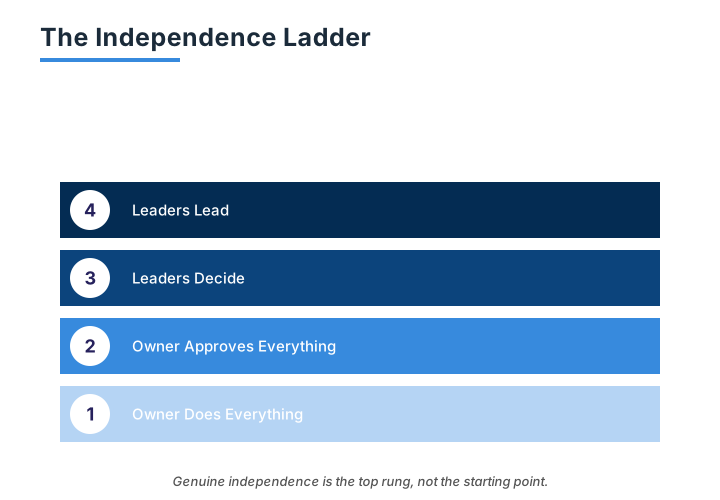
This is the final synthesis of every ladder this book has climbed the Owner Ladder from Chapter 4, the Altitude Ladder from Chapter 25, the Organizational Ladder from Chapter 31 brought together into one last climb.

Owner Does Everything

where every business begins, and where Mike himself started back in Chapter 1.

Owner Approves Everything

the stage most owners eventually reach and then get stuck at, delegating tasks while quietly retaining every real decision.

Leaders Decide

genuine authority has moved to capable people, the work of Chapters 19, 20, and 28.

Systems Decide

routine decisions now happen through documented standards, without even requiring a specific leader's individual judgment each time.

Organization Learns

the company actively improves its own judgment over time, applying the Improvement Cycle from Chapter 18 to its own decision-making, independent of any single person's continued involvement.

Every stage removes another layer of unnecessary dependence on one individual and Mike's two-week vacation was the first real proof that his company had genuinely reached the fourth and fifth rungs, not just the appearance of them.

Common Mistakes

Keeping customer relationships personal.

Relationships that only run through the owner limit the company's growth to exactly what one person's personal network and time can sustain.

Never documenting judgment.

Delegating a task without ever capturing the reasoning behind good decisions means the organization can copy actions but never actually learns to think.

Avoiding difficult succession conversations.

Postponing the question of who leads what, and when, doesn't prevent the eventual need for an answer it just makes the answer more urgent and less prepared when it finally arrives.

Micromanaging leaders.

The exact relapse Mike caught himself in during Chapter 29, still worth guarding against even at twenty-five trucks.

Correcting instead of coaching.

A leader corrected instead of coached learns to avoid decisions rather than improve them.

Measuring personal importance instead of organizational capability.

An owner who quietly wants to still feel needed will unconsciously resist the very independence this chapter is asking them to build.

Sarah's Story

Sarah told Mike about her own first real trip away, years earlier three weeks overseas, prepared for months in advance through deliberate documentation, coaching, and delegation. She expected daily emergencies the entire time she was gone.

Her mentor called her halfway through the trip. "Has anyone phoned you?"

"No," she admitted.

"Good. That means your systems are working."

She laughed, a little surprised at her own reaction. "I thought they'd miss me."

"They do," he told her. "They just don't need you."

"That distinction changed how I understood leadership permanently," she told Mike. "Being missed and being needed are two completely different things and only one of them is actually good for the company in the long run."

Real Contractor Comparison

Company A

Owner answers every difficult question personally. Customers insist on speaking with him specifically, rather than trusting the organization itself. Growth visibly stops during any vacation. The business, as a result, becomes genuinely difficult to sell, because its value is inseparable from one person's continued presence.

Company B

Leaders solve problems independently. Customers trust the organization as a whole, not just one individual inside it. Knowledge is documented and shared, not trapped in anyone's head. The business continues without interruption regardless of who's available on a given day. Company value increases every year, because it's genuinely transferable to a buyer, to a successor, to the next generation of leadership.

Companies become valuable when they stop depending on one person. Company B's advantage isn't better luck it's an owner who deliberately built independence rather than quietly protecting his own indispensability.

The Replaceability Audit

This extends the Dependency Audit from Chapter 31 previously applied to departments now applied directly to the owner. Ask: who approves pricing? Who hires? Who solves customer complaints? Who develops leaders? Who negotiates with vendors? Who reviews financial performance? Circle every answer that comes back "the owner." Every circle identifies another bottleneck standing between the current business and a genuinely independent one.

The Freedom Scorecard

Measure freedom the same disciplined way you'd measure anything else that matters: days the owner is absent, customer satisfaction during those absences, revenue stability, decision quality made without the owner, employee confidence, and overall growth consistency. Freedom is earned through preparation and, tracked this way, it's also measurable, not just a vague aspiration.

Practical Exercise

Track every decision that requires you, specifically, over the course of one week. Categorize each one: Must remain owner, Should become leader, Should become system. Choose one recurring decision from the second or third category, and permanently transfer it not temporarily, not as an experiment, but for good.

Warning Signs

red flag

Vacation anxiety.

This is the clearest personal signal that founder dependency, not just organizational dependency, still runs deep.

habit

Phone never silent.

This means decisions are still routing to the owner out of habit, exactly the pattern first named back in Chapter 19.

subtle

Owner copied on every email.

This is a quieter, less obvious version of the same dependency, hiding inside a habit that feels like simply staying informed.

stuck

Leaders waiting for permission.

This means the Independence Ladder hasn't actually reached the "Leaders Decide" rung yet, regardless of titles.

bypass

Customers bypassing managers.

This means trust still lives with one individual instead of the organization as a whole.

critical

Business slowing whenever the owner is unavailable.

This is the single clearest, most direct sign that the company hasn't yet matured past founder dependency.

Action Checklist

  • Complete the Replaceability Audit honestly, circling every decision still requiring you personally.
  • Document the reasoning behind your recurring decisions, not just the decisions themselves.
  • Expand your leaders' authority deliberately, one specific decision at a time.
  • Reduce your own approvals wherever the Audit reveals they're no longer necessary.
  • Test organizational independence intentionally a weekend away, then longer, building up gradually.
  • Schedule real time away on your calendar, protected the same way any other major commitment would be.

Key Takeaways

Every owner says they want freedom, but very few intentionally build it many contractors become prisoners of successful businesses because they never prepare the company to function without them. The Independence Ladder moves from Owner Does Everything all the way to Organization Learns, removing dependence on any single individual one rung at a time. The goal was never to become unnecessary. It's to become optional. The founder's greatest achievement is building something that genuinely survives the founder's own absence starting with something as simple, and as hard, as two real weeks away.

Reflection Questions

Could your company genuinely operate for one full month without you? Would your customers notice if you were gone? Would your employees? What decisions still belong only to you, and why? What legacy are you actually building one that depends on you forever, or one built to outlast you?


That Sunday evening, Mike sat on the porch scrolling through photos from the family vacation. For the first time in longer than he wanted to admit, he actually remembered the trip itself not the phone calls he'd almost made, not the emergencies that never came, not the problems he'd braced for and never had to solve.

His daughter, curled up beside him looking at the same photos, asked, "Dad, can we do that again next year?"

Mike smiled. "Absolutely."

Sarah called later that evening. "So how'd the company do?"

He laughed. "It didn't need me."

"No," she said. "It simply didn't need you every minute."

Mike looked out toward the office, dark and quiet somewhere across town. "I think that's what I was really building all along."

Sarah smiled, even though he couldn't see it through the phone. "And now you're finally free to build something even bigger."

Chapter 37 is where you learn how to multiply leaders not just managers across a company that's about to get a lot larger.

Scroll to Top