
Chapter 33: Build a Growth Engine, Not a Growth Spurt
Chapter 33

Build a Growth Engine, Not a Growth Spurt

Nearly a year after Mike started forecasting cash three months out instead of checking the balance day to day, he noticed something unusual about the business: it had become remarkably consistent.

Instead of celebrating the occasional huge month followed by an anxious quiet one, the company just kept producing solid months, one after another. Marketing generated leads steadily. Sales converted at a predictable rate. Hiring kept pace with growth. Departments coordinated smoothly, the way Chapter 31's structure had promised they eventually would.

Then one month arrived with noticeably fewer calls than usual, and Mike felt the old anxiety return immediately.

"It feels like we're slowing down," he told Sarah.

"What changed?" she asked.

"Lead volume."

"And what else?"

He thought about it. "Nothing."

Sarah nodded. "So your company isn't slowing down. One input changed." She walked to the whiteboard and drew a chain:

Leads Appointments Quotes Sales Production Happy Customers Reviews More Leads

She circled the whole diagram. "This isn't growth. It's an engine."

Momentum is temporary. Systems are permanent.
The Challenge

Many contractors mistake busy seasons for growth, and good years for scalable businesses. True growth was never an event — a great referral, a lucky big project, a strong quarter. It's a system, built deliberately, that keeps producing results whether or not any single input happens to spike in a given month.

Mike's brief scare over one slow month was the exact test of whether he'd actually built a growth engine, or just gotten comfortable riding a growth spurt long enough to mistake it for something more permanent.

Why It Happens

Growth Spurts vs. Growth Engines. Growth spurts depend on luck, on seasons, on referrals arriving unpredictably, or on one particularly persuasive salesperson having a great run. Growth engines operate consistently, produce measurable results, improve continuously, and scale intentionally. The difference isn't effort or talent. It's whether growth is being produced by a repeatable system or simply happening to a business that hasn't built one yet.

Systems outperform enthusiasm — not because enthusiasm doesn't matter, but because enthusiasm fluctuates, and a business that depends on it fluctuates right along with it.

Inputs vs. Outputs

Owners naturally obsess over outputs — revenue, profit, truck count, the numbers that show up at the end of the process. Growth engines are built by watching inputs instead: leads generated, conversion rate, average ticket, customer satisfaction, review requests sent, employee referrals received, the strength of the hiring pipeline.

Outputs improve only when inputs improve. Mike's momentary panic came from watching an output — this month's call volume — without checking the input that actually explained it. Once he traced the dip back to a single input, the rest of the engine's health became obvious: conversion, reviews, hiring, and customer satisfaction were all still moving in the right direction.

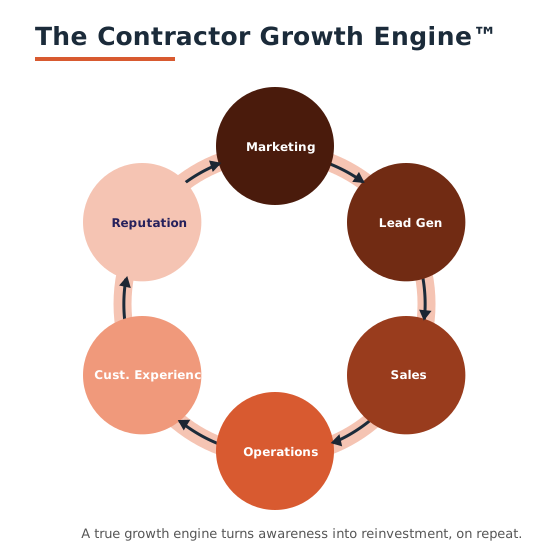
The Framework: The Contractor Growth Engine™

bbok

Growth moves through eight connected stages, each one feeding directly into the next:

Marketing generates awareness. Lead Generation turns that awareness into actual inquiries. Sales Conversion turns inquiries into booked work, using the TRUST Conversation from Chapter 9. Operations delivers the work, supported by the systems from Chapters 5 and 13. Customer Experience shapes how that delivery actually feels to the customer, echoing Chapter 24's culture work. Reputation builds from that experience, the same Five Trust Builders introduced in Chapter 10. Referrals flow from strong reputation. Repeat Business flows from trust already earned — and the cycle feeds back into Marketing once again, stronger than before.

Every stage feeds the next, and weakness anywhere slows the entire engine, not just the stage where the weakness lives. A dip in reviews eventually shows up as a dip in leads, weeks or months later, exactly as invisibly as Mike's brief scare almost convinced him something serious had gone wrong.

Common Growth Mistakes

Stopping marketing during busy seasons.

Creates a delayed quiet month caused by decisions made months earlier.

Hiring only after demand exceeds capacity.

Reactive hiring pattern costing more at a larger scale.

Ignoring customer retention.

Neglecting the cheapest, most reliable stage of the growth engine.

Depending on one lead source.

Single channel dependence creates severe channel fragility.

Measuring only revenue.

Tells you the engine's result without indicating which input needs attention.

Changing strategy every month.

Prevents any single stage from ever fully maturing and compounding.

Sarah's Story

Sarah told Mike about two record-breaking years early in her own growth, years that convinced her she'd genuinely discovered the secret to scaling. Then the broader market slowed, and her revenue dropped quickly right along with it.

Her mentor asked her the same question Sarah had just asked Mike: "What changed?"

"The economy," she answered.

"No," he told her. "You built momentum. You never built an engine."

Over the following several years, she deliberately documented every stage of customer acquisition, service delivery, referrals, hiring, and leadership development — turning what had been lucky timing into something repeatable. "Growth got slower for a while," she told Mike, "but it became dramatically more predictable, and predictable eventually compounds further than lucky ever does."

Real Contractor Comparison

Company A

Has excellent years and terrible years, with little middle ground between them. Hiring reacts to whatever demand shows up. Marketing stops the moment things get busy, planting the seeds of the next slow season without anyone noticing at the time. Growth rises and falls unpredictably, year after year.

Company B

Keeps marketing running continuously, regardless of how busy things currently feel. The hiring pipeline stays active at all times, not just during a crunch. Reviews increase steadily, because asking for them is built into the Customer Experience stage rather than left to chance. Revenue grows consistently, month over month.

Great companies don't chase customers. They build systems that consistently attract them. Company B's advantage isn't luck showing up more often — it's an engine that keeps running whether or not luck shows up at all.

The Seven Growth Levers

Seven levers drive the entire engine: Lead Generation, Conversion, Average Job Size, Customer Retention, Reviews & Referrals, Operational Capacity, and Leadership Capacity. Improving several of these levers slightly, at the same time, often produces far more growth than dramatically improving only one of them in isolation — because the levers feed each other, exactly the way the engine's eight stages do.

The Growth Flywheel

Every delighted customer sets off a specific, compounding chain: a Review, which builds a Referral, which builds a Trust with the next prospective customer, which produces Better Conversion, which produces Higher Revenue, which funds Better Investment back into the business, which produces an even Better Customer Experience, which creates More Delighted Customers — and the flywheel turns again, faster and with less effort each time.

A growth engine works even when the owner isn't pushing. This is the flywheel's real value: momentum that compounds on its own, rather than requiring Mike's constant personal effort to keep it moving.

Practical Exercise

Evaluate each of the seven growth levers, scoring your business from 1 to 10 on each one honestly. Identify the single weakest lever. Choose one specific improvement targeting that lever over the next ninety days. Track the results weekly, watching the input move before expecting the output to follow.

Warning Signs

Revenue changes dramatically every month.

Usually means the business is still running on growth spurts rather than a genuine engine.

Hiring always feels rushed.

Means the Leadership Capacity lever is chronically behind demand instead of staying ahead of it.

Marketing starts and stops.

Creates delayed dips, often months after the decision that actually caused it.

No one knows conversion rates.

Means a core input is being ignored entirely in favor of watching only final output.

Action Checklist

  • Map your own version of the Contractor Growth Engine, stage by stage.
  • Measure your key inputs weekly, not just revenue at the end of the month.
  • Diversify your lead sources deliberately, rather than relying on one channel.
  • Work specifically to improve conversion, not just lead volume.
  • Strengthen the customer experience stage, since it feeds both retention and reviews.
  • Review your growth metrics monthly as a full system, not just as isolated numbers.

Key Takeaways

Many contractors mistake busy seasons for growth and good years for scalable businesses — but true growth is a system, not an event. The Contractor Growth Engine — Marketing, Lead Generation, Sales Conversion, Operations, Customer Experience, Reputation, Referrals, Repeat Business — feeds each stage into the next, and weakness anywhere slows the whole engine. Outputs improve only when inputs improve, and the Growth Flywheel shows how momentum compounds on its own once the engine is genuinely built. Growth is built, not hoped for.

Reflection Questions

Where does your company's growth actually begin, stage by stage? Where does it typically break down when something goes wrong? Which department currently contributes the most to your future growth, and which contributes the least? What would happen to your business if one lead source disappeared tomorrow? What single improvement would create the greatest long-term momentum across the whole engine?


Several weeks later, Mike reviewed the weekly scorecard. Revenue was slightly lower than the previous month. Lead generation, though, was improving. Conversion was improving. Reviews had increased. Hiring was ahead of plan. Customer satisfaction remained high across every crew.

"Worried?" Sarah asked, noticing his expression.

"No," Mike said. "I finally understand. You don't judge an engine by one mile. You judge it by whether it keeps running."

Sarah smiled. "And companies that keep improving their engines eventually leave everyone else behind."

Chapter 35 is where you learn how to protect your culture while you scale.

Scroll to Top