Chapter 32: Cash Fuels Growth. Profit Funds Freedom.
Chapter 32

Chapter 33: Cash Fuels Growth. Profit Funds Freedom.

Business had never looked stronger. Revenue kept climbing. Crews stayed busy across all ten trucks. Customers were happy. By every top-line measure, Mike should have felt completely secure.

Instead, the checking account felt tighter every single month, and he genuinely couldn't explain why. Payroll had grown along with the crew. Inventory needed to grow with it. Fuel costs kept rising. Equipment payments had increased with every new truck. Customers, especially the larger commercial accounts, were taking longer to pay than the small residential jobs he'd started with. Everything about the business looked successful. Cash, somehow, always felt scarce.

"We're making more money than ever," he told Sarah. "So why does it feel like we're always waiting for checks to clear?"

"Because revenue isn't cash," she said.

Mike laughed, half-serious. "Isn't it?"

"It will be," Sarah said. "Just not today."

She walked to the whiteboard and drew three separate circles: Revenue. Profit. Cash.

Mike stared at them. "I always thought they were the same thing."

Sarah smiled. "Almost every contractor does — right up until growth forces them to learn the difference the hard way."

Revenue creates excitement. Cash creates stability.
The Challenge

Many contractors believe profit is what finances growth. It isn't. Growth consumes cash — and a company can be genuinely profitable on paper while simultaneously running out of money, because profit measures success on a delay, while cash reflects reality right now, today, in the account.

Mike's business, back in Chapter 7, first taught him the difference between profit and cash at the level of a single job. Ten trucks later, the same lesson had returned at an entirely different scale — one where the stakes, and the numbers, were large enough to genuinely threaten the business if he kept mismanaging the gap between the two.

Why It Happens

Revenue vs. Profit vs. Cash. Revenue is work sold — the total value of everything customers have agreed to pay for. Profit is what's left after every expense gets subtracted from that revenue. Cash is what actually, physically exists in the bank account today, right now, regardless of what revenue or profit currently show on paper.

Profit is an opinion until the customer pays. A job can be fully profitable on the books the moment it's invoiced, and the cash from it might not actually land in the account for another thirty, sixty, or ninety days — an uncomfortable gap that gets dramatically wider as a business scales into larger commercial accounts with slower payment cycles.

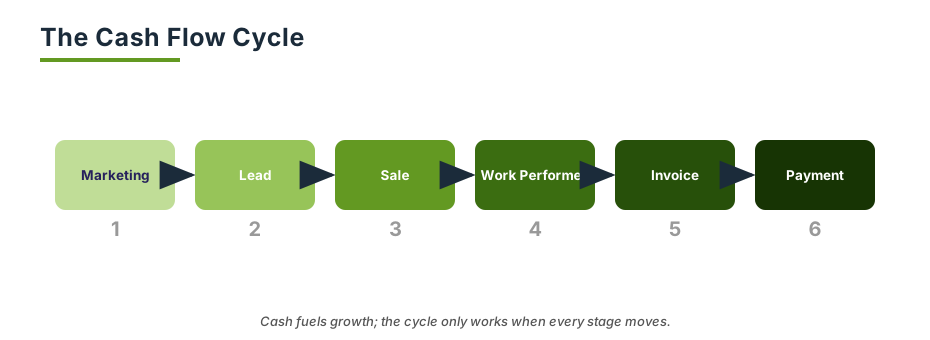
The Framework: The Cash Flow Cycle

Cash Flow Cycle

Every dollar travels the same road, in the same order, and the business spends cash at nearly every stage of the journey before it ever collects anything back.

Marketing — money spent generating interest, before any customer has even called.

Lead — a potential customer identified, still no cash collected.

Sale — the job is won, but materials and labor haven't been spent yet.

Work Performed — materials and labor costs are now real and already spent.

Invoice — the bill goes out, but the cash still hasn't arrived.

Customer Pays — the cash finally lands, often weeks after the work — and the expenses — actually happened.

Cash Available — only now does the business actually have the money it spent weeks earlier fighting to earn.

Businesses spend cash long before they receive it, and growth stretches every single stage of this cycle simultaneously — more marketing spend, more jobs performed, more invoices outstanding, all at once, all before the matching cash has caught up.

Why Growth Eats Cash

New trucks require cash before they generate revenue. Hiring requires cash before a new employee becomes fully productive. Training requires cash with no immediate return. Inventory requires cash sitting on a shelf before it's used on a job. Marketing requires cash spent before any resulting lead even calls. Technology, insurance, equipment, fuel — every one of these investments happens before the revenue they're meant to support ever actually catches up.

The fastest-growing companies often experience the greatest cash pressure, not the least, precisely because they're making all of these investments simultaneously, at an accelerating pace, while the cash from each one still trails weeks or months behind.

Common Financial Mistakes

speed

Growing too quickly.

Growth that outpaces the Cash Flow Cycle's natural delay creates exactly the squeeze Mike was feeling.

receivables

Ignoring accounts receivable.

Money owed but not yet collected looks like an asset and spends like nothing at all, exactly as Chapter 7 first explained.

equipment

Buying equipment too early.

A purchase made in anticipation of growth that hasn't arrived yet ties up cash the business may need before that growth materializes.

spending

Using profit as a spending signal.

Profit shown on a statement isn't the same as cash sitting in the account, ready to spend.

reserves

Failing to build reserves.

The Resilience Pyramid from Chapter 23 applies here directly — no cushion means no room to absorb the natural gap between spending and collecting.

pricing

Underpricing work.

Thin margins from Chapter 8's Pricing Formula leave almost no room to fund growth once cash gets tight.

distributions

Taking owner distributions too aggressively.

Pulling cash out of the business faster than it can actually be replaced starves the very growth the distributions were meant to celebrate.

Sarah's Story

Sarah told Mike about her own biggest sales year, years earlier — revenue up dramatically, profit looking excellent on every report she pulled. Then payroll came due. Vendors needed payment. Insurance renewed. Equipment deposits landed all in the same stretch of weeks. Her checking account nearly emptied, despite what looked, on paper, like her best year ever.

Her mentor reviewed her financial statements and asked one simple question: "How profitable are you?"

She answered proudly.

"That's not what I asked," he said, pointing instead to her actual bank balance. "How much cash do you have?"

"I realized, sitting there, that I'd been managing an income statement instead of managing actual liquidity," she told Mike. "That lesson changed how I ran the company from that point forward — I started watching cash as closely as I watched sales."

Real Contractor Comparison

Company A

has strong revenue and weak cash management. Growth happens quickly, and stress grows right alongside it — constant anxiety about whether payroll will clear, vendors paid late out of necessity rather than choice. Growth eventually stalls, not from lack of demand, but from a cash position too fragile to support it any further.

Company B

grows more moderately, but with strong cash reserves underneath every stage of expansion. Hiring happens with genuine confidence, because the cash to support it already exists. Growth stays predictable and steady, because the business is never one slow month away from a real crisis.

Growth doesn't fail because of lack of work. It fails because of lack of cash. Company B's advantage isn't a bigger market — it's financial discipline that lets growth actually stick instead of collapsing under its own weight.

The Cash Reserve Ladder

Build reserves deliberately, in stages: 30 Days of operating expenses as a starting cushion, then 60 Days, then 90 Days as the business matures, and finally Growth Capital — reserves specifically set aside to fund expansion on the business's own terms, rather than reactively scrambling for financing under pressure.

The Growth Investment Filter

Before any major investment, ask five questions: Does this increase capacity? Does this improve profitability? Does this improve customer experience? Will it generate positive cash flow, and on what timeline? And can we still afford it if growth slows down unexpectedly? A investment that fails several of these questions deserves real hesitation, regardless of how exciting the opportunity feels in the moment.

Practical Exercise

Review the last twelve months of your business. Calculate your average monthly payroll, your average monthly overhead, your average outstanding accounts receivable, and your average cash balance. Determine how many months of reserve that actually represents. Set a specific target reserve to build toward. Identify one concrete improvement — faster invoicing, a tighter collections process — that would shorten the gap in your Cash Flow Cycle.

Warning Signs

payroll

Waiting for customer payments before payroll.

This means the business has essentially no cash cushion between collections and obligations.

frequency
high
borrowing

Constantly borrowing for operating expenses.

This usually means growth has outpaced the cash available to support it.

frequency
moderate
divergence

Growing revenue without improving cash.

This is the exact gap Mike was experiencing — success on paper, strain in the account.

frequency
high
vendors

Late vendor payments.

This is often one of the first visible signs of a cash squeeze building underneath otherwise strong numbers.

frequency
moderate
cushion

No financial cushion.

This means any unexpected disruption — a slow month, a large receivable, a broken truck — becomes an immediate crisis.

frequency
critical
reactive

Making decisions from the checking account instead of forecasts.

This means the business is reacting to cash rather than planning around it.

frequency
moderate

Action Checklist

  • Separate revenue, profit, and cash clearly in how you review your business every month.
  • Monitor cash weekly, not just when something feels tight.
  • Improve collections — faster invoicing, clearer payment terms, more consistent follow-up.
  • Build toward a specific cash reserve target, deliberately, not by accident.
  • Forecast major purchases well in advance, rather than reacting to opportunity in the moment.
  • Delay unnecessary spending until the cash position genuinely supports it.

Key Takeaways

Many contractors believe profit finances growth — it doesn't. Growth consumes cash, and a company can be profitable on paper while quietly running out of money in reality. The Cash Flow Cycle shows that businesses spend cash at nearly every stage before ever collecting it, and growth stretches that gap wider at every single stage simultaneously. Revenue creates excitement. Cash creates stability. The strongest companies don't simply earn more — they manage money better, building the reserves and discipline that let growth actually stick instead of collapsing under its own weight.

Reflection Questions

How long could your company operate right now with no new sales coming in at all? Are you currently growing faster than your cash position can actually support? Which of your recent investments genuinely increased capacity, and which just felt exciting in the moment? Where does cash tend to get trapped in your business right now? If revenue doubled tomorrow, could your cash position actually support that growth?


A week later, Mike sat down and reviewed the company's cash forecast instead of simply glancing at the bank balance the way he always had. For the first time, he found himself looking three months ahead instead of three days ahead.

Sarah walked in and noticed. "What changed?"

Mike smiled. "I stopped asking how much money we made." He pointed to the forecast on his screen. "Now I'm asking how long we can keep growing."

"Exactly," Sarah said. "Growth doesn't begin with ambition. It begins with capacity."

Mike closed the laptop slowly. "I finally understand. We're not just managing money. We're financing the future."

Sarah smiled. "And next, we'll learn how to make that growth predictable instead of accidental."

Chapter 34 is where you build the engine that makes growth repeatable, not just possible.

Scroll to Top