
Chapter 31: Stop Running the Business. Start Scaling It
Chapter 31

Stop Running the Business. Start Scaling It.

Ten trucks now. Real departments, functioning leadership teams, daily operations running smoother than Mike had ever imagined possible back when one truck felt like the whole world. By every measure that used to matter, he'd made it.

The Challenge

Every growing contractor eventually reaches this exact crossroads. One path leads to a larger version of the exact same business — more trucks, more revenue, the same owner still solving the same category of problems, just bigger ones. The other path leads somewhere genuinely different: a scalable company, led by someone who's stopped running daily operations and started designing what the organization becomes next.

Mike had built the departments, the leadership, the systems. What he hadn't yet done was update his own role to match what all of that made possible. He was still filling his calendar with work — just work that had quietly changed shape without him fully noticing.
Why It Happens

Managing keeps work moving. Leading develops people. Scaling builds organizations capable of future growth. Each of these requires genuinely different thinking, and most owners naturally climb through them in order — Mike had spent years mastering the first two. Scaling was the one he hadn't consciously stepped into yet, even though his business had already grown large enough to require it.

Growth eventually becomes limited by the leader's attention — not because the leader isn't working hard, but because the kind of work filling that attention hasn't caught up with what the company actually needs from its owner now.

The Framework: The CEO Time Model

bbok

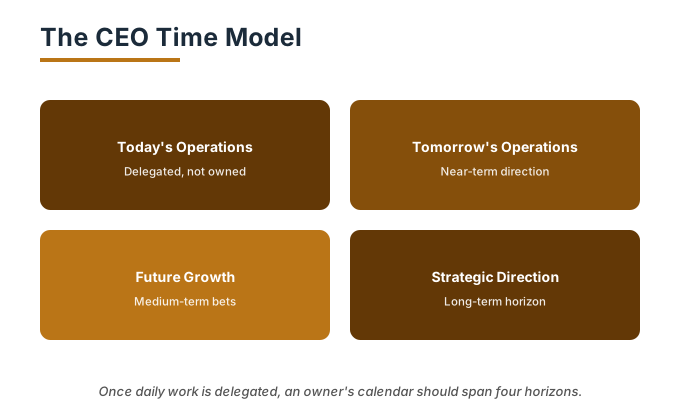
The owner's calendar should span five horizons, from the nearest to the furthest.

1

Today's Operations

— the daily work, now largely handled by the departments and leaders built in Chapters 30 and 31.

2

Tomorrow's Operations

— refining and strengthening the systems that keep today's operations running well, a step removed from doing the work directly.

3

Future Growth

— identifying and preparing for the company's next stage, before it's urgently needed.

4

Strategic Direction

— deciding where the company is actually headed, and why.

5

Company Vision

— protecting and evolving the destination first described back in Chapter 16.

A calendar reveals priorities better than a mission statement. Mike's calendar, even after everything he'd built, was still full of tasks that belonged closer to the bottom of this model than the top.

The Five Responsibilities Only the Owner Can Own

Everything else should eventually belong to someone else in the organization. Five things remain genuinely, permanently the owner's:

Vision

The destination the whole company is building toward.

Culture

The invisible operating system from Chapter 24, requiring the owner's continued attention to stay intact at scale.

Capital Allocation

Deciding where the company's money actually gets invested.

Leadership Development

Continuing to build the pipeline from Chapter 20, now at an organizational level.

Strategic Growth

Deciding what the company pursues next, and what it deliberately declines.

Common Scaling Mistakes

speed

Hiring faster than systems mature.

Growth that outpaces the System Loop from Chapter 13 creates exactly the strain Chapter 27's Complexity Curve warned about.

leadership gap

Growing revenue without strengthening leadership.

Revenue can scale faster than leadership capacity ever can — and when it does, the gap becomes the business's real ceiling.

yes

Saying yes to every opportunity.

Not every opportunity fits the vision or the FIT Filter from Chapter 2 — chasing all of them dilutes focus rather than building it.

locations

Adding locations too early.

Multi-location complexity, covered later in this Part, requires a level of organizational readiness that revenue alone doesn't guarantee.

cash

Expanding without cash reserves.

The Resilience Pyramid from Chapter 23 applies with even more force at this scale, where mistakes are larger and more expensive.

involvement

Trying to remain involved in every department.

This undoes the entire structure built in Chapter 31, pulling the owner back down into work departments now exist to handle.

Mistaking activity for progress.

A full calendar isn't proof of the right kind of work — it's just proof of a full calendar.

Sarah's Story

Sarah told Mike about a moment early in her own scaling journey when she proudly announced to her mentor that she'd finally stopped answering emergency calls personally. He congratulated her — and then asked one simple follow-up: "So what are you doing with the time you gained?"

She admitted, a little sheepishly, that she'd simply filled it with different operational work — different tasks, same category of thinking.

"If you keep replacing operational work with more operational work," he told her, "you'll never actually become a CEO." That conversation, she told Mike, permanently changed how she understood leadership — freeing up time only matters if the freed time gets reinvested somewhere genuinely different.

Real Contractor Comparison

Company A

works harder every single year as the business grows. Revenue climbs. Stress climbs faster. Growth eventually stalls, not from lack of demand, but because the owner's attention — the real bottleneck now — simply can't stretch any further.

Company B

works increasingly on strategy, while capable leaders operate the departments beneath them. The organization keeps improving continuously, because attention is being spent where only the owner can actually add value. Growth accelerates, because it's no longer capped by one person's calendar.

The future belongs to the owner who has time to think. Company B's advantage isn't a bigger market. It's an owner who deliberately climbed into CEO-level work instead of just filling freed-up hours with more of the same kind of task.

The CEO Dashboard

Where the Owner's Dashboard from Chapter 6 tracked operational health and the Performance Dashboard from Chapter 22 tracked company-wide metrics, the CEO Dashboard tracks something one level higher still: Culture, Leadership, Cash, Growth, Customer Experience, and Innovation — six strategic indicators, reviewed regularly, that reveal whether the organization as a whole is actually getting stronger, not just busier.

The Future Allocation Rule

Reserve your time deliberately: roughly 70% strengthening today's organization, 20% preparing the next stage, and 10% genuinely exploring future opportunities that haven't fully taken shape yet. CEOs always reserve real time for tomorrow — not as an afterthought squeezed into whatever's left over, but as a protected, non-negotiable portion of every week.

Practical Exercise

Track every hour of your work for one full week. Categorize each activity as Operator, Manager, Leader, or CEO. Calculate the percentage of your week spent in each category. Identify three activities currently in the Operator or Manager categories that should move to someone else. Schedule two recurring strategy blocks on your calendar every week, protected the same way you'd protect a major customer meeting.

Warning Signs

bottleneck

Every major decision still waits for the owner.

This means the Decision Matrix from Chapter 28 hasn't fully extended to this new scale of the business.

frequency
high
stall

Growth slows despite strong demand.

This is the clearest sign that the owner's attention, not the market, has become the real limiting factor.

frequency
moderate
no thinking

The owner has no thinking time.

This means the calendar is still built entirely around Today's and Tomorrow's Operations, with nothing reserved higher up the CEO Time Model.

frequency
high
short-term

Long-term planning rarely happens.

This means Future Growth and Strategic Direction are being crowded out by whatever feels most urgent that day.

frequency
moderate
firefighting

Meetings focus only on today's problems.

This is the CEO Dashboard being ignored in favor of the daily whirlwind.

frequency
moderate
vision loss

The owner cannot describe the next three years.

This means Company Vision has quietly stopped being actively led, even if it's still technically written down somewhere.

frequency
high

Action Checklist

  • Audit your calendar honestly against the four categories: Operator, Manager, Leader, CEO.
  • Protect real strategic thinking time every week, treated as non-negotiable.
  • Delegate one more recurring responsibility currently still sitting with you.
  • Define your top five priorities as CEO, distinct from your priorities as operator.
  • Build a genuine three-year growth roadmap, even a rough one.
  • Review your organization's overall capacity every quarter using the CEO Dashboard.

Key Takeaways

Every growing contractor eventually reaches a crossroads between a larger version of today's business and a genuinely scalable company — and the difference comes down to whether the owner's role evolves along with everything else. The CEO Time Model spans five horizons, from Today's Operations up to Company Vision, and only five responsibilities — Vision, Culture, Capital Allocation, Leadership Development, and Strategic Growth — genuinely belong to the owner alone at this stage. The greatest bottleneck is no longer the technician. It's the owner's attention, and where that attention goes determines exactly how far the company can actually grow.

Reflection Questions

What work in your business could genuinely only be done by you, at this stage? How much of your time is actually spent creating the future, rather than maintaining the present? If you disappeared for a full month, would the company stop growing, or simply keep operating in place? What would a true CEO spend this coming week actually doing?


Mike sat alone in the office one evening after everyone else had gone home. No emergencies waiting. No unanswered calls. No scheduling problems needing his attention. The company was simply running, the way he'd once only imagined it might.

He opened a blank notebook and wrote a single question at the top: What should this company look like five years from now?

Sarah walked past his office and paused in the doorway, noticing. She smiled. "That's the first real CEO question you've ever asked."

Mike looked up. "I used to spend every day building jobs." He glanced back down at the notebook. "Now I'm building a future."

Sarah nodded. "And tomorrow, we begin learning how to actually finance it."

Chapter 33 is where cash and profit finally get separated for good — one fuels the growth, the other funds the freedom.

Scroll to Top