Chapter 1: Should You Start Your Own Business?
Chapter 1

Should You Start Your Own Business?

Mike Delgado sat in his truck at 6:45 on a Tuesday morning, engine running, heat blasting, waiting on a customer who wouldn't answer the door for twenty more minutes. Three years a licensed plumber. Good enough that customers asked for him by name. Good enough that his boss handed him the accounts nobody else could be trusted with.

The Challenge

Every year, thousands of skilled tradespeople hit the fork Mike was sitting at. Plumbers, electricians, HVAC techs, roofers, landscapers — all of them excellent at the craft, all of them tired of watching someone else profit off their labor.

Here's the trap almost none of them see coming: being great at the trade and being ready to run a business are two entirely different skill sets, and only one of them is on display every day at work.

The trade gets you noticed. The business is a different animal entirely — and it doesn't care how good you are with your hands.

Most contractors only test the first skill before they leap. They find out about the second one after the truck is bought, the savings are gone, and the phone has stopped ringing.

Why It Happens

This isn't a failure of intelligence. It's a failure of framing.

When a skilled tradesperson pictures "starting a business," their brain quietly swaps in an easier question: could I do this work without a boss. Of course they could. They've been doing the actual work half-supervised for years. The trade was never the hard part.

What they're not picturing is the job with no wrench in it at all — chasing a customer who hasn't paid in forty-five days, doing quarterly taxes at eleven at night, answering the phone on a Sunday because there's no one else to answer it, absorbing a slow month personally instead of watching it disappear onto someone else's balance sheet.

Call it the Technician Trap: the belief that being the best hands on the crew qualifies you to own the company. It doesn't. It qualifies you to do the work. Ownership is a different job entirely, built on a different mindset — call it the shift from Technician Mindset to Owner Mindset — and most contractors don't discover the gap until they're three months in with no safety net left.

You'll see this shift again and again as this book moves you from one truck to a hundred. Every stage of growth asks you to let go of the identity that got you here and pick up a new one. This chapter is where that pattern starts.

Common Mistakes

Confusing skill with readiness.

Being the best technician on the crew feels like proof you're ready to own it. It's proof of exactly one thing — that you can do the work. Nothing more.

Underestimating the runway.

New owners budget for a truck and some tools. Almost nobody budgets for the three to six months of thin, unpredictable income while a customer base gets built from zero.

Starting for the wrong reason.

Frustration with a bad boss is a real feeling and a terrible business plan. A business built to escape something usually collapses at the first hard month. A business built toward something usually survives it.

Making the decision alone.

A spouse, a family, a household budget — all of it gets touched by this choice. Too many contractors decide at night, by themselves, and announce it once it's already final.

The Framework: The Go/No-Go Test

e-bbok

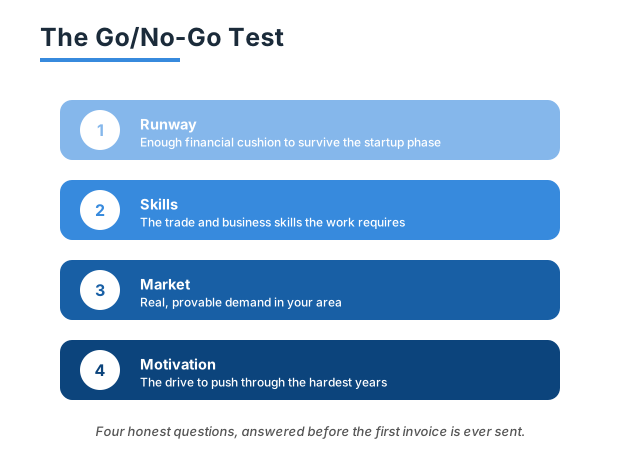
Before you write a single line of a business plan, answer these four questions out loud. This isn't a personality quiz. It's a gate — the same gate every contractor in this book has to pass through before Chapter 2 means anything. Miss one question and you're not ready yet, and that's useful information, not a failure.

1. Runway — can you survive six months on reduced or no income?

Not "would it be tight." Mortgage, groceries, insurance — all of it, with no functioning business behind it yet. If the honest answer is no, your first project isn't a business. It's a cash cushion.

2. Proof — do you have three customers who would follow you today?

Not people who "probably would." People who've already told you, unprompted, that they'd hire you directly. If you can't name three, you don't have a customer base. You have a hope.

3. Motive — can you separate the job you're leaving from the business you're building?

Strip away every annoying thing about your current boss. Do you still want to run a company? If the real driver is escaping a bad situation, fix that first. It's faster and it's free.

4. Ownership — are you willing to run the business, not just do the trade?

Invoicing. Collections. Insurance paperwork. Marketing. Turning down jobs that don't pay enough. If you just want to do the work and hand the rest to somebody else, you're not ready to own the company. You're ready to be the best employee a good company has.

Runway. Proof. Motive. Ownership. Four letters worth remembering: R-P-M-O. Miss one, and the engine you're about to build stalls before it turns over.

Four yeses, and you've passed the Go/No-Go Test — you're ready to build the foundation in the next chapter. Two or three, and you're close: go close the gap first. Zero or one, and this isn't your year. That's a completely legitimate answer, and it's a cheaper one to hear now than after the truck's been paid for.
Real Contractor Example

Mike didn't quit that night. He put the card on the kitchen table and ran all four questions out loud with his wife. First honest answer: no. They had four months saved, not six.

So they built the missing two months instead of ignoring the gap. Mike started quietly telling a handful of trusted customers, off the clock, that he was thinking about going out on his own. By the time he actually gave notice, he had six months of runway and four customers who'd already said yes before he asked.

Two towns over, an electrician named Danny hit the same fork the same week — and answered it the opposite way. Danny got passed over for a bonus he'd earned, blew up at his boss, and quit on the spot. No cushion. No customers lined up. Just anger wearing the disguise of ambition.

He bought a truck. He bought tools he barely used. Eight months later he was back on someone else's payroll, three thousand dollars in debt, telling anyone who'd listen that "the timing was wrong."

The timing wasn't wrong. The question was never asked. Same skill. Same trade. One man answered should I before he answered could I. The other never asked at all.

A business built to escape something rarely survives the first hard month it faces. A business built toward something usually does.

Action Checklist

  • Pull three months of bank statements and calculate your real monthly expenses — not an estimate.
  • Count your actual cash runway, saved and untouched, in months, not dollars.
  • Write down the name of every customer who's ever said they'd hire you directly.
  • Have one honest, out-loud conversation with your household about the real financial risk — before you decide, not after.
  • Score yourself on Runway, Proof, Motive, and Ownership in writing.
  • If you land on two "no" answers or more, pick the biggest one and set a date to fix it before you revisit this decision.

Key Takeaways

Being great at the trade and being ready to run one are two separate qualifications — and only the first one shows up on a résumé. The Go/No-Go Test drags Runway, Proof, Motive, and Ownership into the light before you've spent your savings finding them the hard way. A "not yet" today is the cheapest lesson you'll ever get on this decision. And the businesses that last are almost never the ones built to run from something. They're the ones built to run toward it.

Reflection Questions

Where do you stand on Runway, Proof, Motive, and Ownership right now? If you landed on a "no," what's the smallest thing you could do this month to flip it? Who else needs a seat at this conversation before it's final? Are you being pulled toward ownership — or pushed out of your current job? Because that difference will decide whether this business survives its first bad month.


Passing the Go/No-Go Test doesn't mean you're ready to do any job for anyone who'll pay you. It means you're ready to choose — and choosing wrong here is how good contractors end up trapped running the wrong business for the next twenty years. Before you hire your first employee, before you buy your second truck, before you ever worry about culture or systems or scale, you have to decide exactly who you're going to serve. Chapter 2 is where you make that choice.

Scroll to Top