Chapter 7: Follow Every Dollar
Chapter 7

Follow Every Dollar

Mike walked into their Thursday coffee practically glowing. He'd had the best month of his business, no contest. More jobs booked than ever. His dashboard from Chapter 6 was full of green numbers — leads up, close rate up, average ticket holding steady.

The Challenge

Every contractor eventually hits Mike's exact moment — a record month that somehow leaves the bank account thinner than a slow one. It feels like a math error. It isn't. It's a timing error, and timing errors are one of the most common ways a genuinely profitable contracting business ends up in real trouble.

A business can be profitable on paper for months and still fail, not because the work wasn't worth doing, but because the cash to cover this week's bills never arrived in time to cover them. Understanding the difference between what you earned and what you actually have on hand isn't accounting trivia. It's the difference between sleeping fine on a Sunday night and lying awake doing math you should have done a week earlier.

Why It Happens

Here's the part nobody explains to a new contractor: money doesn't move through a business all at once. It moves in stages, and every stage takes a bite before the rest keeps traveling. Revenue is what customers pay you. Cash is what keeps you alive. They're related, but they don't arrive on the same schedule, and a business can be completely healthy on one measure while quietly starving on the other.

Think about what actually happens between a customer handing over a check and that money becoming something Mike can keep. Materials had to be paid for, often before the job was even finished. Labor had to be paid, on a schedule that doesn't wait for the customer's invoice to clear. Insurance, truck payments, and overhead show up on their own calendar, completely indifferent to how good or bad last month's sales were. Taxes take their share, sometimes on a delay that lulls an owner into thinking the money is safely theirs, right up until a quarterly bill proves otherwise. Only after every one of those stages takes its cut does anything resembling profit exist — and even then, profit sitting on a spreadsheet is not the same as cash sitting in an account you can actually spend from.

Profit is an opinion until the cash reaches your account. A job can be profitable the moment it's invoiced and still leave you cash-poor for weeks if the customer takes thirty days to pay while your material supplier wanted payment up front.

The Framework: The Journey of a Dollar

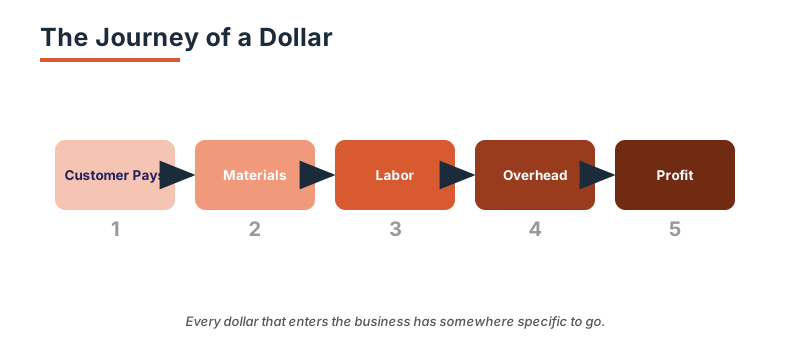
The Journey of a Dollar

Every dollar that enters your business travels the same road, in the same order, whether you're watching it or not. Understanding the road is the whole skill.

Stage 1

Customer Pays. The dollar enters the business. This is the moment most contractors mentally count the money as "theirs." It isn't yet. It's just arrived at the front door.

Stage 2

Materials. Before anything else, the dollar has to cover what was physically used on the job — pipe, wire, shingles, whatever the trade requires. On jobs where materials are purchased up front, this stage can happen before the customer dollar even shows up, which is exactly the trap that caught Mike.

Stage 3

Labor. The dollar covers the hours worked to complete the job — your technician's pay, and eventually your own, once you stop thinking of your paycheck as whatever's left over.

Stage 4

Overhead. The dollar covers the cost of running the business at all, regardless of any single job — the truck payment, the insurance, the phone bill, the shop rent if you have one. Overhead doesn't care which job is in front of you. It shows up every month either way.

Stage 5

Taxes. The dollar sets aside what you'll eventually owe — payroll taxes, sales tax, income tax. This stage is invisible for months at a time, which is exactly why it ambushes so many contractors on a quarterly due date they'd half-forgotten about.

Stage 6

Debt. If the business carries a loan, a line of credit, or equipment financing, the dollar covers that obligation next. Debt payments are fixed and impatient — they don't shrink just because business was slow last month.

Stage 7

Profit. What's left after every prior stage is profit — the actual reward for running the business, not just working in it. This is usually a much smaller number than the revenue that started the journey, and for most contractors, it's the first time they've ever actually calculated it honestly.

Stage 8

Cash Remaining. Even profit isn't the end of the story. Cash remaining is what's physically sitting in the account once timing gets factored in — money you're owed but haven't collected yet doesn't count, and money you owe but haven't paid yet does. This is the number Mike actually needed to be watching, and the one his dashboard hadn't been tracking yet.

Notice that profit and cash remaining show up in two different stages, at two different times. That gap — the space between a job being profitable and the cash from it actually landing safely in your account — is where almost every "I thought we were making money" conversation lives.

A Few Terms Worth Knowing — Only the Ones You Actually Need

Revenue is simply everything customers paid you, before anything gets subtracted. It's the biggest number in the business and the least useful one on its own.

Gross profit is revenue minus the direct cost of doing the job — materials and labor. This tells you whether a specific job was worth doing at all, separate from how the rest of the business is running.

Operating expenses are the costs of keeping the business open regardless of any single job — overhead, insurance, the truck payment. These get paid whether you had a great week or a slow one.

Net profit is what's left after gross profit absorbs operating expenses, taxes, and debt payments. This is the real reward for owning the business, and it's almost always smaller than a contractor expects the first time they calculate it honestly.

Cash flow is the actual movement of money in and out of your account over time — not a snapshot, but the whole current, including money you're waiting on and money you owe.

Working capital is the cushion you have to cover expenses while waiting on customers to pay. Thin working capital is exactly what turned Mike's great month into an empty account — the money was coming, eventually, but "eventually" doesn't cover Thursday's payroll.

Accounts receivable is money customers owe you that hasn't arrived yet. It looks like an asset. It spends like nothing at all until it's collected.

Accounts payable is money you owe someone else that hasn't left your account yet. It looks like cash you still have. It isn't really yours.

That's the whole list. You don't need a degree to use any of it — you just need to know which stage of the journey each term is describing.
Common Contractor Money Leaks

Money doesn't usually disappear all at once. It leaks, quietly, through habits that feel too small to matter until you add up a year of them.

Underpricing

is the biggest leak of all, because it doesn't feel like a leak — it feels like winning the job. Every underpriced job silently shrinks Stage 7 before the work even starts.

Excess callbacks

eat labor and material twice for a job that only got paid for once. A callback isn't just an inconvenience. It's a second trip through Stages 2 and 3 with no matching dollar coming back in at Stage 1.

Slow collections

stretch out the gap between a job being profitable on paper and the cash actually landing — the exact gap that emptied Mike's account this month.

Buying too much inventory

ties up cash in materials sitting on a shelf instead of moving through a job and back out as profit. It feels responsible. It's actually cash quietly parked somewhere it isn't earning anything.

Idle labor

— a technician sitting between jobs, waiting on a delayed start or a scheduling gap — is labor cost leaving Stage 3 with nothing to show for it at Stage 1.

Equipment downtime

does the same thing from a different angle: a broken truck or a down tool doesn't stop the overhead payment attached to it, even while it isn't earning anything.

Fuel waste

— bad routing, unnecessary trips, idling trucks — is a small leak per job and a real number over a year, especially for a growing fleet.

Financing trucks incorrectly

— stretching payments too thin or too short, financing at the wrong rate — quietly inflates Stage 4 every single month for years at a time.

Small purchases nobody notices

— a subscription here, a supply run there, a few dollars at a time — rarely show up as one big number. They show up as death by a thousand cuts on the overhead line.

Poor scheduling

— gaps between jobs, wasted drive time, double-booked technicians — leaks money at almost every stage of the journey simultaneously.

None of these leaks are dramatic on their own. That's exactly what makes them dangerous. A dramatic loss gets noticed immediately. A quiet leak gets discovered eight months later, usually during a month that should have felt like a record month instead of an empty one.

Practical Exercise: Follow One Invoice

Here's the fastest way to make this real. Pick one completed job from the last month — a normal one, not your biggest or smallest. Say the customer paid $1,200.

Write down, line by line, where that $1,200 actually went:

Materials — say $280 for parts and supplies. Labor — say $360 for the hours your technician spent on-site. Fuel — a real number, even if it's a rough estimate, say $25. Insurance — a proportional slice of your monthly premium, say $40. Taxes — set aside roughly 25–30% of whatever's left as a placeholder, since the exact number depends on your situation. Office and overhead — phone, software, admin time, say $60.

Add it up. What's left after all of that is your actual profit on that one job — often startlingly smaller than the $1,200 that first showed up. And separately, ask what's already left your account versus what's still sitting as a receivable if the customer hasn't paid yet.

The goal here isn't perfect accounting. Your bookkeeper handles that. The goal is awareness — the same shift Mike experienced building his dashboard in Chapter 6, applied one level deeper. Once you've followed one invoice all the way through, you'll never look at a "big job" the same way again without silently running it through these stages.

Warning Signs

"We're always busy but never have cash."

This almost always means a working capital problem — you're profitable, but the gap between paying for a job and getting paid for it is too wide for your cash cushion to cover.

"We made money on paper."

This is the exact sentence Mike said at the start of this chapter, and it usually means profit and cash timing have drifted apart — the business is healthy, but the calendar isn't cooperating.

"I have to use my credit card between payrolls."

This is one of the loudest warning signs in contracting, and it usually means collections are too slow, pricing is too thin, or both — the business is patching a cash gap with debt instead of closing the gap itself.

"I don't know what jobs are actually profitable."

This means Stage 2 and Stage 3 costs aren't being tracked per job, which means every pricing decision going forward is still a guess dressed up as a business plan.

Real Contractor Example, Continued

Mike ran his own invoice exercise that weekend, using a mid-sized water heater replacement he remembered clearly. The $1,200 job left him with a real profit of just under $310 once he was honest about materials, labor, fuel, his insurance slice, and the tax set-aside he'd been ignoring. It wasn't a bad number. It also wasn't the number in his head when he'd told Sarah "best month yet" a few days earlier — because that number had been revenue, not the dollar's actual journey.

The bigger discovery was in his accounts receivable. Three of his biggest jobs that month were still unpaid, sitting comfortably as "money coming soon" while his actual bank account handled payroll, insurance, and materials with cash that had already left. He wasn't unprofitable. He was thin on working capital, at exactly the wrong moment, because he'd never separated "I earned this" from "I can spend this yet."

He started two changes that week: a simple rule requiring a deposit on any job over a certain size before materials got purchased, and a weekly fifteen-minute review of exactly which invoices were still outstanding, instead of finding out by accident when the account ran low.

Busy creates invoices. Cash pays payroll. Mike had plenty of the first and was starting to run short on the second — and now, for the first time, he knew exactly why.

Action Checklist

  • Follow one completed invoice, line by line, from customer payment to actual profit remaining.
  • Calculate gross profit on your last five completed jobs, not just total revenue.
  • Review every unpaid invoice on your books right now and note how many days each has been outstanding.
  • List your recurring monthly expenses and confirm none of them have quietly crept up without you noticing.
  • Identify one expense this month that isn't earning its place in the business, and cut or renegotiate it.
  • Calculate your weekly cash requirement — payroll, recurring bills, and materials — so you know the number you actually need on hand, not just the number you hope to see.

Key Takeaways

Revenue does not build businesses. Cash flow does — and a contractor who understands where every dollar goes, from the customer's payment through materials, labor, overhead, taxes, debt, and finally profit, can predict a cash crunch weeks before it happens instead of discovering it the hard way. Profit and cash are not the same thing, and they almost never show up on the same calendar day. Businesses rarely fail because they're unprofitable. They fail because they run out of cash while waiting for profit to arrive.

Reflection Questions

Could you explain, right now, where every dollar from your last completed job actually went? What expense, once you actually looked, surprised you the most? Are you making profits, or just creating invoices and calling it the same thing? Which single money leak from this chapter is quietly costing you the most, and what would it take to close it this month?


Following the dollar tells you where the money goes once it arrives. It doesn't yet tell you how to price the next job so more of that dollar survives the whole journey in the first place. Chapter 8 is where pricing stops being a guess and starts being a system.

Scroll to Top