Chapter 10: Your Reputation Arrives Before You Do
Chapter 10

Your Reputation Arrives Before You Do

Mike had gotten good at the TRUST Conversation. Estimates felt different now — slower, more like a real conversation, less like a performance. He was asking better questions, listening more, and closing at his new, higher prices more often than not.

The Challenge

Contractors spend years mastering the trade, learning to price with confidence, and learning to sell through trust instead of pressure — and then lose jobs to competitors they could out-work without breaking a sweat, simply because the customer never got far enough to find that out. People don't buy from strangers. They buy from businesses they already trust — and a lot of that trust gets built or destroyed before the first phone call ever happens.

Why It Happens

Every contractor believes the estimate is where the sale gets decided. Increasingly, it isn't. A homeowner with a problem does what almost everyone does now — they search, they compare, they read what other people said about a handful of companies, and by the time they call, they've usually already narrowed the field down to two or three names they feel reasonably good about.

Your reputation is answering questions on your behalf before you're even in the room: Can I trust them? Will they answer the phone? Will they actually show up? Can they solve my specific problem? Will they stand behind the work if something goes wrong? An outdated website, a handful of stale reviews, and inconsistent contact information answer all five of those questions with a quiet "maybe not" — regardless of how good the actual work is.

Every review is another salesperson working for your company, around the clock, saying things a homeowner trusts more than anything you could say about yourself in an estimate.

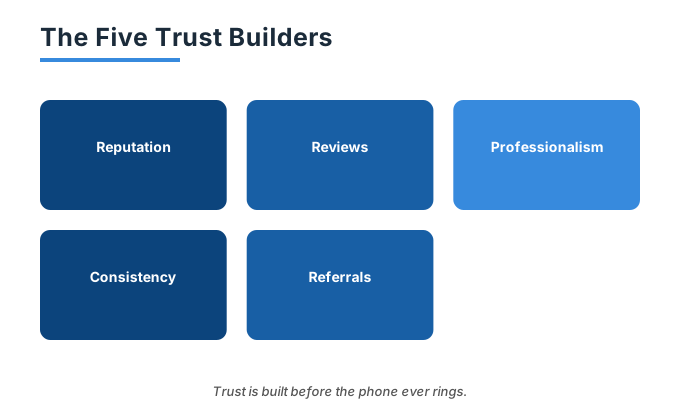
The Framework: The Five Trust Builders

Five Trust Builders
1

Reputation.

The overall impression a stranger forms about your business within the first minute of looking at it — website, photos, online presence, all of it working together or working against you.

2

Reviews.

Specific, recent, written proof from real customers that you did what you said you'd do. Volume matters. Recency matters more.

3

Professionalism.

Consistent branding, a clear voicemail greeting, prompt responses — the small signals that tell a stranger you run a real business, not a side gig.

4

Consistency.

The same business name, the same contact information, the same quality of work, everywhere a customer might encounter you. Inconsistency reads as risk, even when nothing is actually wrong.

5

Referrals.

A direct recommendation from someone the customer already trusts, which is the fastest trust-builder of all five — and the one most contractors do the least to intentionally earn.

Each of these answers part of the trust question before you ever open your mouth. Neglect all five, like Mike had, and a customer arrives at the estimate already halfway out the door, no matter how good your TRUST Conversation turns out to be.

Common Reputation Mistakes

Ignoring reviews.

Not responding to them, not tracking them, not noticing when they've gone quiet for over a year — all of it tells a searching customer the business isn't actively being run with any real attention.

Never asking satisfied customers for referrals.

Happy customers rarely volunteer a referral unprompted. A simple, direct ask after a great job is often the only thing missing.

An outdated website.

A site that hasn't been touched in years reads, fairly or not, as a business that might not still be around.

A poor Google Business Profile.

For most local searches, this is the very first impression a stranger forms — wrong hours, missing photos, or no recent activity quietly costs jobs nobody ever hears about losing.

An unprofessional voicemail.

A rushed, unclear, or outdated greeting undercuts every other signal of professionalism the business is trying to send.

Slow response.

A customer comparing three contractors usually books with whoever responds fastest and most clearly, often before the slower companies have even called back.

No before-and-after photos.

Photos are proof. Their absence leaves a customer to imagine the quality of your work instead of seeing it.

No testimonials.

A specific quote from a real customer does more convincing in ten seconds than a page of self-description.

Different business names across platforms.

A slightly different name on the truck, the website, and the invoice quietly signals disorganization, even when the business itself is perfectly solid.

Broken promises.

Nothing damages reputation faster or more permanently than saying you'll do something — call back, show up, follow up — and not doing it.

Real Contractor Example: Two Companies

Company A

has five reviews total, the most recent one three years old. Its truck photos are faded and outdated. Its website hasn't been touched since it was built. There are no project photos anywhere online.

Company B

has several hundred recent reviews. Its photos are professional and current. Its website is updated regularly, with consistent branding across every platform. It publishes short, helpful content that answers common customer questions. It responds to new inquiries within the hour.

Ask yourself honestly: if you were the homeowner with the flooding basement from Chapter 9, searching both companies at eleven at night, which one would you call first? Most people never even get to comparing the actual work — the decision is functionally over before either company's technician ever knocks on a door.

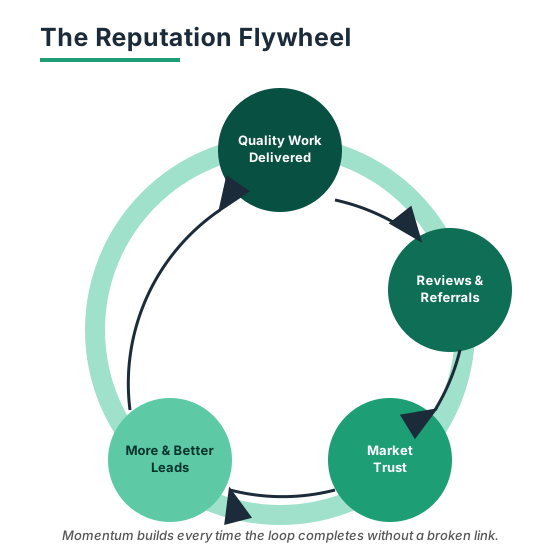
The Reputation Flywheel

The Reputation Flywheel

Reputation isn't built once. It compounds, turn after turn, the same way every time:

Great Work Happy Customer Review Trust More Calls More Jobs Great Work

The flywheel only works in one direction. Skip the review step — never ask, never follow up — and the flywheel stalls after the first turn, no matter how good the work was. Reputation isn't a byproduct of good work. It's a deliberate step that has to be taken on purpose, every single time.

Practical Exercise

Do exactly what Sarah asked Mike to do. Search your own company online, the way a stranger with a problem and no loyalty to you yet would search it. Look at your Google Business Profile, your website, your reviews, your photos, and how quickly your business actually responds to a new inquiry. Then ask yourself honestly: based only on what you just saw, would you hire yourself?

Warning Signs

"We never ask for reviews."

This usually means a happy customer's trust is being left on the table instead of turned into proof for the next one.

"Our last online review was months ago."

This usually signals to a searching customer that the business might not be as active, or as good, as it actually is.

"We rely entirely on referrals."

Referrals are valuable, but relying on them exclusively means the business has no system for reaching the much larger number of customers who don't already know someone who's used you.

"We lose jobs before giving estimates."

This is often the clearest sign of all that the reputation, not the pricing or the pitch, is the actual problem.

"I've never searched my own company."

This means the business is being run entirely from the inside, with no idea what a new customer's very first impression actually looks like.

Action Checklist

  • Search your own company online exactly the way a stranger would.
  • Read every review your business currently has, good and bad.
  • Ask your next five satisfied customers directly for a review.
  • Update your business photos — truck, crew, and finished work.
  • Verify your business name, phone number, and hours are identical across every platform.
  • Pick one first impression — website, voicemail, Google profile — and improve it this week.

Key Takeaways

Your reputation is your first employee, working around the clock to answer the trust questions a customer is asking long before they ever call. The Five Trust Builders — Reputation, Reviews, Professionalism, Consistency, and Referrals — answer those questions on your behalf, or quietly answer them against you if left unattended. The Reputation Flywheel only turns when a happy customer's trust gets deliberately converted into a review, over and over, rather than left to chance. Marketing gets attention. Trust wins customers — and trust is being built or lost long before the estimate ever happens.

Reflection Questions

Would you hire your own company, based purely on what a stranger would see online? What impression do you think customers form of your business in the first sixty seconds of looking it up? Which of the Five Trust Builders needs the most attention right now? What's one thing you could do this week to make trusting you just a little bit easier?


Mike sat with his phone in his hand for a long moment after that Thursday coffee, looking at the gap between his own listing and his competitor's. It wasn't really about the website, or the reviews, or the photos — not entirely. It was about realizing, all over again, that running a business meant paying attention to things that had nothing to do with how well he could actually do the work.

He thought back to the man who'd sat in his truck at 6:45 that first Tuesday morning, card in hand, wondering if he should even start. That man had believed success meant working harder — showing up earlier, saying yes more, doing more of everything himself. The man sitting across from Sarah now understood something different: success came from thinking differently, not just working harder at the same old thinking.

"You've stopped acting like a technician who owns a truck," Sarah said, watching him.

Mike almost laughed. "Feels like it took long enough."

"It always does." She paused, and there was something almost ceremonial in it, like she knew exactly what came next. "Now it's time to learn how to build a company."

Part One taught you how to think like an owner — choosing the right business, escaping the Technician Trap, building systems, knowing your numbers, pricing with confidence, selling through trust, and building a reputation that works even while you sleep. Part Two is where all of that thinking finally gets tested against something harder than your own habits: other people. Mike is about to hire his first employee — and discover that everything he's learned so far was really just preparation for the part of the business that was never about him at all.
Scroll to Top