Chapter 16: Vision Gives People a Reason to Follow
Chapter 16

Vision Gives People a Reason to Follow

Everything was working. Systems, accountability, a technician who was genuinely engaged, customers who were genuinely happy. Mike had started to believe he'd finally figured this whole thing out.

The Challenge

Then, one ordinary afternoon between jobs, his technician asked a question that stopped him cold.

"Mike — where do you see this company in five years?"

Mike laughed, a little nervously, buying time. "I guess... more trucks."

His technician smiled politely and waited a beat. "But why?"

Mike opened his mouth and realized he didn't have an answer. Not a real one. He'd spent so long learning to run the business — pricing, selling, hiring, systems, accountability, leadership — that he'd never once stopped to ask where any of it was actually headed, or why it should matter to anyone beyond himself.

He told Sarah about it that evening. "I've spent years learning how to run the business."

She nodded, unsurprised. "And now it's time to decide where it's going."

Vision turns jobs into journeys. Without one, even a well-run business eventually becomes just another place to clock in — for the owner as much as for the employees.

A business can run beautifully — good systems, good people, good numbers — and still lack the one thing that makes people want to stay for years instead of months: a reason bigger than the next paycheck or the next job. People don't give their best to confusion. A team that knows what to do but not why it matters will always plateau at competence. They rarely reach commitment.

Mike's technician wasn't asking a trick question. He was asking, honestly, whether there was something worth building here beyond a steady job — and Mike, for the first time, had to admit he hadn't thought about it either.
Why It Happens

Most contractors are so consumed by the daily work of running the business that vision feels like a luxury reserved for bigger companies. It isn't. It's the difference between a team that follows instructions and a team that actually believes in where those instructions are leading.

Goals have deadlines. Vision has direction. Goals are achieved and then replaced by the next goal. Vision continues, unbroken, giving every goal along the way a reason to matter. A company that hits every target but has no vision behind them eventually notices something strange: growth stops feeling meaningful, and eventually it stops happening at all, because nobody — including the owner — remembers what any of it was actually for.

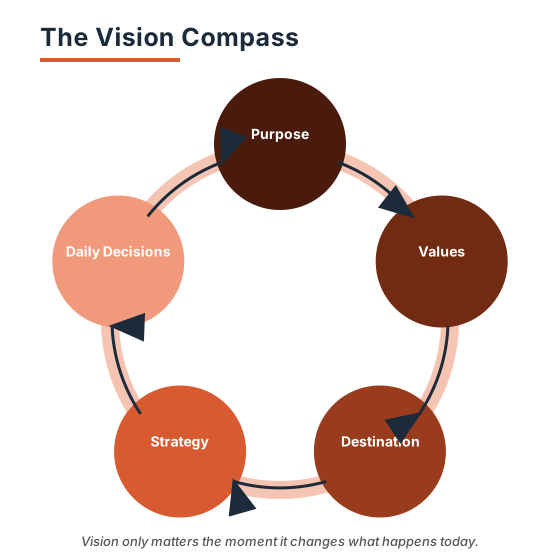
The Framework: The Vision Compass

bbok

Purpose

sits at the center of everything — the honest answer to why do we exist beyond making money. Money is a result of purpose done well. It was never the purpose itself.

Values

come next — the specific things your company will never compromise on, regardless of pressure or opportunity.

Destination

follows — a clear picture of where the company is actually headed, specific enough that someone could recognize it when they arrive.

Strategy

answers how — the practical plan for actually reaching the destination, built on top of purpose and values, not separate from them.

Daily Decisions

sit at the bottom of the compass, and they're the whole point of everything above them — every decision either moves the company closer to its destination or quietly pulls it further away.

Purpose answers why we exist. Vision answers where we're going. Strategy answers how we'll get there. Skip straight to strategy without the purpose and destination underneath it, and you end up with a plan nobody particularly cares whether it succeeds.

Goals vs. Vision

Mike had plenty of goals — more trucks, more revenue, more customers. What he didn't have was vision, and the difference matters more than it sounds like it should. Goals are achieved and checked off. Vision continues, giving every goal a reason to exist in the first place. A company that reaches every single goal on its list, but has no vision underneath them, eventually stops growing — not because it ran out of goals to set, but because nobody, including the owner, remembers what any of the growth was actually building toward.

Employees, it turns out, need direction far more than they need numbers. A revenue target tells someone what to hit. A vision tells them why hitting it matters.

Common Vision Mistakes

Confusing revenue targets with vision.

A number on a whiteboard is a goal, not a reason to care about reaching it.

Writing mission statements nobody remembers.

A vision statement so polished and generic that no employee could repeat it in their own words isn't actually doing its job.

Never discussing the future.

If every conversation is about today's schedule, nobody ever gets a glimpse of where any of it is leading.

Changing direction constantly.

A vision that shifts every few months teaches a team not to invest in believing it.

Keeping the vision only inside the owner's head.

A vision nobody else knows about can't inspire anybody else's effort.

Building a business that exists only to create income.

Income is a legitimate need. It's rarely, on its own, something a team rallies around for years.

Sarah's Story

Sarah told Mike about a moment early in her own leadership journey when she'd asked her team, almost casually, "Why do we come to work?" One employee answered honestly: "To fix plumbing." Another, just as honestly: "To get paid."

"Neither answer was wrong," Sarah said. "But I realized, sitting there, that if those were the only reasons anyone worked for me, then any competitor willing to pay a dollar more an hour could take them from me at any moment. There was nothing underneath the paycheck holding anyone here."

She spent months afterward clarifying what her company actually stood for, beyond fixing HVAC systems for a fee. What she landed on was simple: helping families feel safe and comfortable in their own homes. That purpose changed how she hired, how her team talked to customers, and how decisions got made when there wasn't an obvious right answer. Profit funds the mission. It is not the mission — and once her team understood that, the mission started doing work the paycheck alone never could.

Real Contractor Comparison

Company A

employees know today's schedule perfectly well. Nobody knows what the company is actually building toward next year. Turnover sits at an unremarkable average. Growth happens in fits and starts, entirely dependent on whatever the owner happens to be focused on that particular month.

Company B

employees understand, in their own words, why the company exists. They suggest improvements without being asked, because they feel like builders instead of hired hands. Customers notice something intangible about the culture that's hard to name but easy to feel. People refer their friends to work there. Growth accelerates, not because the strategy is more sophisticated, but because everyone involved is actually pulling in the same direction, for the same reason.

People support what they help create. A shared purpose doesn't just motivate individual effort — it multiplies it, because everyone on the team is finally rowing toward the same destination instead of just completing their own assigned tasks.

The Five Vision Questions

Answer these in plain language, the way you'd actually talk to your own team — not the way a corporate mission statement gets written.

Why does this company exist?

Beyond the trade itself, beyond the money.

Who do we serve best?

The specific customer your business is genuinely built for — echoing the Customer Fit from Chapter 2's FIT Filter.

What kind of company are we becoming?

Not what you are today, but what you're deliberately building toward.

What values will never change?

The non-negotiables, regardless of pressure, growth, or opportunity.

What will success look like ten years from now?

Specific enough that your team could recognize it clearly if they saw it.

Practical Exercise

Write one paragraph, imagining your company exactly ten years from today. Describe the customers you serve, the employees who work there, the reputation you've built, the culture people feel when they walk in, and the impact you've had on your community. Read it out loud to yourself, and then to your team. The future should be visible before it becomes reality — if your team can't understand your vision within two minutes of hearing it, simplify it until they can.

Warning Signs

Employees only do the minimum.

This usually means there's nothing bigger than the paycheck asking for more of their effort.

Nobody suggests improvements.

This usually means the team doesn't feel like builders — they feel like hired hands completing assigned tasks.

Every decision depends on the owner.

This usually means there's no shared vision clear enough for anyone else to make a decision by referencing it.

The company reacts instead of planning.

This usually means there's no destination pulling decisions forward — only whatever's most urgent today.

People don't know what success looks like.

This means the Destination piece of the Vision Compass has never actually been defined out loud.

Action Checklist

  • Write your company's purpose in one honest sentence.
  • Define the five core values your business will never compromise on.
  • Describe your ten-year vision in a single paragraph.
  • Share it directly with your team, in your own words, not a polished statement.
  • Connect at least one decision each week explicitly back to the vision.
  • Revisit and refine the vision every quarter, as the business itself grows and changes.

Key Takeaways

People can follow instructions, systems, and even good leaders — but lasting companies are built by people who genuinely believe in where they're going. The Vision Compass — Purpose, Values, Destination, Strategy, Daily Decisions — starts with why the company exists, not with revenue. Goals have deadlines and get achieved. Vision has direction and continues, giving every goal along the way a reason to matter. A company without vision eventually becomes busy without purpose, no matter how well it's being managed.

Reflection Questions

Would your employees describe your company's vision the same way you would, if asked separately? Does your business stand for something beyond profit, in a way your team could actually articulate? If your company disappeared tomorrow, what would your customers genuinely miss? What legacy are you actually building, one ordinary week at a time?


A few weeks later, Mike gathered his small team before the workday started. Instead of running through the day's jobs like usual, he talked, plainly and a little nervously, about the kind of company they were actually building — who they served, what they stood for, where he hoped they'd be in ten years.

His technician smiled afterward. "I've never worked somewhere that talked about the future like that."

Sarah, who'd come by to watch, said quietly once the meeting ended, "Now everyone knows where they're going."

"So what's next?" Mike asked.

"Knowing where you're going isn't enough," Sarah said. "You also have to start making decisions that actually get you there."

Chapter 17 is where you learn exactly how to do that.

Scroll to Top