Chapter 17: Every Decision Builds-or Breaks-Your Business
Chapter 17

Every Decision Builds-or Breaks-Your Business

Mike had a team now, systems that worked, real accountability, and for the first time, an actual vision his people understood. He felt, for once, like the business was standing on solid ground.

The Challenge

Businesses rarely change because of one giant decision. They change because of thousands of small ones - a hiring choice here, a customer exception there, a shortcut taken "just this once" until "just this once" becomes simply how things are done. Today's shortcut becomes tomorrow's culture.

Mike's Saturday phone call wasn't really about one job. It was about whether the vision he'd shared with his team a few weeks earlier was a real commitment or just a nice conversation that evaporated the moment money and pressure showed up together.
Why It Happens

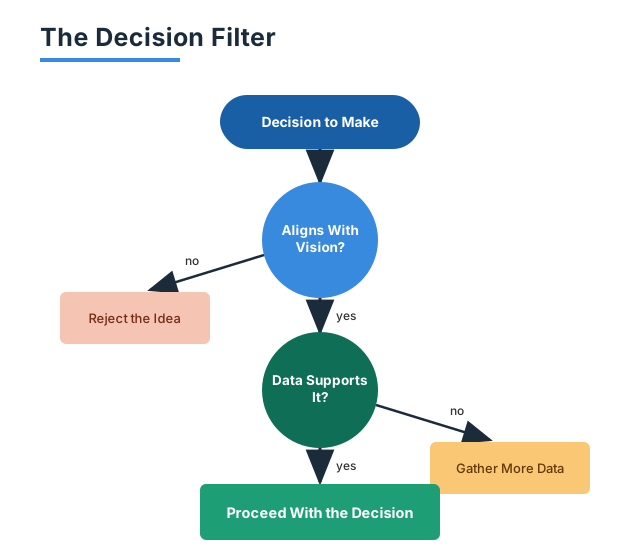
Under pressure, most owners react instead of decide. Reaction responds to pressure. Decision follows principles. A reaction happens fast, feels justified in the moment, and rarely gets checked against anything larger than the immediate situation. A decision, by contrast, gets measured against something that existed before the pressure ever arrived.

Pressure reveals leadership. Anyone can follow their stated values when nothing's on the line. The real test - the one that actually shapes a company's culture - comes when following them costs something real, like a weekend, a customer, or a check that would have felt good to cash.

The Framework: The Decision Filter

Decision Filter

Run any significant decision through five questions, in order, before acting on it.

Does it serve our customer?

Not just this customer, in this moment - the kind of customer relationship you're actually trying to build.

Does it align with our values?

The non-negotiables from Chapter 16's Vision Compass, checked honestly, not conveniently reinterpreted for the situation.

Does it support our vision?

The destination you're building toward, not just whatever feels urgent today.

Can we sustain it?

If you make this same call every time a similar situation arises, does the business hold up - or does it quietly bend a little further each time?

Would I be proud if my team copied this decision?

The sharpest question of the five, because a team always eventually copies what their leader actually does, not what their leader says.

Mike's Saturday decision failed the fourth and fifth questions almost immediately. He couldn't sustain saying yes to every emergency cash offer without eventually breaking every boundary he'd set. And he wouldn't have been proud if his technician made the exact same call - skipping a promised commitment for a good enough excuse - the next time it was his turn to decide.

Common Decision-Making Mistakes

1

Making exceptions constantly.

Every exception quietly redefines the actual standard, regardless of what the stated standard claims to be.

2

Choosing short-term money over long-term trust.

A quick win today can cost far more in eroded trust - with employees, with yourself - than the dollar amount ever suggests.

3

Changing standards for difficult customers.

Bending a boundary for the loudest or most persistent customer teaches everyone, including your own team, that boundaries are negotiable under enough pressure.

4

Ignoring company values when profits are involved.

Values that only apply when they're convenient were never really values - they were preferences.

5

Making emotional decisions when tired.

Exhaustion narrows judgment to whatever feels easiest in the moment, which is rarely the same as what's actually right.

6

Confusing urgent with important.

An emergency phone call feels urgent. It isn't automatically important enough to override a real commitment.

7

Trying to please everyone.

A decision built to avoid disappointing anyone usually ends up serving no one particularly well, including the business itself.

8

Never saying no.

An owner who can't say no to anything eventually has no actual standards left to protect.

Sarah's Story

Sarah remembered a stretch, years earlier, where she said yes to nearly everything - every customer request, every discount, every last-minute emergency, regardless of what it cost her personally. One Friday, she missed her son's school performance for a customer emergency call, and the customer complained anyway, entirely unsatisfied despite the sacrifice.

"That was the moment I understood I wasn't running a business," she told Mike. "I was reacting to whoever called last, with no principle guiding any of it." That was the week she sat down and actually wrote her company's decision principles - the specific, non-negotiable rules she'd hold to, regardless of how persuasive the next request turned out to be.

Real Contractor Comparison

Company A

Says yes to everything. Schedules shift constantly to accommodate whoever asks loudest. Employees grow frustrated, never quite sure what the real standard actually is from one week to the next. Customers receive an inconsistent experience depending entirely on the mood and pressure of the moment. The owner burns out trying to satisfy everyone simultaneously.

Company B

Has clear decision principles, established in advance, applied consistently regardless of who's asking or how much money is on the table. Priorities get protected, even when it's uncomfortable. Customers understand and respect the expectations because they're consistent. Employees trust leadership, because leadership's actions match its stated values even under pressure. Growth becomes predictable, because the business isn't constantly whipsawing between conflicting standards.

A company becomes what it repeatedly chooses. Not what it says in a vision statement - what it actually does, decision by decision, especially the small ones nobody's watching closely.

The Five Decisions Every Owner Makes Daily

Nearly every meaningful business decision falls into one of five categories: customers - who to serve and how; employees - how to treat, develop, and hold them accountable; time - what gets protected and what gets sacrificed; money - what gets spent, saved, or turned down; and reputation - what the business is willing to be known for.

Mike's Saturday decision touched all five at once - a customer request, an employee's stated expectation, protected time, a cash incentive, and the reputation his team would draw conclusions from either way.

Practical Exercise

Think back over your last five genuinely difficult decisions. For each one, ask: did it actually support your vision? Would you make the exact same decision again, knowing what you know now? What principle, stated in one sentence, should guide you the next time a similar situation comes up? Write that sentence down. Collected together, these sentences become your company's actual Decision Rules - not aspirational, but built directly from real situations you've already faced.

Warning Signs

critical
urgent

Every situation feels like an exception.

This usually means there are no real standards yet, only situational judgment calls made fresh every time.

high
team

Employees don't know what to do without asking.

This usually means decision principles have never been clearly communicated, leaving everyone dependent on the owner for every judgment call.

warning
inconsistency

Different customers receive different treatment.

This usually means decisions are being made based on pressure and persuasion rather than consistent principle.

stall
regret

You regret decisions made under pressure.

This is a clear sign that reaction, not decision, is running the business in difficult moments.

silent
pivot

You constantly change your mind.

This usually means there's no stable principle underneath the decision, only whatever feels most convincing in the moment it's being made.

Action Checklist

  • Write your five Decision Rules, one for each of the five daily decision categories.
  • Share them directly with your team, in plain language.
  • Build in a deliberate pause before making any emotionally charged decision.
  • Review your most difficult decisions from the past month and check them against your stated values.
  • Identify and remove one recurring exception that's quietly become your actual standard.
  • Protect your stated values specifically in the moments when it costs you something to do so.

Key Takeaways

Businesses rarely change because of one giant decision - they change because of thousands of small ones, repeated until they become habits, and habits repeated until they become culture. The Decision Filter - does it serve the customer, align with values, support the vision, prove sustainable, and make you proud if copied - turns pressure-driven reactions into principle-driven decisions. Pressure reveals leadership, because anyone can hold their values when nothing's actually being asked of them. A company becomes what it repeatedly chooses, one ordinary Thursday phone call at a time.

Reflection Questions

What decision have you been avoiding, specifically because you already suspect the right answer? Which recent decision best represents your actual values, under real pressure? Do your daily decisions genuinely match the long-term vision you've described to your team? Would your employees make the exact same call you just made, without you in the room?


Months later, Mike noticed something that genuinely surprised him. His team had started making the same decisions he would have made - without asking, without checking, simply applying the principles that had quietly become part of how the company operated. Customers experienced real consistency. Mike's own stress, oddly, kept dropping, even as the business kept growing.

"Your business is finally starting to think for itself," Sarah told him one Thursday.

"So what comes next?" Mike asked.

Sarah smiled. "Now we make sure it keeps improving."

Chapter 18 is where you learn that small, consistent improvements - not dramatic overhauls - are what actually separate good companies from extraordinary ones.

Scroll to Top