Chapter 14: Trust, But Verify
Chapter 14

Trust, But Verify

For a few good weeks, everything held. Mike's technician worked independently, checklists handled most of the questions that used to interrupt Mike's day, and the phone stayed quiet enough that Mike started to trust the whole arrangement.

Then the small things started showing up.

A customer mentioned she hadn't gotten the courtesy call before arrival. An invoice came back missing the completion photos the checklist called for. A job-completion checklist sat unsigned in the truck. The truck itself was running low on a few parts it should have been restocked with the night before.

None of it was serious on its own. Together, it felt like something slipping.

Mike responded the only way he knew how — he started checking everything personally. Reviewing every invoice before it went out. Calling customers himself after every visit, just to be sure. Double-checking checklists that had already been signed.

His technician finally said something, quiet and direct. "Mike. Do you trust me?"

Mike paused, caught off guard. "I do

"It doesn't always feel like it."

Mike felt terrible the rest of the day. That night, he told Sarah, "I don't know how to let go without losing quality."

Sarah smiled, gently. "Good. That's the question every leader eventually asks."

Accountability creates freedom. Not the other way around — and Mike had just discovered what happens when an owner tries to skip straight to trust without ever building the accountability that makes trust safe to give.

The Challenge

Systems, from Chapter 13, solve the knowing problem - they make sure an employee has a clear answer for how to do something. They don't automatically solve the doing problem - whether that answer actually gets followed every single time, especially when nobody's watching.

Mike's instinct, once small inconsistencies appeared, was to swing hard toward control - checking everything personally. That instinct feels responsible. It's actually just the Hero Trap from Chapter 5 wearing a supervisor's clothes, and it teaches an employee exactly the wrong lesson: that their judgment doesn't matter as much as the owner's presence.
Why It Happens

Trust is essential. Blind trust is expensive. Micromanagement is exhausting. Most owners swing between the two extremes because nobody ever showed them the actual middle path - a system for measuring what matters, without hovering over every single action.

Micromanagement means watching every action. Accountability means measuring important outcomes. Those are entirely different jobs. One requires the owner's constant presence. The other requires clear expectations and a simple way to check whether they're being met - which can run perfectly well without the owner standing over anyone's shoulder.

Leaders measure outcomes. Micromanagers monitor activity. The purpose of accountability was never to catch someone doing something wrong. It's to help someone consistently do things right, with a clear enough picture of "right" that they don't need you there to confirm it.

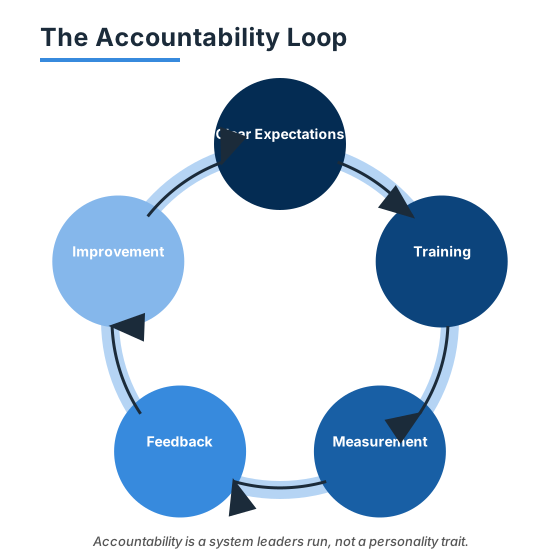
The Framework: The Accountability Loop

Accountability Loop

Accountability doesn't begin with a performance review. It begins much earlier, with clarity.

Clear Expectations. Before anything else, define exactly what success looks like for a task - not vaguely, specifically enough that two different people would agree on whether it happened.

Training. Make sure the expectation was actually taught, using the System Loop from Chapter 13 - not assumed, not implied, actually shown and explained.

Measurement. Track a small number of outcomes that tell you whether the expectation is being met, without requiring you to personally observe every instance of the work.

Feedback. Share what the measurement shows, regularly, in both directions - what's going well and what needs attention.

Improvement. Adjust the training, the system, or the expectation itself based on what the feedback reveals.

Repeat. Accountability isn't a one-time conversation. It's a loop that keeps turning, gradually building both performance and trust at the same time.

Notice that "checking on someone constantly" doesn't appear anywhere in this loop. The loop replaces constant supervision with a small number of clear signals, checked on a predictable schedule.

Common Accountability Mistakes

Assuming expectations are obvious.

What feels obvious to an owner who's done the job for years is rarely obvious to someone new - obvious needs to be said out loud and written down.

Correcting only mistakes.

If the only time an employee hears from you is when something's gone wrong, feedback starts to feel like punishment instead of coaching.

Giving feedback only when something goes wrong.

The absence of praise when things go right quietly teaches people that good work is invisible and only failure gets noticed.

Never recognizing improvement.

Growth that goes unacknowledged tends to stop, because there's no signal it was even noticed.

Changing standards constantly.

An expectation that shifts week to week is impossible to actually meet, no matter how hard someone tries.

Measuring too many things.

A scoreboard with fifteen metrics gets ignored. A scoreboard with two or three gets used.

Using fear as motivation.

Fear produces short-term compliance and long-term resentment - and it's the fastest way to make an employee stop bringing you problems early, when they're still small.

Avoiding difficult conversations.

A performance issue left unaddressed doesn't resolve itself. It just teaches everyone else on the team that the standard is optional.

Sarah's Story

Sarah remembered a stretch early on where she personally walked every completed job before it was considered finished. It felt thorough. It felt like quality control done right.

What it actually did was teach her employees to stop deciding anything on their own. Small judgment calls that used to get handled on-site started getting held for her approval instead - not because the technicians couldn't make the call, but because they'd learned that Sarah's opinion was the only one that mattered in the end anyway.

One of them finally said it plainly: "I can either think, or I can wait for you." Sarah realized, uncomfortably, that she'd trained dependence without meaning to. She stopped walking every job personally and started measuring outcomes instead - callback rates, customer feedback, completed checklists - and checked in on a schedule instead of hovering in real time. Her employees started making decisions again almost immediately, because the space for judgment had finally reopened.

Real Contractor Example: Two Companies

Company A

owner checks everything personally - every invoice, every job, every customer interaction. His employees, sensing this, stop making independent decisions and start waiting for his approval on things they're perfectly capable of deciding themselves. Work slows down, ironically, because the owner has become the bottleneck he was trying to prevent. He burns out trying to be everywhere at once.

Company B

uses simple daily scoreboards, job-completion checklists, weekly review conversations, and direct customer feedback. Expectations are visible to everyone, checked on a predictable rhythm instead of constantly. Employees become increasingly independent over time, because they can see for themselves whether they're meeting the standard, without needing the owner to confirm it in real time.

Inspect what matters. Don't inspect everything. The difference between these two companies isn't how much the owner cares. It's whether expectations are visible enough that people can hold themselves accountable to them.

The Five Accountability Scoreboards

Five simple areas cover almost everything a growing contracting business needs to track, each with only two or three indicators - enough to see clearly, not so much that it becomes noise.

Safety

incidents, near-misses, or safety-checklist completion.

Quality

callback rate, checklist completion, customer complaints.

Customer Experience

customer ratings, response time, follow-up completion.

Productivity

jobs completed, on-time arrival, schedule adherence.

Financial Responsibility

accurate invoicing, collections, expense discipline.

Pick the one or two scoreboards most relevant to your current bottleneck before trying to track all five at once. People cannot consistently achieve expectations they cannot see - a scoreboard's whole purpose is making the invisible visible, for both of you.

Practical Exercise

Choose one recurring responsibility that's been causing you concern - the exact kind of thing Mike started noticing with his technician. Build one simple scoreboard around it: jobs completed, callback rate, customer rating, on-time arrival, whatever fits the specific concern. Review the results together once a week, in a short, direct conversation focused on coaching rather than criticism - what the numbers show, what's going well, and what needs attention.

Warning Signs

Watch for these red flags - they often mean accountability has quietly slipped into micromanagement.

"I check everything."

This usually means accountability has quietly slipped into micromanagement, and independent decision-making has started to disappear as a result.

"My employees wait for permission."

This is the clearest sign that judgment has been trained out of a team, often unintentionally, by an owner who was trying to help.

"Nobody knows how they're doing."

This means feedback has become rare or vague enough that employees have no clear picture of their own performance.

"We only talk when something goes wrong."

This means feedback has become entirely negative, which teaches people to hide problems rather than raise them early.

"I fix problems instead of preventing them."

This usually means the Accountability Loop is missing its earlier steps - expectations and measurement - and everything is being caught, expensively, at the feedback stage instead.

Action Checklist

  • Define success clearly, in writing, for the one responsibility currently causing the most concern.
  • Choose three measurable expectations tied to that responsibility.
  • Create one simple scoreboard to track them.
  • Schedule a short, weekly coaching conversation to review it together.
  • Recognize one specific thing done well each week, not just what needs correction.
  • Address problems early and respectfully, before they become patterns.

Key Takeaways

The purpose of accountability was never to catch someone doing something wrong. It's to help someone consistently do things right, with expectations clear enough that they don't need you standing over them to know it. The Accountability Loop - Clear Expectations, Training, Measurement, Feedback, Improvement, Repeat - replaces both blind trust and micromanagement with something more durable: a system both of you can actually see. Clear expectations remove unnecessary conflict, and trust grows stronger, not weaker, once expectations are visible to everyone involved.

Reflection Questions

What expectations currently exist only inside your own head? What responsibility could be measured with a simple scoreboard instead of constantly supervised in person? Do your employees actually know what success looks like, in specific terms, or are they guessing? Are you, right now, building dependence - or building confidence?


Mike built his first real scoreboard the following week - three simple numbers tied to the exact concerns that had been eating at him: checklist completion, callback rate, and customer follow-up calls made. He reviewed it with his technician every Friday afternoon, fifteen minutes, no more. Within a few weeks, his technician was catching and solving small problems before Mike ever noticed them himself. Customers stayed happy. Quality, if anything, improved.

"I spend less time checking," Mike told Sarah one Thursday, "and more time actually planning."

"Exactly," Sarah said. "You've learned how to manage the work." She paused, and something in her expression told Mike there was more coming. "The next lesson is a lot harder."

"What could be harder than this?"

Sarah smiled. "Getting people to want to follow you - not because they have to, but because they choose to."

Chapter 15 is where you find out what that actually takes.

Scroll to Top