Chapter 44: The Contractor Growth System™
Chapter 44

The Contractor Growth System™

Well over one hundred trucks now. Mike rarely spent much time at headquarters anymore. Most weeks found him out at the branches instead, mentoring leaders, teaching apprentices, showing up in places where a hundred-truck company's owner had no operational reason to be, and every reason in the world.

The Journey Beneath the Journey

Every chapter of this book has told two stories at once. On the surface, it's the story of a plumbing business growing from one truck to over a hundred revenue climbing, systems maturing, leaders multiplying, markets expanding. That story is real, and it matters. It's the story most business books are content to tell.

But underneath it, chapter after chapter, a second story has been unfolding quieter, slower, and ultimately more important than the first. It's the story of a technician becoming a business owner. A business owner becoming a manager. A manager becoming a leader. A leader becoming a CEO. A CEO becoming an institution builder. An institution builder becoming, finally, a steward of something built to outlive him.

The goal was never one hundred trucks. One hundred trucks is simply evidence of something much more important proof, visible and countable, of a transformation that happened inside the person leading the company, one decision at a time, over more than twenty years.

Every system in this book exists for one purpose: to transform the person leading the company. Businesses grow only as far as their leaders grow. The Contractor Growth System™ was never a collection of business techniques. It is, and has always been, a framework for personal transformation. The company simply becomes a reflection of the person who leads it.
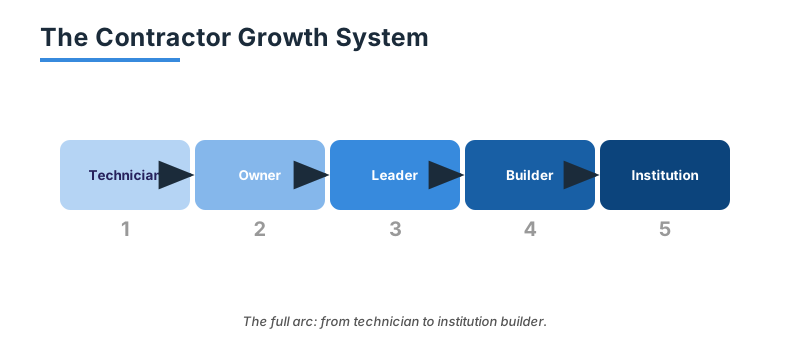
The Framework: The Contractor Growth System

Figure: The Contractor Growth System

bbok

Looking back across the entire journey, six distinct stages emerge, each one requiring a fundamentally different version of the owner than the one before it.

Stage One: Survive.

The earliest chapters the Go/No-Go Test, the FIT Filter, the Technician Trap, the Owner Ladder's first rungs. This stage is about proving the business can exist at all, one job, one dollar, one customer at a time. The owner here is still mostly a technician who happens to also be answering the phone.

Stage Two: Stabilize.

Systems, numbers, pricing discipline, reputation. The Owner's Dashboard, the Journey of a Dollar, the Reputation Flywheel. The business stops being a struggle for survival and starts becoming something repeatable but it still depends entirely on the owner's personal effort to run.

Stage Three: Build a Team.

The first hire, the delegation matrices, the leadership pyramid, vision, communication. The owner has to learn to lead people, not just complete jobs the hardest transition many contractors never fully make.

Stage Four: Lead Leaders.

Organizational design, departments, accountability without micromanagement, the CEO Time Model. The owner stops managing individuals directly and starts building leaders who manage individuals in their place trading direct control for indirect influence, a trade that never stops feeling uncomfortable the first several times.

Stage Five: Build an Institution.

Visibility over control, systems over heroics, culture that survives scale, the Institution Pyramid. The company begins to matter independently of the owner's daily presence, and the owner has to learn to measure success by what the organization does without him rather than what he personally accomplishes.

Stage Six: Create Legacy.

Succession, financial resilience, community trust, acquisition, generational impact. The final stage, where the question stops being "how do we grow?" and becomes "what survives after I'm gone?" the exact question that had quietly been building since Chapter 41, and finally arrived, fully formed, the day Mike stood in front of that old estimate book.

Every contractor moves through these stages in some order, whether they name them or not. Each stage requires a different version of the owner and the contractors who struggle longest are almost always the ones still trying to lead Stage Five with a Stage One mindset.

The Leadership Transformation Ladder

Running parallel to the six stages, a second ladder tracks the owner's personal transformation directly.

Technician

skilled at the work itself, but not yet thinking like an owner.

Owner

responsible for the business, but still doing most of the work personally.

Manager

directing other people's work, the first real step away from doing everything alone.

Leader

inspiring people rather than just directing them, the shift Chapter 15 first named.

CEO

thinking in systems and strategy rather than daily tasks, the altitude Chapter 32 required.

Steward

protecting what's been built rather than simply growing it further, the mindset that opened Part Six.

Mentor

the final rung, where the owner's primary contribution becomes developing the people who will eventually replace him entirely.

Leadership maturity, not truck count, is the true measure of progress. A five-truck company led by someone already thinking like a Mentor will outgrow a fifty-truck company still being run by a Technician wearing an owner's title.

Sarah's Story

Sarah remembered the first day she met Mike clearly, even now. One truck. A cluttered shop. No systems worth the name. No leadership team. No real confidence, if she was honest about it. Only determination, and a folded business card in his pocket from a customer who'd told him he should start his own company.

"Back then you wanted more trucks," she told him, standing in the old garage.

Mike laughed. "I remember."

"Now you spend more time talking about people than trucks."

He nodded. "Because that's what actually builds the trucks."

Sarah smiled. "Exactly."

She'd watched hundreds of contractors over her career chase the wrong measurement truck count, revenue, market share while the thing that actually determined whether any of it lasted was happening somewhere else entirely, inside the person doing the chasing. Mike had figured that out, eventually. Most owners never did.

Common Mistakes

Keeping customer relationships personal.

Relationships that only run through the owner limit the company's growth to exactly what one person's personal network and time can sustain.

Never documenting judgment.

Delegating a task without ever capturing the reasoning behind good decisions means the organization can copy actions but never actually learns to think.

Avoiding difficult succession conversations.

Postponing the question of who leads what, and when, doesn't prevent the eventual need for an answer it just makes the answer more urgent and less prepared when it finally arrives.

Micromanaging leaders.

The exact relapse Mike caught himself in during Chapter 29, still worth guarding against even at twenty-five trucks.

Correcting instead of coaching.

A leader corrected instead of coached learns to avoid decisions rather than improve them.

Measuring personal importance instead of organizational capability.

An owner who quietly wants to still feel needed will unconsciously resist the very independence this chapter is asking them to build.

Real Contractor Comparison

Company A

built a genuinely profitable business, and then stopped learning. Growth plateaued quietly, not from any single crisis but from the slow accumulation of a leader who'd stopped becoming anything new. The organization stayed founder-dependent for its entire life. When the founder eventually stepped back, the legacy faded faster than anyone expected.

Company B

continued growing personally, year after year, long after the business itself had already proven successful. Leaders were developed continuously. Systems matured. Institutions were built deliberately, on purpose, rather than accidentally. The legacy endured not because Company B's founder was smarter than Company A's, but because he never stopped treating himself as a work in progress.

Companies ultimately become reflections of their leaders. Businesses rarely outgrow their leaders they simply reveal, with time, exactly how far those leaders were willing to grow.

The Growth Reflection Wheel

Evaluate yourself annually, honestly, across seven dimensions: leadership, character, decision-making, financial stewardship, innovation, relationships, and legacy. The business has its scorecards the Owner's Dashboard, the Performance Dashboard, the Financial Resilience Score. The owner needs one too. The company will only grow as far as this wheel keeps turning.

The Six Questions

Ask every year, without fail: What stage am I in now? What must I become next? What am I still holding onto that I should let go of? Who am I developing? What institution am I building? What legacy am I leaving? Transformation never stops these six questions exist to make sure it never quietly does, either.

Practical Exercise

Return, for a moment, to Chapter One. Write two letters. The first: a letter from today's version of yourself to the person who once owned a single truck, telling them honestly what you now know that they couldn't have. The second: a letter from the future leader your company still needs you to become, telling today's version of you what still has to change. Read both letters. Sit with them. Then decide what to do about what they told you.

Warning Signs

red flag

Vacation anxiety.

This is the clearest personal signal that founder dependency, not just organizational dependency, still runs deep.

habit

Phone never silent.

This means decisions are still routing to the owner out of habit, exactly the pattern first named back in Chapter 19.

subtle

Owner copied on every email.

This is a quieter, less obvious version of the same dependency, hiding inside a habit that feels like simply staying informed.

stuck

Leaders waiting for permission.

This means the Independence Ladder hasn't actually reached the "Leaders Decide" rung yet, regardless of titles.

bypass

Customers bypassing managers.

This means trust still lives with one individual instead of the organization as a whole.

critical

Business slowing whenever the owner is unavailable.

This is the single clearest, most direct sign that the company hasn't yet matured past founder dependency.

Action Checklist

  • Review all six stages of the Contractor Growth System annually, and identify honestly which one you're actually operating in.
  • Identify your next leadership challenge before it becomes urgent.
  • Continue mentoring future leaders, regardless of how large the company has already become.
  • Protect the institution you've built, deliberately, the way Chapter 46 described.
  • Stay curious, even when curiosity no longer feels necessary.
  • Never stop becoming there is no stage beyond Mentor that excuses you from this one.

Key Takeaways

The real journey, underneath the visible one, was always transformation a technician becoming a business owner, a business owner becoming a leader, a leader becoming a CEO, a CEO becoming an institution builder, an institution builder becoming a steward of something built to outlive him. The Contractor Growth System's six stages and the Leadership Transformation Ladder's seven rungs describe the same climb from two different angles. Businesses grow only as far as their leaders grow, and the company, in the end, becomes nothing more or less than a reflection of the person who led it. The greatest project any owner will ever build is themselves.

Reflection Questions

Who were you when this journey began, whatever your own "one truck" happened to be? Who have you become since? Which single lesson changed you the most, and why? What chapter of your own story are you living right now? Who will continue your work long after you're no longer the one leading it?


Mike and Sarah stood outside the original garage as the sun began to set. In the distance, dozens of company trucks made their way back into the yard after another ordinary, successful day.

Mike said quietly, "I thought I was building a business."

Sarah smiled. "You were."

She paused, watching the trucks come in. "But the business was building you."

Mike looked out across the yard. Young technicians laughed as they finished loading equipment for the next morning. A branch manager somewhere was solving a problem right now that Mike would never even hear about. Customers kept calling, the way they had every day for over twenty years, most of them with no idea who Mike Delgado was and no reason they should need to.

The company kept growing. Whether he was there or not.

Mike smiled.

For the first time, he understood that the journey was complete not because the company had reached one hundred trucks, but because it no longer depended on the man who had once driven the only one.

The story may be complete. But every reader's journey is just beginning. Chapter 48 Your First Truck Starts Today is the epilogue: the invitation, extended directly to you, to begin exactly where Mike began. Every enduring company begins exactly where Mike began with one customer, one truck, and one decision to become something greater.

Scroll to Top