Chapter 8: Stop Buying Customers — Price for Profit
Chapter 8

Stop Buying Customers — Price for Profit

Mike showed up to Thursday coffee with a plan. He'd spent the weekend following his invoice from Chapter 7, and he'd found real profit hiding in the numbers — smaller than he'd expected, but real. His fix felt obvious.

The Challenge

Almost every new contractor makes the same mistake Sarah made, and it doesn't feel like a mistake while it's happening. Winning nearly every estimate feels like proof you're good at the business. A packed schedule feels like success by definition. Both feelings can be completely true and completely misleading at the same time, because neither one has anything to do with whether the jobs are actually worth doing.

Most contractors don't fail because they can't do the work. They fail because they never learned to price the work like a business owner instead of a tradesperson still thinking in hourly wages.
Why It Happens

A technician thinks in hours: how long will this take, what am I worth per hour, what's a fair wage. An owner has to think in something bigger — what does this job actually cost the business once every expense is counted, and what does the business need to earn from it to stay healthy, grow, and still be standing in five years.

Busy without profit is just expensive volunteering. A full calendar of underpriced jobs doesn't build a company. It builds a very tired person who can't understand why hard work isn't translating into anything. Winning every estimate usually means your prices are too low — not because you're the most talented contractor in town, but because price was the only thing anyone was choosing between.

Here's the deeper trap: underpricing doesn't just cost you money on the job you underpriced. It fills your schedule with customers who chose you on price alone, which means the next customer who's willing to pay properly for real value has to wait behind a calendar full of jobs that barely break even.

The Framework: The Pricing Formula

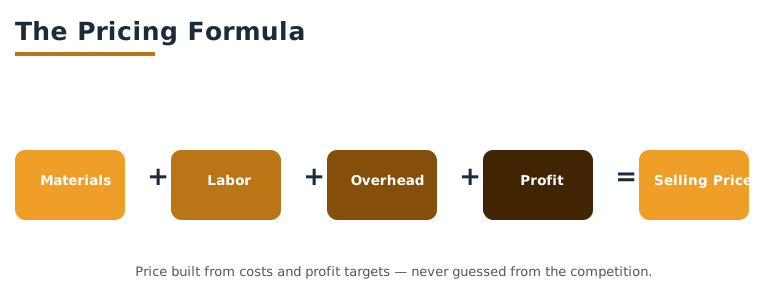
The Pricing Formula

Every price you charge should cover four things, in this order, before anything else matters:

Materials + Labor + Overhead + Desired Profit = Selling Price

Materials is the actual physical cost of what the job requires — no surprise here, most contractors already track this reasonably well.

Labor is the real cost of the hours the job takes, including your own time if you're still swinging a wrench, priced honestly rather than treated as free because "I'm the owner."

Overhead is the slice of your fixed monthly costs — truck payment, insurance, phone, software — that this job needs to help cover. Most underpriced jobs got that way because overhead never made it into the math at all.

Desired Profit is the reward for owning the business, not a leftover you hope shows up if everything else goes well. This is the piece almost every new contractor skips, and it's the one that turns a job into a business decision instead of a favor.

Add all four together, and you get a selling price you can defend — not because it matches what a competitor charges, but because you know exactly what it's built to cover.

The Pricing Pyramid

The Pricing Pyramid

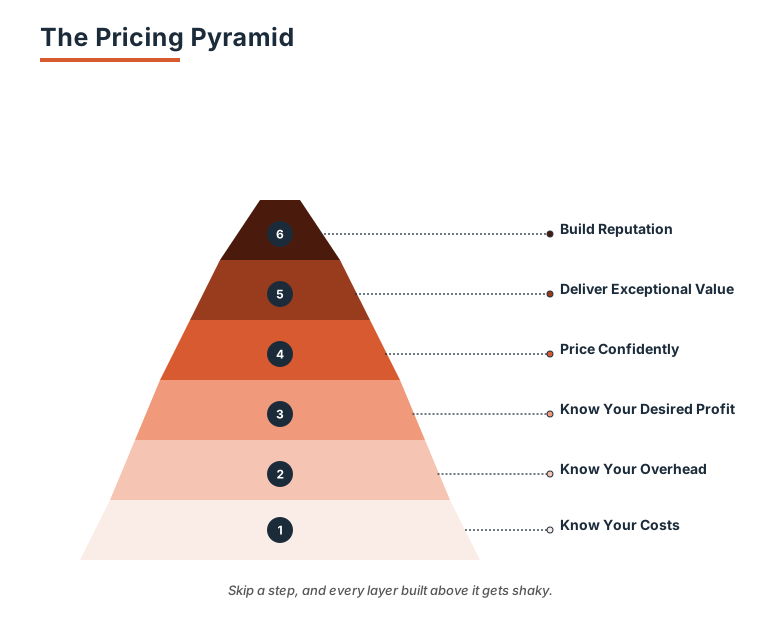
Confident pricing follows a specific order. Skip a step, and the ones above it get shaky.

1. Know Your Costs. Materials and labor, calculated honestly, on every job type you commonly run.
2. Know Your Overhead. The fixed cost of running the business at all, divided across the jobs you expect to do in a month.
3. Know Your Desired Profit. A specific number or percentage you're building into every price on purpose, not hoping for by accident.
4. Price Confidently. Once the first three steps are done, the price isn't a guess anymore — it's a number you can say out loud without flinching.
5. Deliver Exceptional Value. A confident price only holds up if the work backs it up — this is where the FIT Filter niche you chose in Chapter 2 and the systems you built in Chapter 5 start paying off.
6. Build Reputation. Customers who paid a fair price for real value become the customers who talk about you to their neighbors.
7. Earn Referrals. Referred customers rarely shop on price alone, because trust already did the selling before you ever opened your mouth.

Notice where "price" sits in that pyramid. It's step four of seven, not step one. Most struggling contractors are trying to compete on step four while ignoring steps one through three entirely.

A Few Terms Worth Knowing

Cost is what a job actually requires you to spend — materials and labor, mostly.

Price is what you charge the customer.

Margin is profit expressed as a percentage of price — if you charge $1,000 and keep $250 after costs, your margin is 25%.

Markup is profit expressed as a percentage of cost instead — the same $250 profit on $750 of cost is a 33% markup. Contractors mix these up constantly, and the difference matters more than it sounds like it should when you're setting prices across a whole business.

Profit is what's actually left once every real cost, including overhead, has been paid.

Value is what the customer believes the outcome is worth to them — which is often higher than your cost, and has almost nothing to do with how many hours the job took you.

Customers don't buy your hours. They buy the outcome. A homeowner with a flooding basement doesn't care how long the fix takes. They care that it's fixed, by someone they trust, today.

Common Pricing Mistakes

Copying competitors' prices.

Their overhead, their costs, and their desired profit are not your business's numbers. Pricing off someone else's spreadsheet means you're not actually pricing at all.

Guessing labor hours.

A rough guess on time is a rough guess on profit, repeated on every job until the errors add up into a real problem.

Forgetting overhead.

This is the single most common leak in contractor pricing — a price that covers materials and labor perfectly and quietly forgets the truck payment and insurance still need to get paid too.

Discounting too quickly.

A discount offered before a customer even asks trains the market to expect one, and trains you to build it into your baseline pricing without meaning to.

Winning every estimate.

As Sarah learned the hard way, a 100% close rate is rarely a compliment. It's usually a pricing problem wearing a success story's clothes.

Not charging for expertise.

Years of experience that let you diagnose a problem in five minutes instead of fifty are worth something. Pricing only for the physical labor ignores the actual value you're providing.

Free extras.

"I'll just throw that in" feels generous. It's actually an unplanned discount that never shows up anywhere in your numbers.

Scope creep.

A job that grows past its original estimate without a matching price adjustment is a job that quietly becomes less profitable with every extra task added.

Emergency jobs priced like routine jobs.

A 2 a.m. call deserves a price that reflects the inconvenience and urgency, not the same rate as a scheduled Tuesday appointment.

Never increasing prices.

Costs rise every year whether you adjust for it or not. A price that hasn't moved in three years is a profit margin quietly shrinking in real terms the whole time.

Real Contractor Example: Two Contractors, One Job

Picture the exact same roofing job, priced by two different contractors.

Contractor A

prices low to guarantee the win. He's always busy — booked out for weeks. But his margins are thin, his stress is constant, and a single unexpected cost turns an already-thin job into a loss. He can't say no to any job, because he needs the volume just to cover overhead. His crew is exhausted. His customers are fine, but rarely thrilled, because there's no room in the price for anything beyond the bare minimum.

Contractor B

prices to cover materials, labor, overhead, and a real profit target. He wins fewer estimates — maybe six out of ten instead of nine out of ten. But every job he wins actually makes money. He has room to invest in better materials, faster response times, and a crew that isn't stretched thin. His customers pay more and complain less, because the job gets done right the first time. He has better cash flow, more time, and — despite fewer jobs — a healthier business at the end of the year.

Same trade. Same skill. Same market. Completely different businesses, because one of them was pricing to survive and the other was pricing to build something.

The cheapest contractor usually pays the highest price — in stress, in thin margins, in a business that never quite gets ahead no matter how full the schedule looks.

Practical Exercise

Take one recent job and do the real math:

Selling Price, minus Materials, minus Labor, minus Overhead, equals Actual Profit.

Once you have that number, ask yourself one honest question: would you happily do this exact job again, at this exact price, every week for the next year? If the answer is no, the price is telling you something your gut already suspected.

Warning Signs

"I'm winning almost every estimate."

This usually means your price is the only thing customers are comparing, and it's set low enough that almost nobody says no.

"I haven't raised prices in years."

This usually means your margins have been quietly shrinking against rising costs the whole time, even if revenue looks stable.

"I don't know my hourly cost."

This means every price you set is still a guess, no matter how experienced you are at the trade itself.

"My best employee costs more than I charge."

This is one of the clearest signs of underpricing there is — if you couldn't afford to pay yourself what you pay your best technician, the price is broken.

"We're busy but never ahead."

This usually means volume is being used to cover for margin that should have been built into the price from the start.

Objection Handling

What if I lose customers?

Sarah's answer: you will lose some — the ones who were only ever choosing you on price. That's not a loss. That's the market sorting itself into customers who value what you do and customers who don't, and you only want the first kind.

What if my competitors are cheaper?

They might be. That's their pricing decision, not evidence that yours is wrong. A cheaper competitor with thin margins is often one bad month away from a problem you won't have.

What if people say no?

Some will. The goal was never to win every estimate. The goal is a business that's still standing, profitable, and sane in five years — and that business says no to some jobs on purpose.

Action Checklist

  • Calculate your true hourly cost, including overhead, not just wages.
  • Review your last ten estimates and note how many were priced on gut feeling versus the four-part formula.
  • Raise prices on one specific service this month, and hold the line when a customer pushes back.
  • Identify one hidden overhead expense you haven't been building into your prices.
  • Remove one discount you've been offering automatically, without being asked.
  • Set a minimum profit target — a dollar amount or percentage — for every job going forward, and refuse to quote below it.

Key Takeaways

The easiest job to lose money on is the one you were excited to win, because excitement about volume rarely stops to check whether the price actually covers the business. Selling Price should always equal Materials, plus Labor, plus Overhead, plus Desired Profit — skip any one of those and the whole number becomes a guess. The Pricing Pyramid puts price where it belongs: after costs, overhead, and profit targets are already known, not before. Winning every estimate is rarely a compliment. It's usually the clearest sign your prices need to go up.

Reflection Questions

Do you know exactly why your current prices are what they are, or are they mostly inherited from guesswork and competitor-watching? What would actually happen if you raised prices by 5% starting next month? Are you pricing to survive this year, or to build a business you'd still want to own in five? If someone offered to buy your company today, at your current profit margins, would you take the deal — or does that question make you a little uncomfortable?


Confident pricing tells a customer what the work is worth. It doesn't yet tell you how to get them to say yes to that number without feeling like you talked them into it. Chapter 9 is where you learn that selling was never about convincing anyone — it's about diagnosing the real problem, building trust, and presenting a solution the customer feels good about buying.

Scroll to Top