Chapter 37: Scale Through Systems, Not Heroics
Chapter 37

Scale Through Systems, Not Heroics

Nearly forty trucks now. Revenue strong, customers happy, leaders capable and yet Mike kept noticing the same pattern, week after week, dressed up as good news every time.

The Challenge

Growing companies eventually reach a point where hard work alone stops being enough. The systems that carried a five-truck company smoothly begin to buckle under the weight of thirty or forty, and the natural response work harder, solve more problems personally, lean on the strongest employees to save the day feels responsible in the moment and quietly masks the real issue underneath.

Heroics don't scale. Systems do. Mike's company was still running on individual rescue efforts at a size where that approach was becoming genuinely unsustainable, no matter how much everyone involved genuinely cared.

Why It Happens

Heroics vs. Systems. Heroics rely on individual effort, long hours, emergency thinking, personal memory, and constant firefighting. Systems rely on documentation, standardization, clear ownership, and predictable execution. The uncomfortable truth is that businesses which celebrate heroics are often, without meaning to, celebrating the visible symptom of a systemic weakness that nobody's actually fixed.

Every recurring problem is a process asking to be improved. The scheduling crisis, the frustrated customer, the delayed delivery none of these were isolated incidents. They were the same underlying gaps, showing up repeatedly, each time solved heroically instead of permanently.

The Framework: The Heroics-to-Systems Continuum

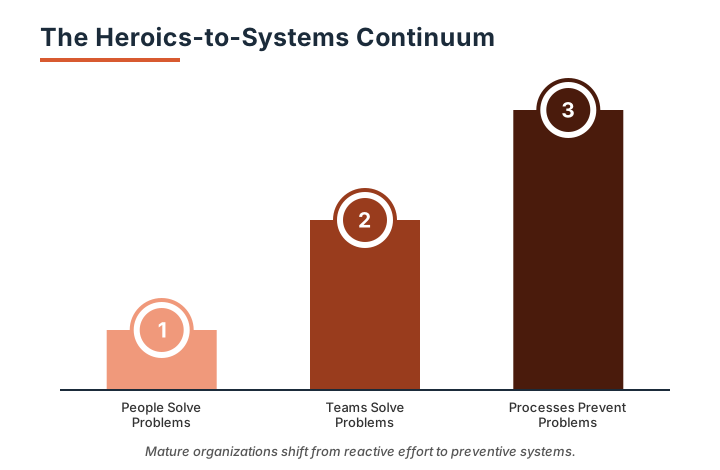
Heroics-to-Systems Continuum

Mature organizations move progressively along this continuum, spending less time reacting and more time preventing.

People Solve Problems

the earliest, most fragile stage, where everything depends on an individual's effort and memory.

Teams Solve Problems

collaboration from Chapter 30 spreads the load, but the underlying issue still isn't actually fixed.

Processes Prevent Problems

the System Loop from Chapter 13, applied deliberately enough that the same problem stops recurring at all.

Systems Improve Themselves

the Improvement Cycle from Chapter 18, built directly into the process, catching weaknesses before they ever become emergencies.

Continuous Improvement

the mature end state, where the organization is constantly getting slightly better at preventing the next problem before it happens.

Mike's company, despite everything built in the previous thirty-seven chapters, was still living mostly in the first two stages when it came to its most visible operational crises.

The System Improvement Cycle

Every recurring problem should trigger this cycle instead of another heroic rescue: Observe the pattern, not just the latest instance. Identify the Root Cause, not just the symptom in front of you. Improve the Process that allowed the problem to happen in the first place. Document the improved standard. Train the people who need to follow it. Measure whether it actually worked. Repeat, refining further as new patterns emerge.

Common Mistakes

high risk

Rewarding firefighters instead of fire prevention.

Praising the rescue, every time, quietly teaches the organization that heroics are the goal rather than the warning sign.

caution

Keeping knowledge inside people's heads.

The same vulnerability from Chapter 31's Dependency Audit, still showing up here as recurring operational fragility.

inconsistency

Allowing each branch to invent different processes.

Inconsistency at this scale multiplies the communication and quality problems Chapters 21 and 24 first named.

gap

Skipping documentation.

A process that only exists as tribal knowledge can't actually improve it can only be repeated, imperfectly, by whoever happens to remember it best.

recurring

Accepting recurring mistakes as "part of business."

This resignation is exactly what keeps a company stuck at the People Solve Problems stage indefinitely.

opportunity

Not celebrating prevention.

When prevention goes unnoticed, the organization learns that only visible heroics matter the quiet work of building better systems gets undervalued.

Sarah's Story

Sarah told Mike about proudly telling her own mentor, years earlier, that one of her operations managers had personally saved three major customer relationships in a single week. Her mentor congratulated the manager sincerely and then turned to Sarah and asked, "Why did three customers need saving in the first place?"

She didn't have an answer.

"You've built a company that celebrates rescue," her mentor told her. "Now build one that prevents emergencies." That distinction, she told Mike, permanently changed how she thought about operational excellence heroics were no longer something to celebrate uncritically. They were a signal pointing directly at whatever system needed fixing.

Real Contractor Comparison

Company A

relies on heroes to solve recurring problems. Knowledge lives with individuals rather than the organization. Performance varies noticeably from team to team. Customer experience stays inconsistent. Growth creates more chaos, because every new truck adds another opportunity for the same unaddressed weaknesses to resurface.

Company B

relies on documented systems, consistent onboarding, and shared best practices across every branch. Continuous improvement is built into how problems get handled, not just occasionally attempted. Growth actually improves efficiency, because each new truck operates on the same proven foundation instead of reinventing it.

The best companies don't solve the same problem twice. Company B's advantage isn't fewer problems arising it's a discipline that turns every problem into a permanent fix instead of a recurring rescue.

The SOP Pyramid

Documentation should become progressively more detailed the closer it gets to actual execution. Mission sits at the top the broadest statement of purpose. Core Processes sit below that the major workflows the business depends on. Department SOPs sit below that specific standards for each function. Checklists sit below that concrete, step-by-step tools used on the ground. Daily Habits sit at the base the actual, repeated behavior that makes everything above it real.

The Repeatability Score

For every major process, ask five questions: Can a new employee perform it? Is it documented? Is it measurable? Is it consistently followed? Can it improve over time? Score each process from 1 to 5 across these questions, and prioritize fixing the weakest ones first exactly where the next hero rescue is most likely waiting to happen.

Practical Exercise

Identify five recurring problems from the past ninety days. For each one, ask honestly: was this actually caused by a person, or by a missing system? Document one specific process improvement that would prevent it from happening again. Assign clear ownership of that improvement. Measure the results after thirty days.

Warning Signs

cycle

The same problems keep returning.

This is the clearest sign the organization is still stuck solving symptoms instead of causes.

burnout

Top performers constantly rescue projects.

This means the company's best people are compensating for systems that should be doing that work instead.

variance

Customers receive different experiences.

This is Chapter 24's culture warning resurfacing here as an operational consistency problem.

improvisation

Managers reinvent processes.

This means SOPs either don't exist or aren't being followed, leaving each leader to improvise their own version.

tribal

Training depends on verbal explanations.

This means the System Loop from Chapter 13 never fully matured into real documentation.

ceiling

Growth creates more chaos instead of more consistency.

This is the clearest possible sign that systems, not people, are the actual constraint on further scaling.

Action Checklist

  • Audit your recurring operational issues from the past quarter.
  • Create or improve the SOPs behind your weakest, most frequently rescued processes.
  • Standardize key workflows across every branch or crew, not just the original one.
  • Assign clear ownership for every core process.
  • Measure process compliance regularly, not just outcomes.
  • Celebrate prevention as visibly and enthusiastically as you've been celebrating rescue.

Key Takeaways

Growing companies eventually reach a point where hard work alone isn't enough heroics don't scale, but systems do. The Heroics-to-Systems Continuum moves organizations from individual rescue efforts toward processes that prevent problems and systems that improve themselves. The SOP Pyramid and Repeatability Score turn vague operational instinct into something measurable and improvable. Heroes build great days. Systems build great companies and the greatest compliment a system can ever receive is that nobody notices it working.

Reflection Questions

Where does your business still quietly depend on heroes to function? Which recurring problems have you started accepting as simply "normal"? What process in your company should never rely on someone's memory? If your best employee left tomorrow, what critical knowledge would leave with them? What would genuine operational excellence look like in your company one year from now?


Several weeks later, a dispatcher noticed an issue that, six months earlier, would have caused a major scheduling crisis. Instead of calling Mike, she simply followed the documented process. The problem was resolved within minutes. Nobody stayed late. Nobody became the hero of the week.

At the weekly leadership meeting, Mike asked, almost casually, "What happened with Tuesday's scheduling issue?"

Jake shrugged. "It never became an issue."

Mike laughed. "That's it?"

"The system handled it."

Sarah smiled from across the table. "The greatest compliment a system can receive is that nobody notices it."

A week later, that same dispatcher noticed something else an extra verification step in the scheduling process that hadn't actually prevented a problem in months, just added a few minutes to every call. She didn't wait for permission to complain about it. She wrote up the change, proposed it at the next huddle, and Jake approved it on the spot. The updated process rolled out to every branch by the following Monday, not just her own.

Sarah heard about it secondhand and smiled. "That's when you know you've built a system. It gets better without waiting for the owner."

Mike looked around the room. "I used to think success meant solving bigger problems." He paused. "Now I think it means preventing them."

Sarah nodded. "And that's exactly how companies become scalable."

Chapter 39 is where you learn how to expand into new territory without losing the control it took this long to build.
Scroll to Top