Chapter 27: Every New Truck Changes the Company
Chapter 27

Every New Truck Changes the Company

Mike ordered Truck Number Six on a Thursday, and the whole shop celebrated. He remembered thinking, driving home that night, that it barely felt like a big decision anymore.

The Challenge

Most contractors believe adding another truck simply means hiring another technician and buying another vehicle — arithmetic, not architecture. It isn't. Every truck changes the structure of the whole business, because every new person, every new schedule, and every new job adds relationships, communication, and decisions that didn't exist before.

Mike's sixth truck didn't add one unit of complexity to a business with five. It multiplied the number of connections running through the whole organization — a much bigger change than the simple math suggested.
Why It Happens

Growth creates complexity before it creates profit. Most owners assume growth is linear — six trucks means roughly twenty percent more work than five. The reality is closer to exponential: six trucks create dramatically more decisions, more communication paths, and more coordination than five, because the relationships between people grow far faster than the headcount itself.

Complexity is the hidden cost of growth, and it rarely shows up on a P&L. It shows up as slower scheduling, more inconsistent customer information, and crew leaders who suddenly feel busier without anyone actually doing anything wrong.

Linear Growth vs. Organizational Growth

Most owners think in linear terms: one more truck means roughly one more truck's worth of everything — revenue, cost, effort. Organizational reality works differently. Six trucks don't just create six trucks' worth of scheduling decisions; they create dramatically more potential conflicts, more communication touchpoints between crews, and more opportunities for one crew to handle a situation differently than another.

Organizations don't scale by accident. Complexity compounds faster than revenue does, which means an organization that isn't deliberately redesigned alongside its growth will eventually feel the strain — exactly what Mike was experiencing, a few weeks into his sixth truck.

The Framework: The Complexity Curve

bbok

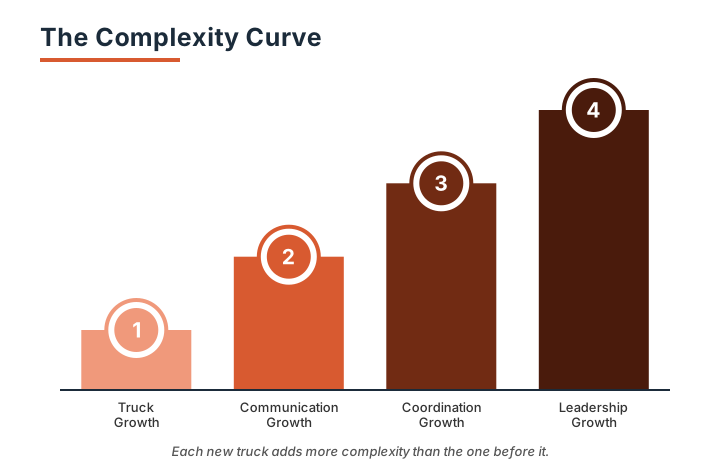
Growth moves through four stages, each one demanding attention before the next one arrives.

01

Truck Growth

— the visible, easy-to-count change everyone celebrates.

02

Communication Growth

— the invisible multiplication of messages, updates, and coordination required to keep everyone aligned, exactly the strain Chapter 21 first addressed.

03

Coordination Growth

— the increasing demand on crew leaders and the office to keep schedules, materials, and people moving smoothly together.

04

Leadership Growth

— the growing need for more capable decision-makers as more situations arise that the owner simply can't personally oversee.

05

System Growth

— the pressure on existing checklists and processes, built for a smaller operation, to hold up under real added weight.

Complexity grows faster than truck count. Organizations must evolve faster than complexity, or the gap between the two becomes exactly the low-grade friction Mike was feeling — nothing dramatically broken, everything slightly harder.

Common Scaling Mistakes

leadership

Adding trucks without strengthening leadership.

More vehicles without more leadership depth simply spreads existing leaders thinner.

communication

Growing revenue faster than communication.

The Communication Loop from Chapter 21 needs deliberate reinforcement at every new stage of growth, not just once.

structure

Keeping the same structure too long.

A structure that worked well at four trucks isn't automatically wrong at six — but it should be actively questioned, not just assumed to still fit.

silos

Treating every crew independently.

Crews operating in isolation, without shared standards, quietly become four or five different small companies instead of one coordinated organization.

roles

Adding people without clarifying responsibilities.

New hires without clear role definitions create exactly the kind of confusion the Delegation Matrix from Chapter 11 was built to prevent.

systems

Assuming yesterday's systems still work.

The System Loop from Chapter 13 needs revisiting at every growth stage — a checklist built for one truck doesn't automatically scale cleanly to six.

Sarah's Story

Sarah told Mike about celebrating her own sixth truck years earlier, expecting nothing but another good year ahead. Instead, meetings grew longer without becoming more productive. Scheduling got harder. Customer complaints ticked up slightly, for no single obvious reason. Nobody on her team could quite explain why things suddenly felt more strained.

Her mentor visited around that time, looked around her busy office, and said simply, "Congratulations. You've reached the point where your organization is now more important than your technicians."

She didn't fully believe him at first. It took her almost a year of mounting friction before she finally sat down and completely redesigned the company's structure — clarifying roles, rebuilding communication rhythms, strengthening leadership layers that had quietly become too thin. Growth accelerated again almost immediately afterward.

"I wasted a year assuming the friction would just work itself out," she told Mike. "It doesn't. The organization has to grow on purpose — it won't grow by itself just because the trucks did."

Real Contractor Comparison

Company A

adds trucks whenever work increases, without ever revisiting its underlying structure. Communication becomes chaotic as more people are added to the same informal systems. Leaders become overwhelmed, stretched across more coordination than they were ever equipped to handle. Growth slows, not from lack of demand, but from an organization straining under a design it outgrew months ago.

Company B

redesigns its structure before expanding. Leadership roles get clarified in advance. Communication systems get strengthened ahead of the added load. Systems get updated proactively. Trucks get added only once real capacity already exists to support them. Growth stays predictable, because the organization is always slightly ahead of its own size, not scrambling to catch up.

The organization must grow before the fleet does — Company B's advantage isn't a better market. It's simply that the structure was ready before the sixth truck arrived, not after.

The Five Questions Before Every New Truck

Ask these before purchasing another vehicle, not after: Who leads it? How will communication need to change to support it? Which existing system will feel the most stress? Who owns accountability for its performance? And what needs to improve before this expansion happens at all?

The next truck should never surprise your systems. Mike's sixth truck surprised nearly all of his — scheduling, inventory, communication — because none of these five questions had been asked in advance.

The Organizational Design Loop

Every successful stage of growth repeats the same cycle: Growth creates Complexity, which demands Redesign, which produces Stability, which makes room for the next round of Growth. Skipping the Redesign step doesn't stop complexity from arriving — it just means the business absorbs that complexity as strain instead of addressing it deliberately.

Practical Exercise

Imagine adding two more trucks next year. List three systems that would struggle under that load. List three leadership responsibilities that would need to expand. List three communication challenges that would likely appear. Choose one specific improvement from that list, and implement it now, before the hiring actually happens.

Warning Signs

slow

Communication becomes slower.

This usually means the Communication Loop from Chapter 21 is straining under more relationships than it was built to handle.

meetings

Leaders attend too many meetings.

This often means coordination has quietly replaced actual leadership as the main use of a supervisor's time.

friction

Scheduling feels increasingly difficult.

This usually signals that a system built for a smaller operation hasn't been redesigned for the current size.

inconsistency

Customers receive mixed information.

This is culture and communication straining simultaneously, exactly the kind of inconsistency Chapter 24 warned against.

altitude

The owner feels busy again.

This often means growth has quietly pulled the owner back down the Altitude Ladder from Chapter 25, toward ground-level problems that leadership should have absorbed.

stress

Growth begins creating stress instead of confidence.

This is the clearest sign that the organization hasn't been redesigned to match its new size.

Action Checklist

  • Review your current organizational structure honestly, not just your revenue.
  • Strengthen leadership capacity before adding more trucks.
  • Improve communication systems proactively, ahead of the added complexity.
  • Clarify exactly who owns which responsibilities as the team grows.
  • Build real capacity before adding demand, not after.
  • Review your organizational design every quarter, not just when something breaks.

Key Takeaways

Most contractors believe adding another truck simply means adding another technician and another vehicle. It doesn't — every truck changes the structure of the entire business, multiplying communication, coordination, and decisions far faster than the headcount itself grows. The Complexity Curve shows that complexity compounds faster than revenue, and the Organizational Design Loop shows that growth, complexity, and redesign have to repeat together, deliberately, at every stage. The organization must grow before the fleet does, not scramble to catch up afterward.

Reflection Questions

What actually changes, beyond revenue, when another truck gets added to your fleet? What hidden complexity already exists in your business today, even before the next truck arrives? Which relationships in your company would become hardest to manage under more growth? What systems would fail first if you doubled tomorrow? Are you growing trucks — or genuinely redesigning a company?


Mike walked through the parking lot that evening. Six trucks now sat in neat rows, exactly like he'd once dreamed about back when one truck felt like an impossible reach. A year ago, he would have simply counted them.

Tonight, he noticed something else instead. Crew leaders talking through tomorrow's schedule. Office staff coordinating a delivery. Warehouse personnel prepping materials for the next morning's jobs. The trucks themselves suddenly seemed like the least important part of what he was looking at.

Sarah joined him. "What do you see?"

Mike smiled. "I used to think I was building a fleet." He paused. "I'm building an organization."

Sarah nodded. "And organizations require a different kind of leadership." She looked back toward the office. "The next lesson is learning how to trust other people with decisions that used to belong only to you."

Chapter 28 is where you learn exactly how to do that.

Scroll to Top