Chapter 28: Delegate Authority, Not Just Tasks
Chapter 28

Delegate Authority, Not Just Tasks

Truck Number Six was running well. Mike had strong crew leaders in place, and most of the daily work happened without him needing to touch it directly. By every visible measure, he'd delegated everything he was supposed to.

The Challenge

Many owners believe they've delegated because someone else is now physically performing the work. But if every important decision about that work still flows back to the owner, nothing has actually been delegated at all — just relocated. Mike's crew leaders were busy, capable, and trusted. They were also still asking permission for nearly everything that mattered, which meant Mike remained exactly the bottleneck he'd worked so hard to eliminate back in Chapter 19 — just at a bigger scale, with more people now waiting on him instead of fewer.
Why It Happens

Responsibility means owning the work. Authority means making the decisions. Giving someone responsibility without authority creates frustration — they're expected to produce a result without the power to actually decide how to get there. Giving authority without accountability creates chaos — decisions made with no ownership of the outcome. Healthy organizations deliberately balance both, and Mike had quietly been handing out responsibility while holding onto nearly all the authority himself.

This is the same Four Levels of Delegation from Chapter 19 — Ask me, Recommend, Decide and tell me, Own it completely — showing up again here at a larger scale. Back then, it applied to individual tasks Mike personally handed off. Now, with a full leadership team in place, the same ladder needs to apply across entire categories of decisions, not just individual chores.

The Framework: The Decision Matrix

Decision Matrix

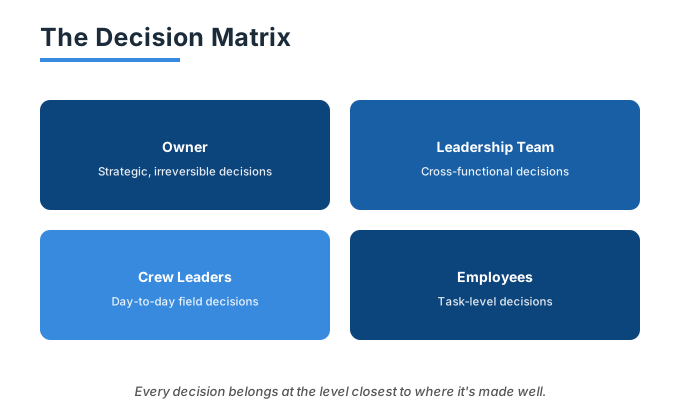
Different decisions genuinely belong at different levels of the organization. Document this explicitly, rather than leaving it to informal habit.

Owner

Strategic decisions, financial risk, vision, and major hiring. The five responsibilities from Chapter 25 that should remain genuinely the owner's to carry.

Leadership Team

Scheduling, customer recovery, pricing within established guidelines, and crew assignments.

Crew Leaders

Field decisions, quality standards, safety calls, and direct customer communication.

Technicians

Technical execution, minor customer issues, and daily improvements within their own jobs.

Mike's phone was ringing constantly because decisions that clearly belonged at the Leadership Team or Crew Leader level — a discount, an overtime approval, an equipment replacement — kept routing all the way up to Owner by habit, not by necessity.

The Trust Equation

Trust isn't blind faith, handed out because someone seems capable. It's built deliberately, through four ingredients working together:

Clear Expectations + Competence + Accountability + Coaching = Trust

Clear Expectations + Competence + Accountability + Coaching = Trust. Skip any one of the four, and the resulting trust is thinner than it looks — which is exactly why Mike, despite genuinely trusting his people in his own mind, hadn't actually built the structure that would let that trust translate into real decision-making authority.

Common Delegation Mistakes

Delegating only unpleasant work.

Handing off tasks nobody wants, while keeping every meaningful decision, teaches a team that delegation is really just extra chores.

Taking decisions back after mistakes.

Reclaiming authority the first time someone gets a call wrong teaches everyone that mistakes aren't survivable, which quietly ends real delegation.

Correcting people publicly.

Feedback delivered in front of others damages the very confidence delegation is supposed to build.

Giving unclear expectations.

Authority handed over without a clear picture of what success actually looks like sets someone up to guess, not decide.

Micromanaging after delegating.

Hovering over every decision after handing it off is functionally the same as never delegating it at all.

Expecting perfection immediately.

New decision-makers need room to learn, the same way Mike's first technician did back in Chapter 13.

Confusing coaching with controlling.

Coaching helps someone get better at deciding. Controlling just makes the decision for them again, quietly, under a different name.

Sarah's Story

Sarah told Mike about promoting her very first operations manager, years earlier, and delegating scheduling to him with real confidence. Within two weeks, she'd quietly overridden roughly half his decisions — a small correction here, a "let me just handle this one" there. Within a month, he'd stopped making decisions at all, simply routing everything back to her the way Mike's team was routing everything to him now.

Her mentor noticed and asked her directly, "Who is the operations manager?"

"He is," she answered.

"Then let him manage," her mentor said simply.

"Every unnecessary override I made had quietly taught him that his decisions didn't actually count," Sarah told Mike. "After that, I stopped reclaiming authority the moment something went slightly differently than I would have done it. I started coaching him privately instead — and let his decisions actually stand."

Real Contractor Comparison

Company A

Approves nearly everything. Employees wait for sign-off before acting. Problems stack up while waiting for a decision that could have been made hours earlier. Customers wait longer as a result. Leaders lose confidence in their own judgment, because it so rarely gets to actually count. Growth slows under the weight of all that waiting.

Company B

Has clearly defined decision authority at every level. Leaders own real outcomes, not just tasks. Problems get solved quickly, at the level closest to where they actually occur. Customers receive faster service because decisions aren't stuck in a queue waiting for the owner. The owner, freed from the smaller decisions, focuses on the bigger ones only they can make. Growth accelerates.

Organizations scale at the speed of decision making. Company B's advantage isn't smarter leaders — it's leaders who are actually allowed to decide.

Practical Exercise

For one full week, write down every decision you personally make. Highlight every one that someone else could eventually own, given the right expectations and coaching. Choose three. Create clear decision guidelines for each — what the boundaries are, what "good" looks like, when to escalate versus when to simply act. Transfer one of the three this month. Review how it went after thirty days, adjusting the guidelines rather than reclaiming the decision at the first imperfect outcome.

Warning Signs

red flag

Employees constantly ask permission.

This means responsibility has been delegated without the authority to match it.

habit

Meetings become approval sessions.

This usually means decisions that belong at a lower level are still being routed all the way up out of habit.

subtle

Customers wait for owner decisions.

This is one of the clearest signs that decision speed — and therefore competitiveness — is being lost to unnecessary bottlenecking.

stuck

Leaders avoid taking initiative.

This often means past initiative was quietly overridden, teaching the team that deciding isn't actually worth the risk.

critical

The owner works long hours despite strong staff.

This means capable people exist, but the authority to use their capability hasn't actually been transferred.

Action Checklist

  • List every recurring decision currently flowing through you.
  • Assign clear ownership of each one to the appropriate level using the Decision Matrix.
  • Document the boundaries of each delegated decision in writing.
  • Coach privately when a decision doesn't go the way you would have made it yourself.
  • Accept that early mistakes are part of genuine learning, not evidence delegation failed.
  • Review delegated authority monthly, looking for decisions quietly drifting back to you.

Key Takeaways

Many owners believe they've delegated because someone else is doing the work — but if every important decision still comes back to the owner, nothing has actually been delegated. Delegating tasks creates busier employees. Delegating authority creates leaders. The Decision Matrix assigns real ownership across Owner, Leadership Team, Crew Leaders, and Technicians, while the Trust Equation — Clear Expectations, Competence, Accountability, and Coaching — shows that trust is built deliberately, not assumed. The goal was never fewer decisions. It's better decision makers.

Reflection Questions

Which decisions genuinely require only you? Which ones are you still keeping out of habit rather than necessity? What's actually preventing you from trusting your leaders with more real authority? How often do you quietly reclaim a decision after handing it off? If every leader in your company made one more real decision tomorrow, how would the business improve?


Late one afternoon, Mike's phone rang. Jake's name appeared on the screen. For a moment, out of pure habit, Mike reached to answer it.

Then he stopped himself. Jake already knew exactly what to do.

A few minutes later, a text came through instead: "Handled it."

Mike smiled. Sarah, sitting across from him, noticed. "You didn't answer."

"I didn't need to."

"Neither did the company," Sarah said. She paused. "The next challenge isn't making decisions anymore. It's making sure the right people own the right results."

Chapter 29 is where you learn how to build exactly that kind of accountability, without slipping back into micromanaging the people you just learned to trust.

Scroll to Top