Chapter 24: Create a Culture That Outlives the Owner
Chapter 24

Create a Culture That Outlives the Owner

Things had stabilized. Four trucks, a working leadership team, weekly meetings that actually produced decisions, scoreboards everyone trusted, a real cash reserve, systems that held up under pressure. Mike had every reason to feel good about where the business stood. What surprised him wasn't the numbers. It was what customers kept saying, unprompted, in almost identical words.

The Challenge

Every company has a culture, whether anyone ever deliberately built one or not. The only real question is whether it's intentional or accidental. As a business grows beyond a few trucks, the owner physically cannot be present for every customer interaction, every small decision, every ordinary moment where someone chooses to do the right thing when nobody's checking.

Culture is what people do when nobody is watching. Mike had spent twenty-three chapters building systems, communication, accountability, and leadership. What he was witnessing in the shop that morning was something those tools alone couldn't produce directly — they'd simply created the conditions for it to grow.
Why It Happens

Systems tell people what to do. Processes tell people how to do it. Culture determines what they choose to do when nobody is watching. A checklist can tell an employee to clean the truck at the end of the day. Nothing on that checklist explains why Jake would clean someone else's truck, unasked, for no reward.

Policies vs. Culture. Policies define expectations — the written rule. Culture defines behavior — what people actually do, especially in the countless small moments a policy could never anticipate. A company with a genuinely strong culture needs fewer rules, not more, because people already understand what the right decision looks like without being told.

Culture vs. Personality. Many owners quietly confuse their own personality with their company's culture — the business runs well when the owner's mood is good, and struggles a little when it isn't. A healthy culture doesn't depend on the owner's mood, energy, or physical presence. It survives good days and bad ones equally, because it's been built on shared values rather than borrowed from one person's temperament.

The Framework: The Culture Cycle

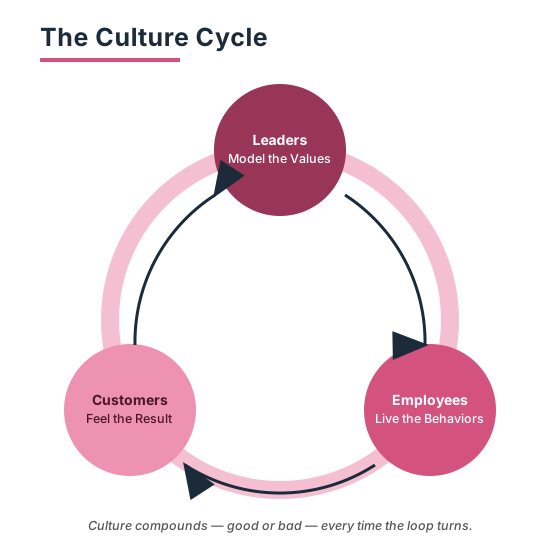
The Culture Cycle

Culture doesn't sit still. It reinforces itself, for better or worse, in a continuous loop.

1. Owner Behavior sets the initial tone — what the owner models, tolerates, and rewards, especially in small, ordinary moments.
2. Leader Behavior follows — supervisors and crew leaders copy what they've watched the owner actually do, not just what they've been told to say.
3. Team Behavior follows leader behavior in turn — employees learn the real standard by watching their immediate leaders, far more than by reading a posted value statement.
4. Customer Experience is shaped directly by team behavior — the courtesy, care, and consistency customers actually encounter, job after job.
5. Company Reputation builds from repeated customer experience — exactly the reviews Mike had been receiving without fully understanding why.
6. Hiring & Retention are shaped by reputation — the kind of people drawn to and kept by a company known for treating people a certain way.
7. Owner Behavior closes the loop, because the people hired and retained continue reflecting — and reinforcing — whatever the owner modeled in the first place.

Culture compounds just like interest. Every repeated behavior, good or bad, strengthens tomorrow's version of the culture a little further in the same direction.

Common Culture Mistakes

Writing company values nobody follows.

Words on a wall that don't match daily behavior teach employees that the values aren't actually real.

Ignoring bad behavior from high performers.

Tolerating poor conduct because someone produces good numbers quietly teaches the entire team that results excuse anything.

Rewarding only production.

A culture that only celebrates output, never character or teamwork, produces exactly what it rewards — and nothing more.

Never recognizing teamwork.

If cooperation goes unnoticed while individual output gets all the praise, cooperation eventually stops happening.

Allowing negativity to spread.

One consistently negative voice, left unaddressed, reshapes the tone of an entire crew faster than any single policy could.

Accepting inconsistent customer experiences.

If different crews are allowed to represent the company differently, culture has already fractured, whether anyone's named it yet or not.

Failing to coach new employees.

A new hire left to guess at the real standard will invent their own, often incorrectly.

Thinking culture is built during company events.

A single holiday party or team outing does almost nothing compared to what happens on an ordinary Tuesday. Culture is created during ordinary workdays — not special occasions.

Sarah's Story

Sarah told Mike about the time, early in her leadership, she'd spent real money on a polished new mission statement — professionally printed, framed, hung in the office where everyone would see it. Employees nodded politely when she introduced it. Nothing about how anyone actually worked changed afterward.

A few weeks later, she happened to notice one of her senior technicians staying late, unasked and unpaid for the extra time, helping a brand-new apprentice organize his truck properly. Nobody had told him to. Nobody praised him for it, because nobody else even saw it happen.

When she asked him about it later, he simply said, "That's what we do here."

"That one ordinary act taught me more about real culture than every framed poster in my office combined," Sarah told Mike. "I stopped spending money on slogans after that. I started paying attention to behavior instead — noticing it, naming it, rewarding it out loud. The company changed slowly, but it actually changed."

Real Contractor Comparison

Company A

depends entirely on the owner's presence and mood. Every supervisor manages a little differently. Employees solve problems inconsistently, depending on who happens to be watching. Customers receive an experience that varies noticeably from crew to crew. Turnover stays stubbornly high, because people rarely feel like they truly belong anywhere specific — they just show up and work.

Company B

shared values guide daily decisions, independent of any single person's mood. Leaders model the behaviors the company actually wants repeated. Employees coach each other, the way Sarah's technician coached his apprentice, without being asked. Customers receive a genuinely consistent experience, crew to crew. New employees quickly absorb an unspoken but clear message: this is how we do things here.

Culture scales consistency far better than supervision ever could — a supervisor can only watch so many people at once. A genuine culture watches itself.

The Five Culture Builders

Model the behavior you expect. Employees copy what leaders actually do, far more than what leaders say.

Celebrate values publicly. Recognize the behaviors that reflect your culture, out loud, in front of others, not just quietly to the individual.

Correct behavior immediately. A value violated and left unaddressed quietly becomes the new, lower standard.

Hire for character before skill. The Hiring Scorecard from Chapter 12 exists precisely because character shapes culture far more durably than technical ability does.

Protect the culture relentlessly. Even when it costs a talented employee who consistently undermines it — a hard trade, and usually the right one.

There is no neutral. Every action either strengthens or weakens the culture. Ignoring a problem is itself a choice, and it teaches the team exactly as much as addressing one would.

The Culture Test

Ask honestly: if the owner disappeared for thirty days, would employees treat customers exactly the same? Would they help one another the way Jake helped his coworker, unasked? Would they protect the company's reputation as carefully as if the owner were standing right there? Would they continue making good decisions, and following the standards already built?

Culture becomes visible when leadership is absent. Mike's early morning walk through the shop — Jake's hosed-down truck, the crew leader thanking the office coordinator, someone quietly picking up trash in the parking lot — was the Culture Test passing in real time, without Mike ever announcing that a test was even happening.

Practical Exercise

Write down the five words you hope customers use to describe your company — professional, reliable, respectful, helpful, honest, or whatever genuinely fits. Then ask: what specific behaviors inside the company would naturally produce those exact words? Choose one of those behaviors. Recognize someone demonstrating it this week, specifically and publicly. Repeat the exercise every week from here forward.

Warning Signs

Employees behave differently depending on who's supervising them.

This means the real standard still lives in individual supervisors' habits, not in a shared culture.

Customers receive inconsistent experiences.

This is culture's version of Chapter 21's communication breakdown — the same root cause, showing up as behavior instead of information.

Top performers ignore company values.

This teaches everyone else that results excuse character, a lesson that spreads quickly once it's been proven true even once.

Leaders tolerate poor attitudes.

This means the Culture Cycle is actively reinforcing the wrong behavior, one tolerated moment at a time.

New hires struggle to understand expectations.

This means the culture has never actually been made explicit enough for someone new to absorb it quickly.

People say "that's not my job."

This is one of the clearest signs that teamwork isn't actually part of the real, lived culture, regardless of what any mission statement claims.

Morale depends entirely on the owner's mood.

This means the business still has a personality, not yet a culture.

Action Checklist

  • Define, specifically, the handful of behaviors that actually matter most to your company.
  • Reward those behaviors publicly — not personalities, not just results.
  • Coach any violation of those behaviors immediately, not eventually.
  • Hire deliberately for cultural fit and character, not just technical skill.
  • Promote the leaders who visibly strengthen the culture, not just the ones who produce the most.
  • Make culture a standing topic in every leadership meeting, not an occasional afterthought.

Key Takeaways

Every company has a culture — the only real choice is whether it's intentional or accidental. Systems tell people what to do, processes tell them how, and culture determines what they choose to do when nobody's watching. The Culture Cycle shows that owner behavior, leader behavior, team behavior, customer experience, reputation, and hiring all reinforce each other continuously, for better or worse. Your team copies your behavior far more than your instructions, and every tolerated behavior quietly becomes tomorrow's standard.

Reflection Questions

What behaviors genuinely define your company today, based on what actually happens, not what's written on a wall? What behaviors are you accidentally rewarding without meaning to? Would your culture survive thirty days without you in the building? What stories do your employees actually tell new hires about how things work here? Would you be proud if every single employee behaved exactly like your best leader?


Several weeks later, Mike walked through the shop before sunrise, well before anyone expected him there. Nobody noticed him standing near the door. One technician helped another load materials onto a truck without being asked. A crew leader quietly thanked the office coordinator for untangling a scheduling mix-up from the day before. Someone bent down and picked up a stray piece of trash in the parking lot on their way inside. Another technician stayed a few extra minutes helping a brand-new hire finish a paperwork form he was still getting used to.

None of them were performing for Mike. None of them expected recognition. It was simply, unremarkably, the way they worked.

Sarah walked up beside him quietly. "What do you see?"

Mike watched for a long moment before answering. "I don't see employees. I see a company."

Sarah smiled. "That's the difference. A business depends on its owner. A company depends on its culture." She paused. "But the next stage requires one more transformation."

"What now?" Mike asked.

Sarah looked toward the office, where his leadership team was already gathered, meeting productively without him. "You've learned to build a company. Now you have to learn to lead an organization."

Chapter 25 is where that final shift begins.

Scroll to Top