Chapter 29: Build Teams That Lead Themselves
Chapter 29

Build Teams That Lead Themselves

Mike noticed it gradually, the way most real changes in his business seemed to happen. Jake had stopped coming to him with problems nearly as often. Instead, Jake was taking problems to his own crew — talking them through together, out loud, before anyone reached for a phone.

The Challenge

Many contractors believe leadership is entirely about developing strong individuals — and it is, as far as it goes. Growing companies need something more than a collection of talented people, though. They need teams that function together, solve problems together, and hold each other accountable without waiting on the owner for every decision.

Mike had spent chapters 19 through 29 building individual leaders — Jake most visibly among them. What he was witnessing now was a different achievement entirely: those individuals starting to operate as something greater than the sum of their separate skills.
Why It Happens

Groups work beside one another. Teams work with one another. A group shares a workplace, a schedule, maybe a truck. A team shares actual responsibility for outcomes. A group depends on management to coordinate it. A team develops its own internal leadership, the way Jake's crew had started solving problems before anyone thought to call him.

Individual success rewards personal performance. Team success rewards collective outcomes. A business that only ever celebrates its best individual performer, without building the collaboration around them, eventually discovers that talent alone doesn't scale — it just creates a company that depends entirely on a small number of exceptional people staying exactly where they are.

The Framework: The Team Development Cycle

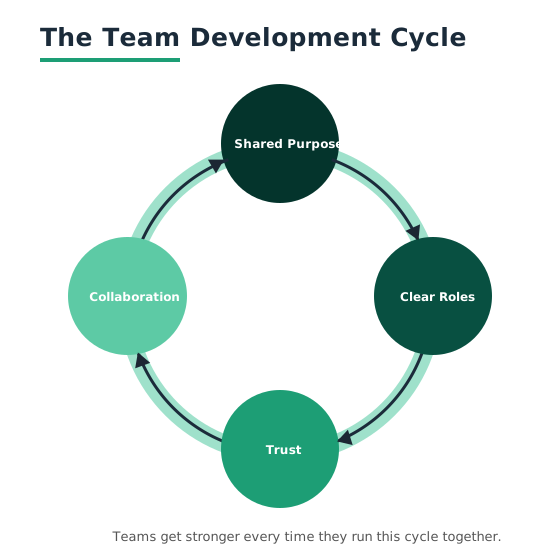
Team Development Cycle

Great teams get stronger every time they solve a problem together, moving through the same cycle repeatedly.

Shared Purpose

— everyone on the team understands not just their individual task, but what the team as a whole is actually trying to accomplish, echoing the vision work from Chapter 16.

Clear Roles

— each person knows what they specifically own within the shared purpose, avoiding the confusion of overlapping or undefined responsibilities.

Trust

— built the same way the Trust Equation from Chapter 28 describes, through clear expectations, competence, accountability, and coaching, repeated consistently.

Communication

— the habits from Chapter 21, now operating peer-to-peer instead of just top-down.

Collaboration

— the team actually working through problems together, the way Jake's crew now did instinctively.

Continuous Improvement

— the team applying Chapter 18's Improvement Cycle to itself, getting a little better every time it solves something together.

Higher Trust

— the cycle completes by depositing more trust than it started with, setting up the next round to go even further.

Group vs. Team, Individual vs. Team Success

The distinction matters more than it sounds like it should. A room full of talented individuals, each working in isolation, is a group — capable, but limited by how much any single person can personally accomplish. A team multiplies capability, because knowledge, effort, and problem-solving all move between people instead of staying locked inside any one of them.

Companies that reward only individual heroics tend to build exactly that — groups of skilled individuals, competing quietly for recognition instead of building anything together. Companies that deliberately shift recognition toward collective outcomes build something structurally stronger: teams whose performance doesn't collapse the moment one talented person has a bad week, takes a vacation, or leaves entirely.

Common Team-Building Mistakes

Rewarding individual heroes.

Constant praise for one standout performer, without recognizing collaboration, quietly teaches everyone else that teamwork doesn't actually pay.

Allowing internal competition.

Competition between coworkers for recognition or reward undermines the trust a real team depends on.

Ignoring conflict.

Unresolved tension between team members festers and eventually poisons collaboration far more than the original disagreement ever would have.

Never celebrating team wins.

If only individual achievements get recognized, teams quietly learn that working together isn't worth highlighting.

Expecting teamwork without shared goals.

Collaboration doesn't happen automatically just because people share a schedule — it requires the Shared Purpose layer to actually exist first.

Building departments instead of relationships.

Organizational structure alone doesn't create a team; the relationships and trust inside that structure do.

Promoting technical experts who cannot collaborate.

Technical skill, exactly like Chapter 20 warned, doesn't automatically translate into the ability to build a functioning team around it.

Sarah's Story

Sarah told Mike about a technician she'd once had, years earlier, who everyone genuinely admired. His work was incredible. Customers loved him. And almost nobody actually wanted to work alongside him — he solved every problem alone, quietly criticized coworkers who didn't match his pace, and, without meaning to, weakened the people around him every time he outperformed them without helping them improve.

Her mentor watched the shop for a single day and told her plainly, "You don't have your best employee. You have your biggest dependency."

Sarah eventually coached him, deliberately and patiently, toward becoming a mentor instead of a lone hero — teaching him to bring others up to his level instead of simply outpacing them. "The whole company got stronger once he did," she told Mike. "I finally understood that multiplying capability mattered more than any single person's brilliance, no matter how impressive that brilliance looked on its own."

Real Contractor Comparison

Company A

has several excellent individual technicians and weak teamwork connecting them. Knowledge stays isolated inside whoever happens to know it. Problems escalate because nobody's built the habit of solving them collaboratively. The owner ends up coordinating constantly, exactly the bottleneck Chapter 19 was built to eliminate. Growth slows under the weight of all that coordination.

Company B

turns average individuals into something exceptional together. Knowledge moves freely between people. Leaders coach as a matter of habit, not obligation. Problems get solved collectively, the way Jake's crew now handled things without him. Teams improve continuously, because the Team Development Cycle keeps turning on its own. Growth accelerates.

Heroes win jobs. Teams build companies. Mike's business, for years, had run largely on individual effort. What was forming now, in Jake's crew, was something built to outlast any single person's presence.

The Five Behaviors of High-Performing Teams

Great teams don't happen by accident. They're built on five foundational behaviors that reinforce each other, creating a culture of trust, accountability, and continuous growth.

01

Shared Goals

— everyone pulling toward the same outcome, not just their own individual task list.

02

Open Communication

— problems and ideas moving freely between team members, not just up to a supervisor.

03

Mutual Trust

— team members confident enough in each other to raise concerns, admit mistakes, and ask for help without fear.

04

Shared Accountability

— the whole team owning outcomes together, not just individually assigned pieces of them.

05

Continuous Learning

— the team actively getting better after every job, not just repeating whatever worked last time.

Mike could see all five already forming in Jake's crew — shared goals in how they approached each job, open communication in how freely they talked through problems, mutual trust in how comfortably a newer technician could ask for help.

The Leadership Multiplication Model

Leadership moves through a company in a specific, repeatable chain: Owner develops Leaders, who build Teams, who in turn naturally develop the company's Future Leaders — and the cycle repeats itself, one generation deeper each time.

Every team should be developing its next leader. Jake's crew, without any formal program, was already doing exactly that — newer technicians learning not just the trade, but how to lead a crew, simply by working inside one that already led itself well.

Practical Exercise

Choose one team in your business and evaluate it honestly. Do they solve problems together, or route everything to a supervisor? Do they share knowledge freely, or does it stay locked inside individuals? Do experienced people coach newer ones without being asked? Do they celebrate success together, or only individually? Do they actually improve after a mistake, or just move past it? Identify one specific behavior to strengthen over the next month, and focus there before trying to fix everything at once.

Warning Signs

dependency

One employee becomes indispensable.

This often means capability never actually spread beyond that one person, exactly like Sarah's early technician.

silo

Knowledge stays with individuals.

This means the System Loop from Chapter 13 hasn't fully extended into peer-to-peer sharing yet.

tension

Conflict remains unresolved.

This quietly poisons the trust layer of the Team Development Cycle, blocking everything built on top of it.

silo

Employees work around each other instead of together.

This usually means Shared Purpose was never genuinely established, only assumed.

bottleneck

The owner coordinates everything.

This means the team hasn't yet developed the internal leadership that would let it coordinate itself.

reporting

Team meetings feel like reporting sessions instead of collaboration.

This means the meeting structure is still built for individual accountability, not shared problem-solving.

Action Checklist

  • Define clear, shared goals for each team, not just individual task lists.
  • Celebrate team achievements publicly, not just individual performance.
  • Encourage peer coaching as an expected norm, not an occasional favor.
  • Create habits for openly sharing knowledge across the team.
  • Address conflict quickly, before it quietly undermines trust.
  • Deliberately develop a future leader within every crew, not just at the top of the org chart.

Key Takeaways

Many contractors believe leadership is entirely about developing strong individuals — it is, but growing companies need teams that function together, solve problems together, and hold each other accountable. The Team Development Cycle — Shared Purpose, Clear Roles, Trust, Communication, Collaboration, Continuous Improvement, Higher Trust — makes teams stronger every time they solve something together. Heroes win jobs. Teams build companies. Organizations grow when leadership becomes contagious, spreading from one person to an entire crew.

Reflection Questions

Do your crews currently function as groups, or as genuine teams? Who becomes stronger specifically because of your best employees, rather than simply overshadowed by them? What knowledge in your business remains trapped inside individuals instead of shared across a team? Would your teams keep improving without your daily involvement? How can your current leaders start creating more leaders beneath them?


Late one afternoon, Mike watched Jake's crew finish a genuinely difficult job. Nobody asked him for help. Nobody waited for instructions. They cleaned the site together, reviewed tomorrow's schedule together, helped a newer technician load his equipment, and left together, easily, like it had never occurred to them to do it any other way.

Sarah, standing beside him, asked, "What did you notice?"

Mike smiled. "They didn't need me."

"They didn't just work together," Sarah said. "They led together."

Mike looked out across the parking lot. "I used to measure success by how many leaders I had." He paused. "Now I think success is measured by how many teams no longer need me at all."

Sarah smiled. "And that's when a company actually begins to scale." She pointed toward the office. "A company stops depending on heroes when it starts depending on systems, teams, and clearly defined responsibilities."

Chapter 31 is where you learn how to build departments — not dependencies.

Scroll to Top