
Chapter 15: People Don't Leave Jobs. They Leave Bosses.
Chapter 15

People Don't Leave Jobs. They Leave Bosses.

Things were going well. Systems were holding, quality was improving, customers were happy, and Mike had started to relax into the rhythm of actually running a small team instead of just surviving it.

So he wasn't prepared for the knot in his stomach when his technician knocked on the truck window one Friday afternoon and asked, "Mike, can we talk?"

Mike braced for bad news. A complaint. A resignation. Something broken.

Instead, his technician said, quietly, "I like working here."

Mike smiled, relieved. "But?"

"But I never really know if I'm doing a good job. You only talk to me when something needs fixing."

Mike sat with that for a second, and then it landed harder than he expected. He thought back over the last month of conversations with his own employee - nearly every one of them had been a correction, a checklist gap, a missed detail. Not once, that he could remember, had he simply told the guy he was doing well.

That night, he told Sarah, "I thought paying him on time was enough."

Sarah smiled gently. "It gets someone to show up to work." She let the pause sit there. "It doesn't give them a reason to stay."

People work for money. They stay because of leadership.

-

The Challenge

Every contractor eventually reaches this exact moment - a good employee, doing good work, quietly wondering whether any of it is actually seen. It rarely shows up as a complaint. It shows up as a hesitant Friday afternoon conversation, or it doesn't show up at all, and the employee simply leaves for a job two dollars an hour better, and the owner spends months blaming the labor market for something that was never really about the money.

Employees rarely leave because the work is hard. They leave because they don't feel respected, don't know what's expected of them, don't feel appreciated, or stop believing they're growing. The quality of a business rarely exceeds the quality of its leadership - and leadership, it turns out, isn't a title Mike had been given when he hired his first employee. It was a responsibility he hadn't fully picked up yet.
Why It Happens

Most new owners default to managing, because managing is a natural extension of everything Part Two has taught so far - systems, accountability, scoreboards. Management organizes work. Leadership develops people. A manager asks, "What got done?" A leader asks, "Who is this person becoming?"

Mike had built excellent systems and a fair accountability structure. What he hadn't built was any deliberate space for the relationship itself - recognition, growth, the simple act of noticing effort out loud instead of only noticing its absence.

Leadership begins where authority ends. Mike had the authority to direct his technician's work from day one. He hadn't yet earned the kind of trust that makes someone want to stay, grow, and eventually bring their friends along too.

The Framework: The Leadership Pyramid

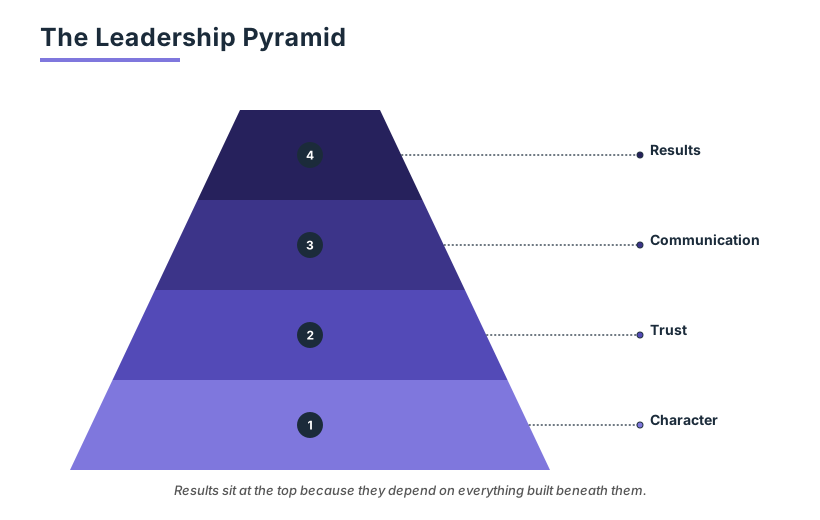
Leadership Pyramid

Results sit at the top of every business's concerns - and that's exactly the mistake most owners make, trying to improve results directly instead of building what actually supports them.

Character is the base of the pyramid - your own integrity, consistency, and honesty, which everything else depends on entirely.

Trust is built on character - an employee's confidence that you'll do what you say and treat them fairly, even when it's inconvenient for you.

Communication is built on trust - the ongoing exchange of expectations, feedback, and recognition that keeps a working relationship healthy.

Development is built on communication - actively helping someone grow, not just correcting them when they fall short.

Results sit at the top, resting on everything beneath them. Chase results directly, skipping the foundation, and they become fragile - dependent on fear or obligation instead of genuine investment.

Most owners try to fix results first. Great leaders fix everything underneath them, and the results tend to follow on their own.

Common Leadership Mistakes

Only speaking up when something is wrong.

This was Mike's exact mistake - every conversation becomes a correction, until an employee starts to believe silence is the closest thing to praise they'll ever get.

Assuming employees know they're appreciated.

Appreciation that's never spoken out loud might as well not exist, from the employee's side of the conversation.

Leading through fear.

Fear produces short-term compliance and long-term resentment - and it's the fastest way to make someone stop bringing you problems while they're still small.

Avoiding difficult conversations.

A performance issue left unaddressed doesn't resolve itself, and everyone else on the team quietly learns the standard is optional.

Playing favorites.

Even small, unconscious favoritism erodes trust across an entire team faster than almost anything else an owner can do.

Trying to be everyone's friend.

Leadership requires the willingness to have hard conversations a friendship would often avoid - respect matters more than being liked.

Never explaining why decisions are made.

A decision without a reason feels arbitrary, even when it isn't, and arbitrary decisions erode trust over time.

Expecting loyalty without earning trust.

Loyalty is a response to how someone is treated. It can't be demanded - only earned, the same way it was earned from every one of Mike's five hundred good decisions and lost the moment he stopped noticing his technician's effort.

Sarah's Story

Sarah told Mike about one of the best technicians she'd ever had - someone she assumed left, a year or so back, because a competitor offered him two dollars more an hour. She'd told herself that story for months, comfortable with an explanation that had nothing to do with her own leadership.

Then they ran into each other over coffee, long after he'd moved on. She finally asked him directly why he'd left.

"It wasn't the money," he told her. "I just stopped feeling like I mattered."

"That conversation changed how I led forever," Sarah said. "I'd been so focused on paying fairly and managing well that I never noticed I'd stopped actually seeing him as a person with his own growth, his own goals, his own need to know he mattered beyond the work he produced."

Real Contractor Comparison

Company A

has high turnover - employees rarely last past their first year. The owner blames the labor market, blames younger workers, blames anything but the daily experience of working there. Nobody stays long enough to become truly skilled, so the business perpetually operates with inexperienced hands and a frustrated owner who can't understand why "nobody wants to work anymore."

Company B

holds regular one-on-one conversations, recognizes effort specifically and often, sets clear expectations, and actively helps employees grow toward something beyond their current role. Employees stay for years. They refer their friends - the single strongest signal that a workplace is genuinely valued by the people inside it, because nobody recommends a job they secretly can't wait to escape.

People remember how leaders made them feel far longer than they remember any specific instruction or correction. That memory is what determines whether they stay, refer someone else, or quietly start looking elsewhere.

The Five Leadership Habits

Listen before speaking.

Understand what's actually going on before jumping to correct or direct.

Recognize effort publicly.

A specific, genuine acknowledgment in front of others carries far more weight than a private nod ever will.

Correct privately.

Mistakes get addressed one-on-one, respectfully - never in front of a customer or a teammate.

Explain the why.

Every significant decision deserves a reason, spoken out loud, even when you don't think you owe one.

Invest in someone's growth every week.

A small, consistent habit - teaching a new skill, asking about their goals - compounds into real loyalty over time.

Culture is simply leadership repeated every day. These five habits aren't a program. They're a daily practice, and the compounding effect of repeating them, week after week, is what eventually becomes "the way things are around here."

Practical Exercise

Meet individually with every employee you have, and ask exactly four questions: What's going well? What's frustrating you? How can I help you succeed? What should I do better? Listen without defending yourself. Write down everything you hear. Then take action on at least one specific suggestion - visibly enough that they know it was actually heard, not just collected.

Warning Signs

Employees stop bringing ideas.

This usually means past ideas were ignored or dismissed, teaching people that speaking up isn't worth the effort.

People avoid difficult conversations.

This usually means past honesty was met poorly, and silence has started to feel safer than candor.

Nobody takes initiative.

This usually means initiative was corrected or micromanaged out of existence at some point, and waiting for instructions became the safer habit.

High turnover.

This is rarely purely about pay - it's usually a leadership signal disguised as a market condition.

Everyone waits for instructions.

This means the team has learned that decisions only ever come from the owner, regardless of what they're actually capable of deciding themselves.

Action Checklist

  • Thank one employee specifically, for something specific, every day this week.
  • Schedule a regular one-on-one conversation with each employee, even if it's brief.
  • Explain the reasoning behind one significant decision you make this week.
  • Recognize a specific improvement publicly, in front of the team or a customer.
  • Correct any mistake privately, respectfully, and promptly.
  • Help every employee learn one new skill or take on one small new responsibility this month.

Key Takeaways

Employees rarely leave because of hard work. They leave because they stop feeling respected, stop knowing what's expected of them, stop feeling appreciated, or stop believing they're growing. The Leadership Pyramid - Character, Trust, Communication, Development, Results - reminds you that results are supported by everything beneath them, not achieved by focusing on them directly. Leadership begins where authority ends, and it's practiced daily, in small habits, not delivered once a year in a review.

Reflection Questions

Would you genuinely enjoy working for yourself, given how you lead right now? When was the last time you thanked someone specifically, by name, for something exact? Do your employees know where they're growing, or just what they're doing today? What kind of leader are you actually becoming, one ordinary Tuesday at a time?


Over the following months, Mike noticed something he hadn't expected. His technician started suggesting small improvements on his own, without being asked. Customers began mentioning, unprompted, how professional the whole company felt. And one afternoon, a second technician called out of the blue, saying he'd heard good things and wanted to apply.

"I think we're finally building a team," Mike told Sarah, a little amazed at himself.

"Almost," she said. "A team still needs direction. It's one thing to get people who want to follow you. It's another thing entirely to actually know where you're leading them."

Mike asked, "So what's next?"

Sarah smiled. "You've learned to lead people. Now you need to teach them where you're going."

Chapter 16 is where vision enters the story - and gives your team a reason to follow you somewhere worth going.

Scroll to Top