He was also calling Mike's phone roughly every fifteen minutes.
"Hey Mike, where do we keep the extra fittings?" "Mike, how do we normally handle a customer who wants to reschedule same-day?" "What do I charge for this extra part?" "What do I tell her if she asks about the warranty?" "What happens if the crawlspace access is blocked?"
By Wednesday of his new hire's second week, Mike was spending more time answering questions from the truck than he was spending on his own jobs. He said as much to Sarah, half-joking, half-desperate. "Hiring made me busier."
"No," Sarah said. "You hired someone. You forgot to build a system." She let that land. "A good employee without a system just becomes a very motivated person who has to interrupt you constantly to find out what to do. That's not his failure, Mike. That's yours."
The best system answers questions before people ask them.
The Challenge
Hiring solves one problem and immediately creates another. A great employee with no system still has to get every answer from somewhere, and if that somewhere is you, personally, every single time, you haven't actually freed up any capacity. You've just added a second full-time job: answering questions.
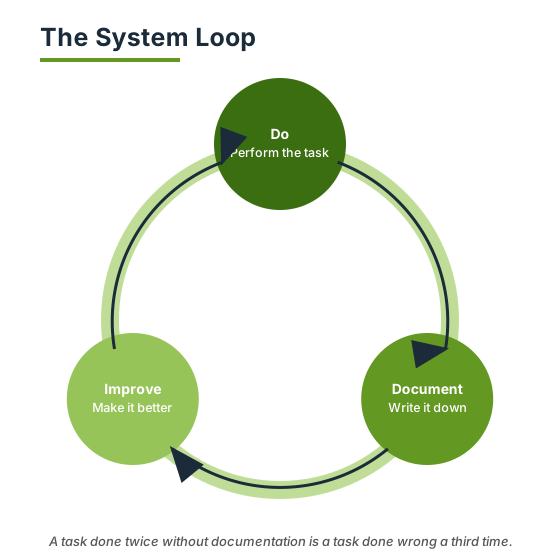
Chapter 5 introduced the Repeatability Rule - if it's happened twice, it needs a system. Now that you actually have someone to use those systems, that lesson stops being theoretical and starts being the only thing standing between you and your phone ringing constantly.