Chapter 26: Think Beyond Five Trucks
Chapter 26

Think Beyond Five Trucks

Months had passed since Mike closed his office door to think about the future instead of solving another fire. The company now ran consistently at four to five trucks. Leadership meetings produced real decisions. Customers stayed happy. Cash flow held steady, month after month.

The Challenge

Most contractors become quiet prisoners of their current size. They get good at solving today's problems using today's organization, and understandably, that competence starts to feel like mastery. Great companies are built differently — they solve tomorrow's problems before tomorrow ever arrives, which means an owner who wants ten trucks can't keep thinking the way a five-truck owner thinks, no matter how well that thinking has worked so far.

Mike's comfort was earned and real. It was also, quietly, a trap — the exact moment most contractors stop growing, precisely because everything finally feels like it's working.

Why It Happens

Companies don't outgrow opportunities. They outgrow their systems. The demand for Mike's next five trucks almost certainly existed already. What didn't yet exist was an organization built to handle it — the leadership depth, the systems, the cash reserves that a bigger company would actually require.

Today's success can become tomorrow's limitation when an owner assumes the structure that got them here will automatically scale to get them there. It rarely does, and the gap between the two shows up as exactly the kind of chaos Sarah had warned him about back in Chapter 23.

The Framework: The Growth Horizon

Growth Horizon

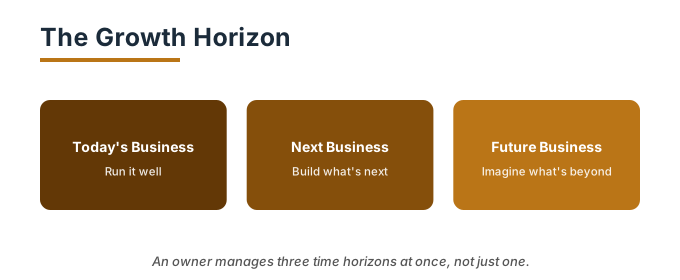
Owners should spend their time across three horizons simultaneously, not just the nearest one.

Today

Today's Business

Operate it well. This is where daily operations, the systems from Chapter 5 and 13, and the leadership from Chapter 20 keep everything running smoothly right now.

Next

Next Business

Prepare its systems. This is the version of the company one stage ahead, the one that will need stronger leadership depth, more refined processes, and greater financial capacity than today's version requires.

Future

Future Business

Imagine its possibilities. This is the furthest horizon, where an owner allows themselves to think past the next stage entirely, toward what the company could eventually become.

Businesses stop growing the moment an owner lives entirely inside the first horizon. Mike had spent years there by necessity. The comfort he was feeling now was actually his first real invitation to start spending deliberate time in the second and third horizons as well.

Reactive Growth vs. Intentional Growth

Reactive companies hire only after becoming overwhelmed, move into larger space only after running out of room, develop systems only after mistakes force the issue, and promote leaders only after chaos has already begun. Every stage of growth, handled this way, feels like a crisis, because the organization is always one step behind its own demand.

Intentional companies build capacity before demand arrives. They develop leaders early, before the business desperately needs them. They create systems before complexity forces the issue. They strengthen finances before expansion, not during it. Successful scaling always feels early — uncomfortably early, in fact, which is exactly why so few contractors actually do it.

Common Growth Mistakes

Assuming today's systems will handle tomorrow's size.

A checklist built for one truck rarely holds up cleanly at ten, without deliberate redesign along the way.

Growing revenue faster than leadership.

Revenue can climb quickly. Genuine leadership capacity, the kind built in Chapter 20, takes real time to develop — and it can't be rushed just because the growth arrived faster than expected.

Expanding without sufficient cash.

The Resilience Pyramid from Chapter 23 applies just as directly to growth as it does to crisis — expansion without a real cash cushion creates exactly the kind of fragility that a setback could easily expose.

Waiting until overwhelmed before hiring.

Hiring reactively, out of exhaustion, was already named as a mistake back in Chapter 12 — and it becomes even more costly at scale, where the stakes of a rushed hire are higher.

Confusing growth with progress.

More trucks without more organizational capability isn't progress. It's just more weight sitting on the same foundation.

Believing success today guarantees success tomorrow.

Every stage of growth creates genuinely new problems that the previous stage's success has no automatic answer for.

Sarah's Story

Sarah told Mike about reaching five trucks herself, years earlier, and feeling exactly the same pride Mike was feeling now — convinced she'd finally mastered the business. Growth stopped shortly afterward, not because demand disappeared, but because her systems had simply reached their limit.

Her own mentor, at the time, drew two circles on a napkin. Inside the first, he wrote: "The business that got you here." Inside the second: "The business that gets you there." He looked at her and said simply, "They're never exactly the same."

"I realized I needed to redesign the company before I added another truck," Sarah told Mike, "not after. That lesson changed how I've approached every stage of growth since."

Real Contractor Comparison

Company A

Lets growth happen accidentally. The owner hires only after becoming overwhelmed. Processes evolve inconsistently, built reactively in response to whatever mistake just happened. Leadership develops slowly, always a step behind the company's actual size. Every new truck creates fresh chaos, because nothing was prepared in advance for it.

Company B

Plans growth years ahead. Systems get built early, before complexity demands them. Leaders are developed continuously, ready before the business urgently needs them. Hiring follows a real long-term plan rather than a crisis. Growth feels steady and manageable instead of constantly stressful.

The next stage is built before it arrives — Company B's advantage isn't luck or a bigger market. It's simply that preparation happened on a different timeline than reaction ever could.

The Five Questions of Tomorrow

Ask these every quarter:

  • If we doubled next year, what would break first?
  • Who would need to lead that we don't currently have ready?
  • What system would fail under twice the current load?
  • What resource would become scarce — cash, trucks, trained people?
  • What should we begin building today, specifically because of the answers to the first four questions?

The Expansion Blueprint

Growth should follow a specific order, not the order most contractors default to.

  • Visionknowing where the company is actually headed.
  • Organizationdesigning the structure that vision requires.
  • Leadershipdeveloping the people capable of running that structure.
  • Systemsbuilding the processes strong enough to support it.
  • Growthmore trucks, more revenue — is the final outcome of all that preparation, not the starting point most owners mistakenly reach for first.

Practical Exercise

Imagine your company doubles within the next twenty-four months. Write down three systems that would fail under that load. Write down three leadership positions you'd need that don't currently exist. Write down three habits you'd need to develop, starting now, to be genuinely ready. Choose one specific improvement from that list, and begin it this month — well before doubling actually happens.

Warning Signs

red flag

Growth has stalled.

This often means the organization has quietly outgrown its own design, even if revenue still looks fine on paper.

habit

Every new employee creates confusion.

This usually means systems weren't built early enough to absorb the added complexity smoothly.

subtle

Leadership meetings discuss only current problems.

This means the organization is still living entirely in the first horizon, with no attention paid to the next one.

stuck

Hiring always feels urgent.

This is the clearest sign that hiring is happening reactively, exactly like Company A, instead of according to any real plan.

bypass

Customers begin experiencing inconsistency.

This is often growth outpacing the systems and culture from Chapters 13 and 24, stretched thinner than they can currently support.

critical

The owner keeps saying "we'll fix it later."

This usually means preparation is being postponed until it becomes an expensive emergency instead of a manageable choice.

Action Checklist

  • Identify the bottlenecks most likely to appear at your next stage of growth.
  • Build one system now that your future size will require.
  • Begin developing one future leader before the role is desperately needed.
  • Review your long-term growth plans every quarter, not just once a year.
  • Create capacity deliberately, ahead of demand, rather than scrambling to catch up.
  • Keep redesigning the organization itself, not just adding more trucks to the same design.

Key Takeaways

Most contractors become prisoners of their current size, solving today's problems with today's organization. Great companies solve tomorrow's problems before tomorrow arrives. The Growth Horizon — Today's Business, Next Business, Future Business — demands attention across all three timeframes simultaneously, not just the nearest one. Preparation always feels early, right up until the moment it would have been too late. Growth is designed before it is experienced, and the business that gets you to ten trucks will never be exactly the same business that got you to five.

Reflection Questions

What assumptions about your business might no longer actually be true? If your company doubled tomorrow, what would fail first? Are you building today's company, or tomorrow's? What should exist before your next truck is even purchased? What leadership capability do you need to begin developing today, well before you desperately need it?


That evening, Mike stood outside the shop, looking at five trucks sitting quietly in the parking lot. Only a year earlier, one truck had felt like an impossible reach. Now five felt, strangely, almost small.

Sarah joined him. "What are you thinking?"

Mike smiled. "I'm not looking at five trucks anymore. I'm wondering what ten looks like."

"Good," Sarah said. "Because the next company has to be designed before it can be built." She looked out toward the road leading away from the lot. "The next stage isn't about working harder. It's about building an organization capable of carrying far more weight than this one currently can."

Mike took one last look at the trucks, then turned back toward the office — not to solve today's problems, but to begin designing tomorrow's.

Mike is no longer just a technician, a supervisor, or even simply a business owner. He has become an organizational leader who thinks beyond today's operations — a transformation that took him through delegation, hiring, systems, accountability, leadership, vision, decision-making, continuous improvement, resilience, and culture, one deliberate stage at a time. He is ready now for Part Four — Building a Company, five to ten trucks — where the challenge shifts from creating a stable business to designing an enterprise built to scale.
Scroll to Top