Chapter 9: Stop Selling. Start Solving.
Chapter 9

Stop Selling. Start Solving.

Mike had raised his prices, exactly like Sarah pushed him to in Chapter 8. He believed in the number now — it covered materials, labor, overhead, and a real profit, not a guess. What he hadn't expected was how much that number would scare him the first time a customer actually questioned it.

The Challenge

Every contractor who raises their prices runs into this exact moment eventually — a customer with a lower number in hand, watching to see what you do next. Most contractors do what Mike did. They talk. They justify. They discount before anyone asks. And the more they talk, the smaller they seem, because none of it addresses the only thing the customer actually came to the conversation to solve.

The fear behind all of it is simple: what if nobody hires me at this price. But the fear is aimed at the wrong target. The problem was never the price. It was that Mike walked in ready to sell plumbing to someone who needed to be understood first.
Why It Happens

Contractors fear "selling" because they picture it as convincing — talking someone into something they don't want. That fear makes sense, and it's also based on a version of selling that never actually works in this business. The best salespeople don't sound like salespeople. They sound like someone asking good questions because they genuinely want to understand the problem.

"I used to think every estimate was a performance," Sarah told him. "I'd walk in and start presenting — here's what I found, here's what it costs, here's why I'm the right guy. One day, out of pure exhaustion, I stopped presenting and just started asking questions instead. What's actually bothering you about this? How long has it been going on? What happens if it doesn't get fixed? My close rate went up. My prices were higher than ever. People weren't buying my pitch anymore. They were buying the feeling that I finally understood what they were dealing with."

Every estimate is really a conversation about trust, not a negotiation about price. A customer who trusts you completely rarely asks about the competitor's number at all.

The Framework: The TRUST Conversation

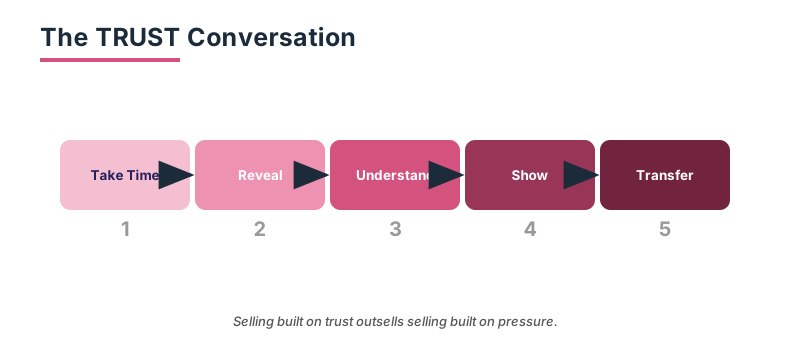
TRUST Conversation

This isn't a script. It's an order of operations for a conversation you already know how to have — you just haven't been having it in this order.

T Take time to understand. Before anything else, slow down. Ask what's actually going on, in their words, before you start diagnosing anything yourself.
R Reveal the real problem. Often the stated problem ("the water heater's making noise") isn't the real one ("I'm worried it's about to fail during a holiday with family visiting"). Ask enough questions to find the second one.
U Understand priorities. Every customer is weighing something — cost, speed, reliability, peace of mind. Find out which one matters most to them specifically, instead of assuming it's always price.
S Show the solution. Only now, once you understand the real problem and their real priority, do you explain what you'd do and why — connected directly to what they told you mattered.
T Transfer confidence. Close by making sure they feel equipped to decide, not pressured to decide. Ask if they have questions. Answer them fully. Then ask for the job directly.

Price becomes smaller when confidence becomes larger. A customer who's gone through all five steps with you rarely needs to hear your number defended — they've already decided you understand the problem better than the other guy did.

How Customers Actually Decide

Customers move through a predictable sequence before they say yes to anything, and almost none of it involves comparing line-item prices the way contractors assume.

  • 1. First, they need to feel understood — that you heard the actual problem, not just the symptom.
  • 2. Then they need to trust the contractor in front of them, which mostly comes from how well you listened in the first step, not from your years of experience or your truck's logo.
  • 3. Once trust exists, they need to understand the solution you're proposing, in plain language, connected to what they actually care about.
  • 4. From there, they need to believe the value — that what you're proposing is worth more than what it costs.
  • 5. And only at the very end do they feel confident making a decision, which is the moment they actually say yes.

Skip straight to price, the way Mike did, and you've asked someone to make the final decision without ever walking them through the first four steps. No wonder it felt like a fight.

Common Selling Mistakes

Talking too much.

Every minute you spend explaining is a minute you're not spending understanding. The contractor who talks the least, asked the best questions.

Quoting before diagnosing.

A price given before the real problem is understood is a guess with a dollar sign on it, and customers can feel the difference.

Competing only on price.

If price is the only thing being discussed, it's because nothing else about the value has been communicated yet.

Interrupting.

Cutting a customer off to correct a small detail says, quietly, that you're more interested in being right than in understanding them.

Using technical language.

Explaining a problem in jargon makes you sound smart and makes the customer feel stupid — neither one builds trust.

Rushing.

An estimate that feels rushed tells the customer their problem wasn't important enough for your full attention.

Not listening.

The most common mistake on this whole list, and the root cause of most of the others.

Not asking questions.

A contractor who doesn't ask questions is guessing at what the customer values, instead of finding out.

Not confirming understanding.

Restating the problem back to a customer before proposing a solution proves you actually heard them — and most contractors skip this step entirely.

Leaving without asking for the job.

After all that work understanding the problem, many contractors still walk away without simply asking, "Would you like me to go ahead and get this scheduled?"

Real Contractor Example: Two Estimates

Contractor A

walks in, looks around, writes a number on a piece of paper, and leaves. The whole visit takes eight minutes. The homeowner has no idea why the price is what it is, no sense of what makes this contractor different from the last one, and no reason to choose him over anyone else except whichever number happens to be lowest.

Contractor B

walks in and starts with a question: "Tell me what's been going on." He listens for two full minutes without interrupting. He asks a follow-up: "How long has it been like this?" Then another: "What happens for your family if this isn't fixed soon?" He explains what he found in plain language, connects his recommendation directly to what the homeowner said mattered — reliability, not just speed — and offers two clear options instead of one flat number. He answers a concern about the price by explaining exactly what it covers, without flinching or discounting. Then he asks, plainly, "Would you like me to get this scheduled?"

Contractor B's price was higher than Contractor A's. He won the job anyway, because he was the only one who made the customer feel like the actual problem had been understood.

Questions Great Contractors Ask

"When did you first notice the problem?" "What happens if this isn't fixed?" "What matters most to you here — speed, cost, or getting it exactly right?" "Have you had this repaired before, and how did that go?" "What concerns you most about moving forward?"

None of these are tricks. They're the questions a genuinely curious person asks when they actually want to understand a problem before they try to solve it.

Objections

"You're too expensive." This is rarely about the number itself — it's usually a request for more confidence that the number is worth it. Answer with value, not a discount.

"I need to think about it." Often this means the customer doesn't yet feel confident, not that they're not interested. Ask directly: "What would help you feel more confident deciding today?"

"I'm getting more estimates." This is a reasonable, healthy instinct. Respond with confidence, not defensiveness — the contractor who made them feel most understood usually wins the comparison anyway.

"My spouse isn't here." Ask if there's anything you can explain now that would help that conversation go smoothly later, rather than treating it as a dead end.

Practical Exercise

For your next five estimates, track four things: how many questions you asked before quoting a price, roughly what percentage of the conversation the customer spent talking versus you, what objections came up, and the outcome. After five estimates, look for the pattern. Contractors who ask more and talk less almost always find their close rate — and their confidence — moving in the same direction.

Warning Signs

"I lose every job on price."

This usually means price was the only thing discussed, because nothing else about the value ever got communicated.

"I quote too fast."

This usually means diagnosis is being skipped in favor of speed, which leaves the customer with a number and no reason to trust it.

"I don't know why customers say no."

This usually means the conversation ended before real objections or hesitations were ever surfaced and addressed.

"I talk more than my customer."

This is the clearest sign of all that questions are being replaced with explanations nobody asked for yet.

Action Checklist

  • Ask five more questions than you normally would before giving any price.
  • Explain what you found and why it matters before discussing cost at all.
  • Offer customers a real choice between two options instead of a single take-it-or-leave-it number.
  • Practice staying quiet after asking a question, even when the silence feels uncomfortable.
  • Ask every customer, directly, if they have any remaining questions before you leave.
  • End every estimate by confidently asking for the job.

Key Takeaways

Customers don't buy your trade. They buy relief, confidence, and trust — and the contractor who understands that will out-earn the one who's simply better at explaining a price. The TRUST Conversation — Take time to understand, Reveal the real problem, Understand priorities, Show the solution, Transfer confidence — turns selling from a performance into a conversation you already know how to have. Price becomes smaller when confidence becomes larger, and confidence is built by listening, not by talking.

Reflection Questions

In your last estimate, did the customer feel understood, or did they just receive a number? Did you diagnose the real problem, or quote the first one mentioned? What assumptions did you make about what mattered to that customer, and were you ever asking, or just guessing? What would change in your close rate if you talked less and asked more?


Mike thought about the water heater conversation the whole drive home from coffee. "I thought sales was about talking," he admitted to Sarah. "Now I realize it's mostly listening."

Sarah smiled. "Good. Because next you'll discover something even more useful — your reputation starts selling long before you ever walk in the door. Chapter 10 is where we build the trust that arrives before you do."

Scroll to Top