Chapter 34: Protect Your Culture as You Scale
Chapter 34

Protect Your Culture as You Scale

Nearly twenty trucks now. Revenue still climbing steadily, departments running smoothly... And yet, walking through the shop one ordinary morning, something felt different in a way Mike couldn't quite name.

Nearly twenty trucks now. Revenue still climbing steadily, departments running smoothly, customers still happy by every measure Mike could actually track. And yet, walking through the shop one ordinary morning, something felt different in a way he couldn't quite name.

The crews seemed quieter. Meetings wrapped up fast, with little of the easy back-and-forth that used to fill them. New technicians left the moment their shift ended, without lingering the way people used to. The laughter that had once filled the shop most afternoons had thinned out, gradually, without any single moment marking when it happened.

Nothing was actually wrong. Something still felt missing.

"Did we lose something?" he wondered out loud, almost to himself, before he'd even decided to say it.

"No," Sarah said. "You didn't lose it. You simply stopped reinforcing it."

"I can't explain it," he told her that afternoon. "The business is healthier than it's ever been. It just doesn't feel the same."

Sarah nodded slowly. "That's because your culture is changing."

Mike frowned. "I thought culture just happened."

"It did," she said. "Back when everyone fit around one lunch table." She pointed across the parking lot, toward the rows of trucks and the crews scattered near them. "Now you need twenty lunch tables."

Culture is what people do when the owner isn't watching.
The Challenge

Culture happens naturally in small companies. It has to be built intentionally in large ones. When there are three employees, everyone watches the owner, and the owner's own behavior teaches the culture directly, every single day, through simple proximity. When there are thirty, they watch each other instead — and the owner's direct influence, the thing that built the culture in the first place, physically can't reach everyone anymore.

Mike hadn't done anything wrong. He'd simply grown past the size where culture could survive on proximity alone, without anyone deliberately building the systems that would carry it further.

Why It Happens

Companies don't lose culture overnight. They lose it one hire, one decision, one small compromise at a time — quietly enough that, like Mike, an owner can feel something shift without being able to point to any single cause.

Culture vs. Perks. Culture was never pizza Fridays, company shirts, or a holiday party — those are perks, pleasant but disconnected from what actually shapes behavior. Culture is how people treat customers, how leaders solve problems, how mistakes get handled, how success gets recognized, and how people behave when nobody's watching. Culture is demonstrated, not announced, and demonstration gets harder to scale than announcement ever was.

Every leader becomes a culture carrier. As departments grow, the owner physically stops being able to shape every individual employee directly. Department leaders do that shaping instead, whether or not anyone's named that responsibility out loud. This means leadership development, from Chapter 20 onward, quietly became culture development the moment the company outgrew Mike's personal reach — and poor managers, left unchecked, will eventually erode even the strongest culture a founder ever built.

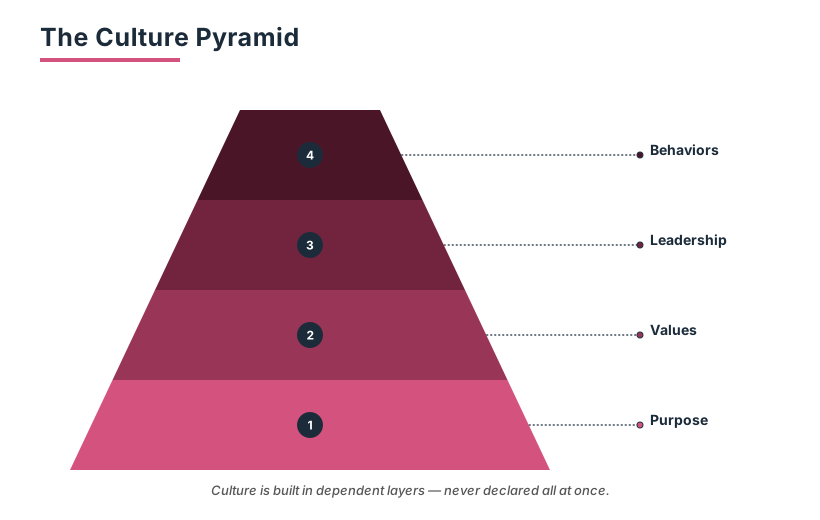
The Framework: The Culture Pyramid

bbok

Culture is built in layers, each one depending on the one beneath it.

Purpose sits at the base — the reason the company exists at all, first articulated back in Chapter 16.

Values sit above purpose — the specific, non-negotiable principles that flow from it.

Leadership sits above values — the people responsible for modeling those values daily, at a scale the owner alone can no longer cover.

Behaviors sit above leadership — the specific, observable actions that values actually produce in practice.

Daily Habits sit above behaviors — those actions, repeated consistently enough to become simply "how we do things here."

Results sit at the top, resting on everything built beneath — the revenue, retention, and reputation that culture eventually produces, though never directly or immediately.

Where Chapter 24's Culture Cycle showed how culture reinforces itself over time, the Culture Pyramid shows the structure holding it up at any given moment — and Mike's unease was the sensation of that structure quietly weakening somewhere in its middle layers, exactly where department leaders were now standing in for him.

Common Culture Mistakes

Hiring only for skill.

The Hiring Scorecard from Chapter 12 exists precisely because character shapes culture more durably than technical ability — a lesson that matters even more at scale.

Ignoring attitude.

A skilled employee with a poor attitude spreads that attitude to everyone working alongside them.

Allowing toxic high performers.

Production numbers that mask real cultural damage happening underneath them.

Changing values for revenue.

A value abandoned for a large enough opportunity teaches the entire company that values were negotiable all along.

Avoiding difficult conversations.

A cultural violation left unaddressed becomes, quietly, the new accepted standard.

Failing to recognize great behavior.

If only output gets praised, and never the behavior behind it, the behavior stops being reinforced.

Growing faster than onboarding.

New hires absorbed faster than they can be properly introduced to the culture end up defining their own version of it instead.

Sarah's Story

Sarah told Mike about an exceptional operations manager she'd once hired — someone who genuinely improved efficiency, increased profit, and reduced costs everywhere he touched. Everyone praised his results. Quietly, over the following months, good people started leaving.

Her mentor asked her directly, "What's your turnover telling you?"

She blamed the labor market, the same easy explanation nearly every struggling owner reaches for first.

"No," her mentor said. "You optimized operations. But you damaged culture."

She eventually replaced that high performer with someone who embodied the company's actual values, even at some short-term cost to raw efficiency. Performance recovered. Retention improved. Morale came back. "I never again separated results from values after that," she told Mike. "The best results, over time, always come from people who actually represent what the company stands for — not around them."

Real Contractor Comparison

Company A

Company A has excellent individual technicians and poor teamwork connecting them. Turnover stays high, quietly explained away as "the labor market" the way Sarah once explained her own. Customer experience varies noticeably depending on which crew shows up. Growth becomes increasingly difficult, because the culture that once made hiring easy has eroded without anyone deliberately noticing.

Company B

Company B has shared values, reinforced consistently through leadership at every level. Employees recommend friends, the strongest possible signal that a workplace is genuinely valued from the inside. Customers notice the professionalism, even when they can't articulate exactly why. Growth gets easier every year, because culture is actively compounding rather than quietly eroding.

Great culture reduces nearly every business problem — Company B's advantage touches hiring, retention, customer experience, and reputation all at once, from a single underlying source.

The Five Culture Builders

Five systems reinforce culture every single day, whether or not anyone's actively thinking about it:

Hiring — who actually gets brought into the company.

Onboarding — how quickly and clearly new hires absorb the real standard.

Leadership — how consistently department leaders model the values they're responsible for carrying.

Recognition — what actually gets praised, publicly and specifically.

Communication — how clearly expectations and values travel through the organization, extending the Communication Loop from Chapter 21 into cultural territory specifically.

The Legacy Filter

Before any major decision, ask four questions:

  • Does this strengthen trust?
  • Does this support our values?
  • Would we proudly explain this decision to every single employee, not just the ones directly affected?
  • Would this decision still make sense five years from now, or only in this quarter's pressure?

Values become real only when they influence difficult decisions — the easy ones never actually test whether a value is genuine or just decorative.

Practical Exercise

Write down your company's five core values. For each one, describe one specific, observable behavior that would prove it's actually being lived, not just stated. Review your recent hiring interviews against those behaviors. Review your onboarding process the same way. Review what actually gets recognized publicly in your company. Identify one specific culture habit to strengthen this month.

Warning Signs

Increasing turnover.

This is often the clearest early signal of cultural erosion, long before it shows up anywhere else.

Growing employee silos.

This means the Team Development Cycle from Chapter 30 has stalled, or never fully extended past the original crews.

Leaders acting differently from one another.

This means the Culture Pyramid's leadership layer has become inconsistent, teaching different standards depending on who's supervising.

Declining communication.

This is Chapter 21's warning sign resurfacing here, now specifically eroding cultural consistency rather than just operational clarity.

Different customer experiences.

This means culture and communication are straining together, exactly as Chapter 24 first warned.

Employees saying "that's not my job."

This remains one of the clearest single signs that shared ownership, the very thing Chapter 30's teams were built to create, has broken down.

Action Checklist

  • Define your company's values explicitly, in language every employee could actually repeat.
  • Hire deliberately for character, not just technical skill.
  • Strengthen onboarding so new hires absorb the real culture quickly and clearly.
  • Recognize the right behaviors publicly and specifically, not just strong output.
  • Hold every leader accountable for modeling the culture consistently, not just producing results.
  • Measure employee retention as seriously as you measure revenue.

Key Takeaways

Culture happens naturally in small companies and must be built intentionally in large ones — companies don't lose it overnight, they lose it one hire, one decision, one quiet compromise at a time. The Culture Pyramid shows Purpose, Values, Leadership, Behaviors, Daily Habits, and Results all depending on each other in order. The Legacy Filter protects culture one decision at a time, asking whether a choice would still make sense five years from now. The strongest companies hire for values and train for skill — and culture compounds just like reputation, for better or worse, depending entirely on whether it's actively protected.

Reflection Questions

Would a brand-new employee describe your culture the same way you would? What behaviors currently receive real recognition in your company? What behaviors currently receive quiet tolerance instead? If your best employees left tomorrow, would they genuinely recommend working here to a friend? Are your current systems actively strengthening your culture, or slowly, quietly replacing it with something else?


That Friday afternoon, Mike watched several technicians cleaning their trucks before heading home for the weekend. A new employee, without being asked, quietly stepped over to help another crew finish loading equipment. No supervisor noticed. Nobody had assigned it. He simply did it, the way Jake once had, years earlier, with a hose and an unwashed truck that wasn't his responsibility either.

Mike smiled. Sarah walked up beside him. "What are you looking at?"

He pointed toward the crews. "I think... that's our culture."

Sarah nodded. "It isn't what people say. It's what they naturally choose to do."

Mike watched another employee stop to help a customer carry supplies to her car, unprompted, on his way to his own truck. He smiled again.

"I used to think I had to personally teach everyone," Mike said.

"No," Sarah said quietly. "You taught leaders. The leaders taught everyone else." She paused. "That's how culture actually scales."

Chapter 36 is where you learn to make yourself replaceable — before the company forces the issue for you.

Scroll to Top