Chapter 25: Lead the Company, Not the Daily Work
Chapter 25

Lead the Company, Not the Daily Work

A few weeks after the sunrise walk through the shop, Mike noticed something that unsettled him more than any crisis had. He had almost nothing urgent to do.

The Challenge

Every growing contractor eventually faces this exact discomfort: the skills that built the business are not the skills that will grow it further. Mike had spent years earning his value through visible effort — fixing, deciding, showing up in the middle of every crisis. A business that no longer needed him to do any of that felt, at first, like evidence he'd stopped mattering.

The truth was the opposite. Leadership was never supposed to be measured by how much work the owner personally completed. It's measured by how well the organization performs without him.

Why It Happens

Owners get trapped in operational thinking because operational work is immediate, visible, and satisfying in a way strategic work rarely is. Solving a scheduling conflict feels like progress in the moment. Spending an hour thinking about where the company should be in three years feels, uncomfortably, like doing nothing at all — even though it's often the more valuable hour by far.

Every problem you continue solving becomes someone else's missed opportunity to grow. Every time Mike jumped into a decision his leadership team was fully capable of handling, he wasn't just spending his own time — he was quietly taking a growth opportunity away from whoever would have made that call instead.

Manager vs. Leader

Managers focus on today. Leaders prepare for tomorrow. Managers solve problems directly. Leaders build people who can solve problems themselves. Managers supervise activity closely. Leaders shape the direction that activity is actually moving toward. Managers maintain what already exists. Leaders improve what comes next.

Every growing company genuinely needs both — Mike's crew leaders were doing excellent management, handling today's operational reality with real skill. What the business needed from Mike specifically, at this stage, was less management and more of the leadership only he could provide: setting direction, developing people, and thinking further ahead than any single day's schedule.

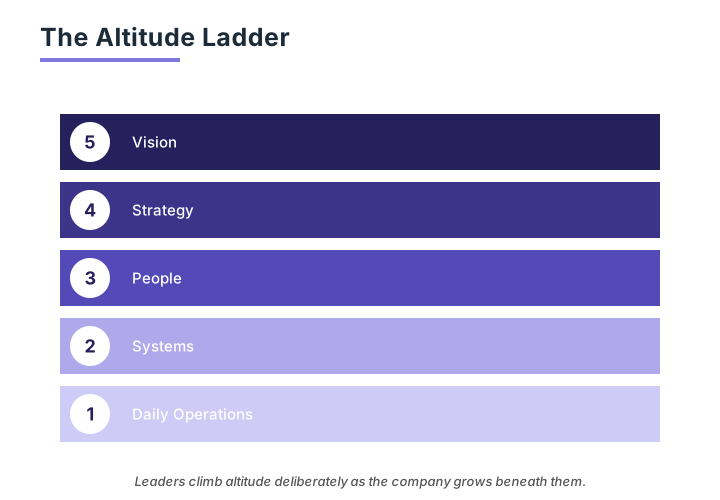
The Framework: The Altitude Ladder

bbok
Level 5 Vision The destination from Chapter 16's Vision Compass
Level 4 Strategy Decisions about where the business is headed
Level 3 People Hiring, training, and leadership development
Level 2 Systems Checklists, processes, and standards
Level 1 Daily Operations Jobs, schedules, immediate problems

Every business decision happens at a different altitude, and owners naturally start at ground level and need to deliberately climb.

Daily Operations sits at ground level — the jobs, the schedules, the immediate problems. This is where Mike lived for years, and where most new contractors spend nearly all their time.

Systems sit one level up — the checklists, processes, and standards from Chapters 5 and 13 that let daily operations run consistently without constant personal attention.

People sit above that — the hiring, training, and leadership development from Chapters 12, 13, 19, and 20 that let systems actually get followed by capable hands.

Strategy sits higher still — the decisions about where the business is headed, which markets to pursue, which opportunities to chase or decline.

Vision sits at the top — the destination from Chapter 16's Vision Compass, the reason any of the levels below it matter in the first place.

Owners naturally begin at ground level, because that's where a one-truck business genuinely lives. Leaders eventually spend the majority of their time near the top — not because the ground level stops mattering, but because it's finally being handled well by the systems and people built into the levels beneath it. An organization stays limited for exactly as long as its owner remains stuck at ground level, no matter how much revenue is flowing through it.
Common Leadership Mistakes

Measuring success by busyness.

A full calendar feels productive and often just means operational work hasn't been handed off yet.

Attending every meeting.

Presence at every discussion, even ones your team can clearly handle alone, quietly signals that nothing actually happens without you.

Approving every decision.

The same Ask-me trap from Chapter 19, resurfacing here at the organizational level instead of the individual one.

Jumping into every problem.

Rescuing every fire personally teaches your team that their own judgment isn't quite trusted yet.

Replacing leadership with control.

Tight control over daily details can feel like leadership. It's usually a substitute for the harder work of actually building direction and people.

Thinking delegation means disengagement.

Climbing the Altitude Ladder doesn't mean checking out — it means engaging with the parts of the business only the owner can actually move forward.

Never scheduling strategic thinking.

Time at the top of the ladder rarely happens by accident. It has to be deliberately protected on the calendar, or the daily whirlwind will always fill it first.

Sarah's Story

Sarah told Mike about her own early years, working sixteen-hour days and genuinely believing the exhaustion itself proved how committed she was. A mentor finally asked her one blunt question: "If you disappeared for a month, would your company stop growing?"

She answered honestly: yes.

"Then you've built a job," he told her. "Not a company."

"That conversation completely changed how I measured myself," she told Mike. "I stopped counting effort. I started counting organizational capability — how well the business could function, grow, and improve with less and less of me physically inside it."

Real Contractor Comparison

Company A

owner stays personally involved in every estimate. Every customer issue eventually reaches his desk. Leaders wait for his permission before acting on anything significant. Growth slows, because the entire organization's pace is capped by one person's available hours. Stress climbs right alongside the workload.

Company B

leadership team genuinely owns operations. Problems get solved at the appropriate level, by the people closest to them. The owner focuses on strategy, hiring, partnerships, and future opportunities — the top rungs of the Altitude Ladder. The business keeps improving month after month, because growth is no longer bottlenecked by a single person's calendar.

Your company cannot outgrow your leadership. Company B's advantage isn't a better market or better luck. It's an owner who deliberately climbed the ladder instead of staying comfortable at ground level.

The Five Responsibilities of the Owner

Everything else, over time, should gradually move to capable leaders. Five responsibilities remain genuinely the owner's to carry:

Protect the vision

make sure the destination from Chapter 16 stays clear and alive

Develop leaders

continue building the pipeline from Chapter 20

Strengthen systems

keep improving the foundation from Chapters 5 and 13

Allocate resources wisely

decide where money, time, and attention actually go

Prepare the company for tomorrow

think further ahead than anyone else in the organization has time to

The CEO Calendar

Divide a typical week into five categories: Operational Work, Leadership, Strategic Thinking, People Development, and Business Improvement. Look honestly at where your actual hours go, not where you intend them to go.

Calendars reveal priorities better than intentions. Mike's calendar, a year earlier, would have shown almost nothing outside Operational Work. His calendar now — the shop walk, the conversation with Jake, the scoreboard review, the meeting with the office, the time spent on next quarter — was already shifting toward the other four categories, even before he consciously noticed the change. The goal from here is simple: gradually increase time spent in the last four categories, week over week, without waiting for permission to feel like it's "earned."

Practical Exercise

Track every hour of your work for one full week. Sort each activity into one of two columns: Operator or Leader. At the end of the week, ask two questions: what could someone else eventually own? And what should only the owner continue doing? Choose one specific responsibility from the Operator column to delegate over the next thirty days.

Warning Signs

01

The owner approves every decision.

This means the organization is still operating at ground level, regardless of how many trucks it has.

02

Vacations feel impossible.

This is the clearest sign the business hasn't actually climbed the Altitude Ladder yet, no matter how healthy its revenue looks.

03

Employees constantly ask permission.

This usually means authority hasn't genuinely moved to the people capable of using it.

04

Meetings focus only on today's problems.

This means the organization is spending its shared time entirely at ground level, with no room left for strategy or direction.

05

Nobody discusses the future.

This usually means the owner is the only one who's supposed to be thinking about it, and he's too busy at ground level to actually do so.

06

Growth has plateaued despite working harder.

This is the clearest sign that more effort at the wrong altitude won't solve a problem that requires a different altitude entirely.

Action Checklist

  • Schedule protected weekly time specifically for strategic thinking.
  • Delegate one operational responsibility you're still personally holding.
  • Meet regularly with your leadership team, not just when there's a problem.
  • Review your long-term goals monthly, not just annually.
  • Stop solving problems your team is already capable of solving themselves.
  • Deliberately spend more time building the company's future than reacting to its present.

Key Takeaways

The skills that built the business are rarely the same skills that grow it further — and every growing contractor eventually has to trade personal busyness for organizational leadership. The Altitude Ladder — Daily Operations, Systems, People, Strategy, Vision — shows that owners naturally start at ground level and must deliberately climb toward the top as the business matures. The goal was never to become indispensable. The goal is to build a company that is.

Reflection Questions

How much of your week is currently spent reacting rather than leading? If you disappeared for two full weeks, what would actually stop? What responsibilities genuinely require only you? Which ones are you holding onto simply out of habit? What would your company look like a year from now if you spent twice as much time leading and half as much time managing?


Late on a Friday afternoon, Mike walked through the office. Nobody stopped him with a problem to solve. His leadership team had already made the decisions that mattered that day. The trucks came back on schedule. Customers were happy. Next week's calendar was already full.

He walked into his own office and, for the first time in years, closed the door — not because another emergency demanded privacy, but because he wanted to think, uninterrupted, about where the company should be three years from now.

Sarah paused in the doorway. "What are you working on?"

Mike smiled. "Tomorrow."

Sarah nodded. "That's what leaders do." She paused a moment longer than usual. "And tomorrow is about to get a lot bigger."

Chapter 26 is where you find out exactly how much bigger.

Scroll to Top