Chapter 39: From Business Owner to Institution Builder
Chapter 39

From Business Owner to Institution Builder

Several years after the visibility system finally caught the branch manager's yellow number before Mike ever heard about it, the company stood at fifty trucks multiple leadership teams, several markets, more people than Mike could keep track of by name anymore.

The Challenge

Businesses create income. Institutions create impact that outlasts the person who started it. A successful contracting company can provide an excellent living for its owner Mike had achieved that many chapters ago. An institution continues creating value for employees, customers, and communities long after the founder has stepped back entirely, whether by choice or by time.

Most contractors build businesses. Very few intentionally build institutions, because the difference isn't about size. It's about permanence and permanence has to be built on purpose deliberately, chapter by chapter, decision by decision, or it never actually forms no matter how large the company grows.

Why It Happens

Business vs. Institution. A business generates revenue. An institution creates enduring value. A business depends on its founder. An institution depends on its principles. A business measures success yearly. An institution measures success across generations.

This distinction changes nearly every major decision an owner makes, once genuinely understood. A business decision asks what's best for this year's numbers. An institutional decision asks what's best for the organization decades from now, long after the current leadership has moved on to whatever comes next.

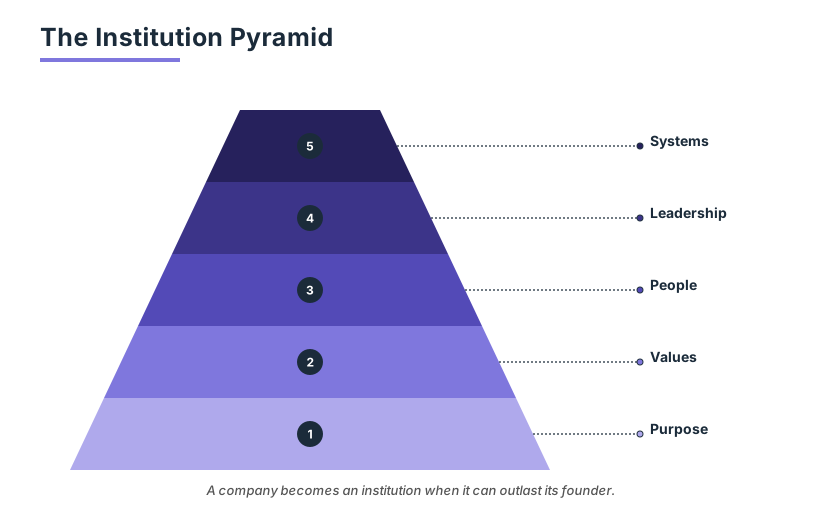
The Framework: The Institution Pyramid

bbok

Lasting companies are built from the inside out, in layers.

Purpose

sits at the base the reason the company exists, first named back in Chapter 16.

Values

sit above purpose the non-negotiable principles established and protected throughout Chapters 24 and 35.

People

sit above values the individuals who actually carry the mission forward, day after day.

Leadership

sits above people the pipeline from Chapter 37, continuously developing the next generation.

Systems

sit above leadership the processes from Chapters 13 and 38 that keep excellence consistent regardless of who's currently in any given role.

Reputation

sits above systems the trust built over years, described back in Chapter 10.

Legacy

sits at the very top and it's the outcome of everything below it, never the objective pursued directly.

The Four Pillars of Enduring Companies

Every enduring organization rests on four pillars. Purpose why the company exists at all. People who actually carries that mission forward, generation after generation. Processes how excellence stays consistent regardless of any single leader's presence. Perpetuation how the organization keeps improving beyond today's leadership entirely, the true test of whether an institution has actually been built. Every major decision should strengthen at least one of these four pillars, and the best decisions strengthen several at once.

Common Mistakes

Keeping customer relationships personal.

Relationships that only run through the owner limit the company's growth to exactly what one person's personal network and time can sustain.

Never documenting judgment.

Delegating a task without ever capturing the reasoning behind good decisions means the organization can copy actions but never actually learns to think.

Avoiding difficult succession conversations.

Postponing the question of who leads what, and when, doesn't prevent the eventual need for an answer it just makes the answer more urgent and less prepared when it finally arrives.

Micromanaging leaders.

The exact relapse Mike caught himself in during Chapter 29, still worth guarding against even at twenty-five trucks.

Correcting instead of coaching.

A leader corrected instead of coached learns to avoid decisions rather than improve them.

Measuring personal importance instead of organizational capability.

An owner who quietly wants to still feel needed will unconsciously resist the very independence this chapter is asking them to build.

Sarah's Story

Sarah told Mike about asking her own mentor, years earlier, "When do you know you've succeeded?"

He smiled and told her, "When I walked into one of our offices and nobody noticed."

She laughed, surprised. "Wouldn't that bother you?"

He shook his head. "No. It means the company belongs to its mission now. Not to me."

"It took me years to actually understand what he meant," she told Mike. "I thought success meant being recognized. It actually means building something so solid that recognition stops being necessary the mission carries itself forward whether or not anyone remembers whose idea it originally was."

Real Contractor Comparison

Company A

is highly profitable and entirely founder-centered. Customers still ask specifically for the owner, even at significant scale. Leadership turnover creates real instability, because the organization never developed the pillars strong enough to hold steady without him. Growth slows noticeably, sometimes stalls entirely, once the founder eventually steps back.

Company B

is mission-driven, with genuine leadership continuity built deliberately over years. Customer experience stays consistent regardless of which crew or branch handles the work. Its reputation, built patiently, continues compounding. It thrives across multiple generations of leadership, because the institution itself, not any single person, became the thing customers and employees actually trust.

The greatest companies eventually belong to their mission Company B's advantage isn't better luck finding a successor. It's decades of decisions that deliberately strengthened the institution instead of just the founder's personal position within it.

The Institutional Filter

Before any major decision at this scale, ask five questions distinct from and larger than the daily Legacy Filter from Chapter 35: Will this strengthen the organization five years from now? Will it strengthen it twenty years from now? Would future leaders, people not yet even hired, thank the organization for this decision? Does it protect the company's reputation for the long term? Would we proudly explain this decision to employees who haven't joined yet? Legacy is built one decision at a time and the Institutional Filter makes sure each major decision is actually being weighed against decades, not just quarters.

The Institutional Health Score

Measure organizational health beyond revenue entirely: mission clarity, leadership continuity, culture strength, customer trust, community reputation, financial resilience, and innovation capability. A company can score well financially and still be institutionally fragile exactly the vulnerability Company A represents, no matter how strong its current numbers look.

Practical Exercise

Imagine stepping away from the company permanently, starting tomorrow. Would it continue improving without you, the way Chapter 36's two-week vacation first proved was possible at a smaller scale? Identify three areas still overly dependent on today's specific leadership, rather than the institution as a whole. Create one deliberate initiative that strengthens continuity in one of those three areas.

Warning Signs

red flag

Vacation anxiety.

This is the clearest personal signal that founder dependency, not just organizational dependency, still runs deep.

habit

Phone never silent.

This means decisions are still routing to the owner out of habit, exactly the pattern first named back in Chapter 19.

subtle

Owner copied on every email.

This is a quieter, less obvious version of the same dependency, hiding inside a habit that feels like simply staying informed.

stuck

Leaders waiting for permission.

This means the Independence Ladder hasn't actually reached the "Leaders Decide" rung yet, regardless of titles.

bypass

Customers bypassing managers.

This means trust still lives with one individual instead of the organization as a whole.

critical

Business slowing whenever the owner is unavailable.

This is the single clearest, most direct sign that the company hasn't yet matured past founder dependency.

Action Checklist

  • Clarify your organization's purpose in language that will still make sense decades from now.
  • Strengthen succession planning at every level, not just at the very top.
  • Protect your company's values explicitly, especially under growth pressure.
  • Invest deliberately in leadership continuity, extending the pipeline from Chapter 37.
  • Preserve institutional knowledge in systems, not just in individual people's memory.
  • Build your community reputation intentionally, treating it as a long-term asset rather than an afterthought.

Key Takeaways

Businesses generate income. Institutions generate impact that survives the person who built them. The Institution Pyramid Purpose, Values, People, Leadership, Systems, Reputation, Legacy is built from the inside out, and legacy is always the outcome, never the direct objective. The Four Pillars Purpose, People, Processes, Perpetuation should guide every major decision at this scale. The greatest achievement of an entrepreneur was never building a company that depends on them. It's building one that continues to improve long after they're gone.

Reflection Questions

What do you actually want your company to be remembered for, decades from now? Would your organization continue improving without you, starting today? What traditions and values should survive every future leadership change? What must never change, no matter how much everything else does? What legacy are you intentionally building right now, in the ordinary decisions nobody else is watching?


As the sun began to set, Mike and Sarah sat quietly outside the company's very first shop the same one, still standing, now converted into a training center. A group of new apprentices filed out after finishing their orientation for the day.

Mike watched them go, remembering his own first morning here, the used van, the customer's card still folded in his pocket. The place where he had once learned to build a business had become the place where others learned to build their futures.

"They'll probably never know the story of this place," Mike said, watching them go.

Sarah smiled. "They don't need the story. They're living it."

Mike looked out across the parking lot, where dozens of branded trucks were pulling back in after another ordinary, successful day. Twenty years earlier, sitting in his own truck with a customer's card in his hand, he'd hoped, at most, to own a second one someday. Now hundreds of families his employees, their families, the customers they served every day depended in some way on the organization he'd built.

He turned to Sarah. "I used to think I was building a company."

She waited.

"I think we built something much bigger."

Sarah shook her head gently. "No. You built the foundation. The institution will keep building itself from here."

Mike watched one more group of apprentices head toward the training center, the same building where he'd once parked his single, used van on his very first morning in business. The future had already arrived. And for the first time in twenty years, it no longer depended on him.

Sarah stood, brushing off her jeans. "So."

Mike smiled. "So what?"

She laughed. "You've built a company. Now it's time to learn how to protect it."

Mike looked puzzled.

Sarah pointed toward the horizon, where the sun was finally dropping below the tree line. "Growth creates success. Legacy requires stewardship."

Mike has completed one of the longest journeys in this book from a single van and a customer's card in his hand, to an institution that no longer needs him to survive. Part Six Building an Enduring Business, fifty to one hundred trucks and beyond asks a different question entirely, the one every founder eventually has to face. The next challenge isn't building something great. It's ensuring greatness endures.
Scroll to Top