Chapter 30: Build Departments, Not Dependencies
Chapter 30

Build Departments, Not Dependencies

Everything else was working. The crews ran well. Jake was developing his own leaders. Accountability had genuinely taken hold across the company. Mike had every reason to feel like the hardest lessons were behind him.

The Challenge

Growing companies eventually reach a point where they can no longer organize around people. Many contractors, without ever meaning to, build a business that depends entirely on one estimator, one dispatcher, one office manager — Mike had done exactly this with Lisa, not out of carelessness, but because she was excellent, and excellence has a way of quietly absorbing more and more of the organization's real structure into one person's head.

That kind of business remains fragile no matter how talented the people inside it are. A single vacation, illness, or resignation can expose how much of the company was never actually organized at all — just delegated to whoever happened to be capable and willing.

Why It Happens

Person-Based Organization vs. Function-Based Organization. In a person-based organization, Lisa does scheduling, Jake solves field problems, Mike approves estimates — and nobody else fully knows how any of it actually works, because the knowledge lives in the person, not in the company. In a function-based organization, scheduling has a documented process, dispatch has clear standards, sales has defined ownership, operations has real leadership — and anyone properly trained can step into the role, because the knowledge belongs to the organization itself.

Mike had unintentionally built the first kind. Lisa wasn't a department. She was a single point of failure wearing a job title.

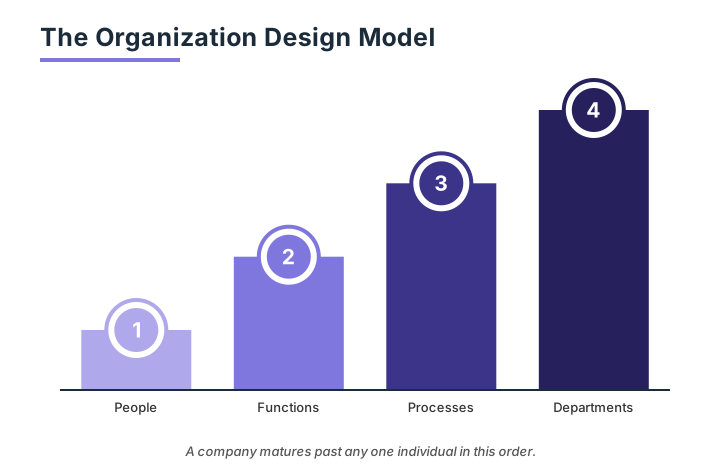
The Framework: The Organization Design Model

 Organization Design Model

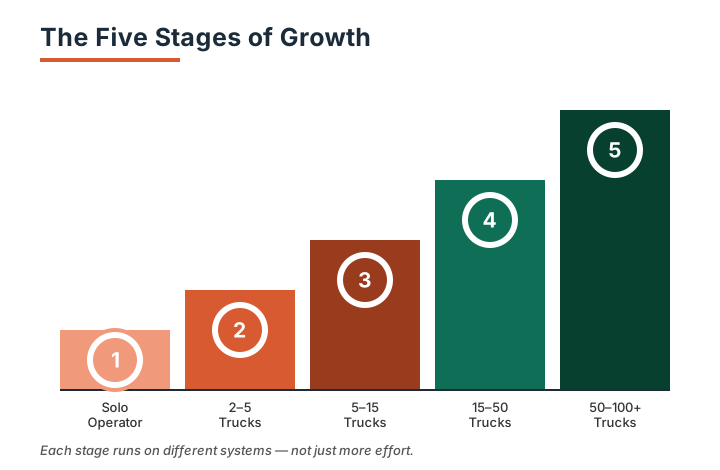
The Framework: The five stages of growth

Five Stages of Growth

Growing companies move through five stages as they mature past dependency on any one individual.

1

People

— where every business starts, with specific individuals doing specific tasks.

2

Functions

— the actual categories of work those people are performing, named and recognized as distinct roles rather than just "what Lisa does."

3

Processes

— the documented, repeatable way each function actually operates, extending the System Loop from Chapter 13 to cover entire roles, not just individual tasks.

4

Departments

— functions and processes formally organized together, with clear ownership and standards that outlast any single employee.

5

Company

— the fully coordinated organization, where departments work together through defined handoffs instead of informal relationships between specific people.

Organizations become stronger as work becomes independent of individuals — not because people stop mattering, but because the company stops being fragile every time one of them is unavailable.

The Five Core Functions

Every contractor already performs five core functions, whether or not anyone has ever named them: Sales — winning and pricing the work. Marketing — generating demand and building reputation. Operations — actually delivering the service. Customer Service — managing the relationship before, during, and after the job. Administration — the billing, scheduling, and paperwork that keeps everything running.

Growing companies don't invent new work at this stage. They simply assign real ownership to functions that were already happening informally, often through whoever happened to be available and capable — exactly how Lisa had ended up owning scheduling, dispatch, billing, and communication all at once, without anyone deliberately deciding that was the plan.

Common Organizational Mistakes

personality

Building jobs around personalities.

A role shaped entirely around one person's particular strengths becomes nearly impossible to hand off cleanly to anyone else.

knowledge

Keeping knowledge in people's heads.

The exact vulnerability that turned Lisa's short absence into a company-wide slowdown.

single point

Allowing "only one person" to know a process.

Any process with a single point of knowledge is a process one bad week away from breaking down entirely.

overlap

Crossing responsibilities constantly.

Overlapping, undefined ownership creates the same confusion Chapter 21's communication breakdown described, just at the department level instead of the crew level.

undocumented

Never documenting workflows.

Documentation is what actually separates a function from a person — skip it, and the function never really exists independently at all.

hero

Creating hero employees.

The same warning from Chapter 30, resurfacing here structurally — a business quietly built around one indispensable person's capability.

Building departments too late.

Waiting until a crisis forces the issue, rather than building structure proactively the way the Growth Horizon from Chapter 26 recommends.

Sarah's Story

Sarah told Mike about losing her own office manager unexpectedly, years earlier, and genuinely believing for a few terrifying days that she might lose the whole business along with her. Nobody else knew payroll. Nobody else understood the scheduling system. Nobody else had the vendor relationships or knew how ordering actually worked.

Her mentor asked her plainly, "Did you lose a person? Or did you lose your systems?"

The honest answer was both, tangled together so completely she couldn't tell where one ended and the other began. She spent the following year deliberately documenting every recurring process in the business — not because a crisis demanded it in the moment, but because she never wanted to be that vulnerable again. When another employee resigned sometime later, under far calmer circumstances, nothing stopped. "That was one of the biggest turning points in my company's whole history," she told Mike, "and it happened quietly, months after the actual crisis that caused it."

Real Contractor Comparison

Company A

runs on a loose, informal spirit of everyone helping everyone. Nobody actually owns anything specifically. Questions bounce around without a clear destination. Customers wait longer than they should. The owner ends up personally coordinating nearly everything, exactly the bottleneck Chapter 19 first identified. Growth slows under the weight of all that improvisation.

Company B

has clearly defined functions, documented responsibilities, and departments that communicate through real systems instead of personal relationships alone. Cross-training exists deliberately, not accidentally. Ownership is unambiguous. Growth accelerates, because the organization doesn't depend on any single person's continued presence to keep functioning.

The strongest businesses organize work — not personalities.

The Dependency Audit

Ask, honestly: who is the only person who can schedule a job? Dispatch a crew? Approve pricing? Order inventory? Run payroll? Handle a serious complaint? Generate an estimate? Wherever the answer is a single name, the business has a dependency, exactly the kind that turned Lisa's few days off into a company-wide slowdown. Address them one at a time, starting with whichever dependency would cause the most disruption if it disappeared tomorrow.

The Organizational Ladder

Leadership shifts through five layers as a company matures: Owner, down through Department Leaders, down through Team Leaders, down through Teams, down to the Processes those teams actually run on. As a company grows, the owner's real work increasingly moves toward improving the design of this ladder itself, rather than personally supervising the people standing on any single rung.

  • Owner
  • Department Leaders
  • Team Leaders
  • Teams
  • Processes

Practical Exercise

Draw out every recurring responsibility currently running through your business. Group them into the five core functions. Assign one clear owner to each function. Document one specific process this month. Cross-train one additional employee on it. Repeat this exercise monthly, steadily closing the gaps the Dependency Audit reveals.

Warning Signs

dependency

Everything stops during vacations.

This is Mike's exact experience with Lisa — the clearest possible sign of a person-based, rather than function-based, organization.

frequency
high
overlap

Employees constantly interrupt one another.

This usually means ownership between roles hasn't been clearly defined.

frequency
moderate
ownership

Nobody knows who owns decisions.

This means functions exist informally, without ever having been assigned real ownership.

frequency
high
variance

Processes vary by employee.

This means the process itself was never actually documented — only demonstrated once, informally, exactly like Chapter 13 warned against.

frequency
moderate
inconsistency

Customers receive inconsistent experiences.

This is culture, communication, and organizational structure all straining at once, from the same underlying cause.

frequency
moderate
bottleneck

The owner coordinates every department.

This means the Organizational Ladder hasn't actually been built yet — everything still funnels through one person at the top.

frequency
high

Action Checklist

  • Identify your core business functions, even the ones currently living entirely inside one person's head.
  • Assign clear, explicit ownership to each function.
  • Document one recurring process this month, in enough detail that someone new could follow it.
  • Cross-train at least one additional employee on that process.
  • Identify and remove one single point of failure in your organization.
  • Review your organizational dependencies every quarter, not just when a crisis forces the issue.

Key Takeaways

Growing companies eventually can't keep organizing around specific people — they have to organize around functions instead. Many contractors unknowingly build fragile businesses that depend entirely on one estimator, one dispatcher, or one office manager, exactly the trap Mike fell into with Lisa. The Organization Design Model — People, Functions, Processes, Departments, Company — shows how work becomes independent of any single individual over time. Great companies depend on systems, not superheroes. People leave. Departments remain.

Reflection Questions

Which employee would create the biggest disruption if they resigned tomorrow, without warning? Which responsibilities in your business genuinely belong to a department rather than a specific person? What critical knowledge currently exists only in someone's head? Where are responsibilities still unclear or overlapping? If you rebuilt your organization from scratch today, knowing everything you know now, what would it actually look like?


Several weeks later, Mike walked through the office while Lisa was away on a real vacation — the first one she'd taken without checking in constantly. The phones were answered. Scheduling continued without a hitch. Invoices went out on time. Crews left for their jobs exactly when they were supposed to. Nobody seemed the least bit worried.

Mike caught himself smiling, quietly, at nothing in particular.

Sarah noticed. "You were looking for Lisa."

He laughed. "I was. I didn't need to."

"Exactly," Sarah said. "You didn't build a business that survives because of Lisa. You built one that works because everyone understands their role."

Mike looked around the quiet, functioning office. "I used to think building a company meant hiring more people." He paused. "Now I realize it's designing how they work together."

Sarah smiled. "And that's the difference between growing and scaling." She looked out toward the horizon beyond the parking lot. "The next challenge isn't building a company anymore. It's leading one that keeps getting bigger."

Mike has learned to think beyond himself — beyond individual heroics, beyond dependency on any single person, toward an organization built on functions, systems, and shared leadership strong enough to outlast any one name on the org chart. He is ready now for Part Five — Scaling Beyond Ten Trucks — where the challenge shifts once again, from building a company to leading an organization that can multiply far beyond anything Mike could personally touch, oversee, or even fully see.
Scroll to Top